
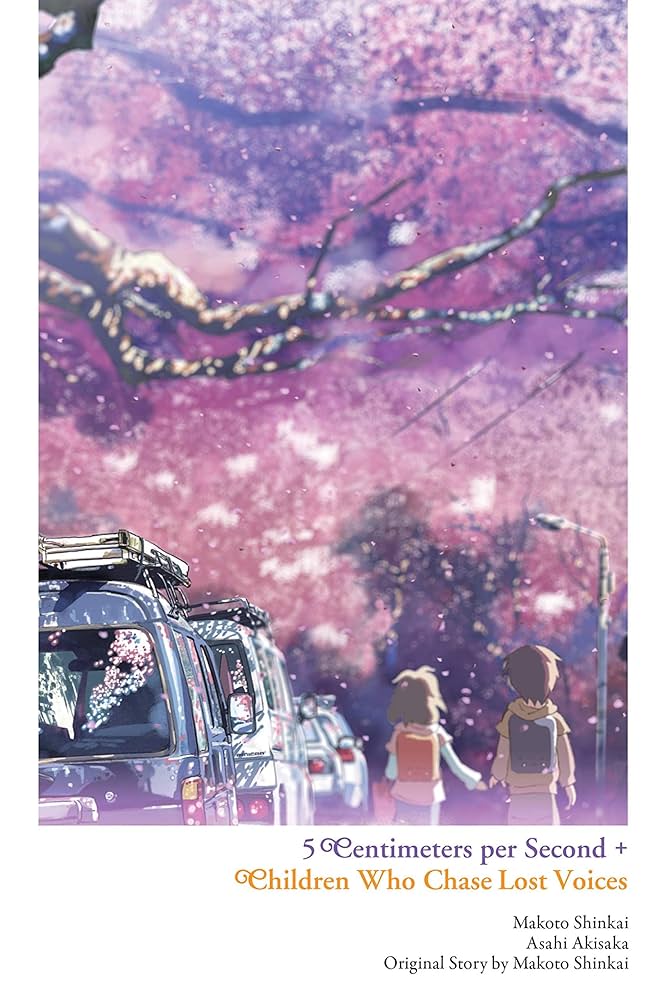
In the contemporary landscape of Japanese anime and light novels, 5 Centimeters per Second (Byōsoku Go Senchimētoru) stands out as a quietly influential work whose power lies not in dramatic spectacle, but in emotional restraint and thematic depth. Rather than relying on conventional narrative climaxes or overt romantic resolutions, the work adopts a subdued, introspective tone, guiding the audience through fragments of everyday life that are shaped by distance, memory, and the inexorable passage of time.
At its core, 5 Centimeters per Second does not seek to portray love as a triumphant or redemptive force. Instead, it presents human relationships as inherently fragile, subject to gradual erosion under the pressures of physical separation, changing circumstances, and psychological divergence. Through a deliberately slow narrative rhythm and a fragmented structure, the work captures the subtle ways in which once-intimate connections drift apart – not through conflict or betrayal, but through the quiet accumulation of time itself.
What distinguishes 5 Centimeters per Second from many romantic narratives in anime and manga is its refusal to offer emotional closure in the traditional sense. The story does not resolve its tensions through reunion or confession; rather, it confronts the audience with the reality that some relationships, no matter how sincere, are destined to remain incomplete. In doing so, the work transcends the boundaries of a simple love story and becomes a meditation on growing up, loss, and the emotional cost of moving forward in a modern, constantly shifting world.
Seen from a literary and critical perspective, 5 Centimeters per Second functions as a reflective study of distance – spatial, temporal, and psychological – and its impact on human consciousness. It is this restrained yet profound exploration of everyday melancholy that has allowed the work to maintain lasting resonance, positioning it as a significant artistic statement within contemporary Japanese anime and narrative fiction.
1. Introduction to the Author and the Work 5 Centimeters per Second
1.1. Makoto Shinkai as an Author and Creator
Makoto Shinkai (新海誠, born in 1973) is widely recognized as one of the most influential figures in contemporary Japanese animation, occupying a unique position as a director, screenwriter, novelist, and visual storyteller. Prior to achieving international acclaim with commercially successful works such as Your Name and Weathering With You, Shinkai had already established a distinctive artistic identity through a series of independent and low-budget productions that emphasized atmosphere, introspection, and emotional distance.

Shinkai’s creative background is notably interdisciplinary. Trained in Japanese literature and initially employed in the video game industry, he developed a strong sensitivity to narrative pacing, visual composition, and internal monologue. These elements later became defining features of his storytelling style. Rather than constructing plots driven by external conflict, Shinkai consistently focuses on the inner emotional states of his characters, particularly their sense of isolation, longing, and disconnection within modern society.
A recurring thematic concern in Shinkai’s body of work is the tension between human relationships and the forces that gradually erode them – time, physical distance, social mobility, and technological mediation. His narratives often portray characters who struggle to articulate their emotions, resulting in relationships that fade not because of dramatic rupture, but because of silence and emotional inertia. This thematic orientation situates Shinkai within a broader tradition of Japanese narrative art that privileges subtlety, transience, and emotional understatement.
1.2. The Work 5 Centimeters per Second
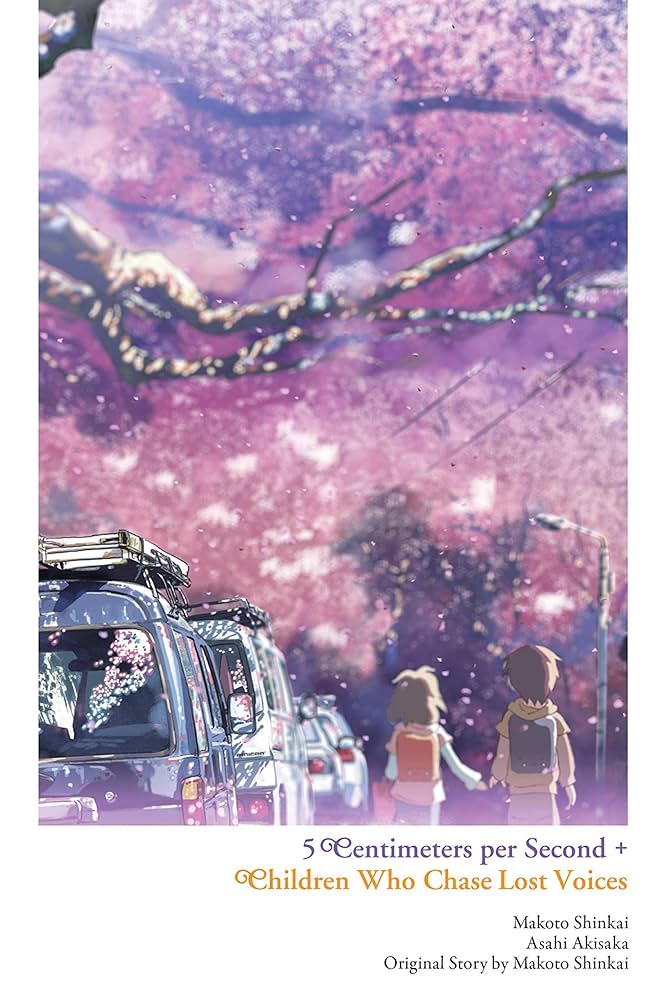
5 Centimeters per Second (Byōsoku Go Senchimētoru) was released in 2007 as an animated feature film and later adapted into a novel written by Makoto Shinkai himself. The title refers to the speed at which cherry blossom petals fall – five centimeters per second – a metaphor that encapsulates the central concerns of the work: the slow yet irreversible movement of time and the gradual drifting apart of human relationships.
Structurally, 5 Centimeters per Second is divided into three interconnected episodes: Cherry Blossom Extract, Cosmonaut, and 5 Centimeters per Second. Each segment corresponds to a different stage in the life of the protagonist, Takaki Tōno, and together they form a fragmented yet coherent portrait of emotional development from childhood to adulthood. Rather than following a linear narrative arc, the work adopts an episodic structure that mirrors the way memory functions – selective, incomplete, and shaped by emotional resonance rather than chronology.
The dual existence of 5 Centimeters per Second as both an animated film and a literary text further reinforces its artistic significance. The novelization expands upon the inner monologues and psychological reflections of the characters, while the animated version relies heavily on visual symbolism, ambient sound, and spatial composition. Together, these forms exemplify Shinkai’s approach to storytelling, in which image and text function as complementary modes of emotional expression.
Within the context of Japanese anime and narrative fiction, 5 Centimeters per Second occupies an important position as a work that bridges visual poetry and literary introspection. It represents a formative stage in Makoto Shinkai’s career, crystallizing many of the themes and stylistic strategies that would later define his broader artistic legacy.
2. Summary of the Plot of 5 Centimeters per Second
5 Centimeters per Second unfolds through three interconnected episodes, each representing a distinct phase in the life of the protagonist, Takaki Tōno. Rather than presenting a single continuous storyline, the narrative adopts a fragmented structure that reflects the gradual transformation of human relationships over time. The transitions between episodes are marked not by dramatic turning points, but by subtle shifts in circumstance, emotion, and perspective.
2.1. Cherry Blossom Extract
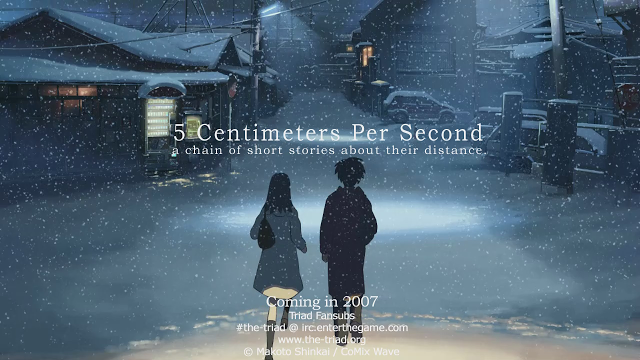
The first episode focuses on Takaki Tōno and Akari Shinohara during their final years of elementary school. Both children share a quiet, introspective temperament and find companionship in their mutual sense of displacement, as each comes from a family that frequently relocates due to work. This shared instability fosters a deep emotional bond, expressed through intimate conversations, shared routines, and an unspoken understanding that distinguishes their relationship from those around them.
When Akari is forced to move to a distant prefecture, the physical separation introduces the first major rupture in their connection. Communication is maintained through letters, yet the limitations of time, distance, and daily life gradually intrude upon their closeness. The emotional center of this episode is Takaki’s arduous journey to meet Akari one winter evening, a trip marked by delayed trains, snowfall, and mounting anxiety. Their reunion, though brief, affirms the sincerity of their feelings while simultaneously underscoring the fragility of their bond. The episode concludes with a lingering sense of uncertainty, signaling the beginning of a separation that neither character can fully articulate or prevent.

2.2. Cosmonaut
The second episode shifts perspective to Kanae Sumida, a middle school student living on a remote island in southern Japan. Kanae harbors unspoken romantic feelings for Takaki, who has transferred to her school. Observant and emotionally perceptive, she gradually realizes that Takaki remains psychologically distant, his thoughts perpetually directed toward something beyond the present moment.
Despite spending time together, Kanae senses that Takaki is emotionally unavailable, burdened by memories and unresolved attachments from his past. Her internal conflict – caught between the desire to confess her feelings and the recognition that they may never be reciprocated – forms the emotional core of this episode. Unlike the first part, which emphasizes mutual connection, Cosmonaut explores unidirectional affection and emotional asymmetry. Through Kanae’s perspective, the narrative illustrates how emotional distance can persist even in the absence of physical separation, revealing the invisible barriers that prevent genuine intimacy.
2.3. 5 Centimeters per Second
The final episode follows Takaki into adulthood, depicting his life as a working professional in Tokyo. Despite living in a densely populated urban environment, Takaki experiences profound emotional isolation. His romantic relationships are fleeting and unsatisfying, and his daily routines are marked by a pervasive sense of emptiness. Memories of Akari continue to surface, not as vivid recollections, but as persistent fragments that shape his emotional state and prevent him from fully engaging with the present.
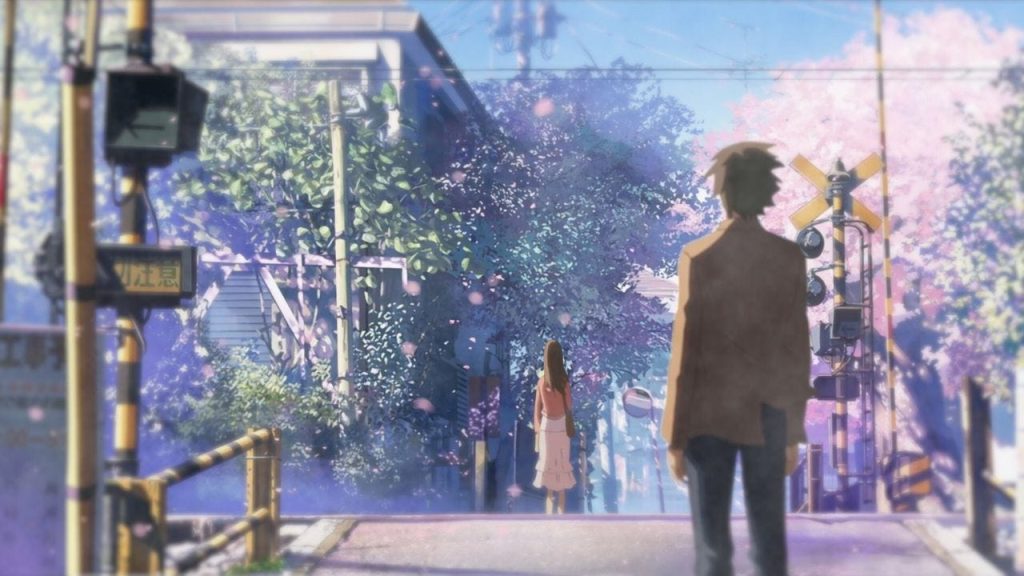
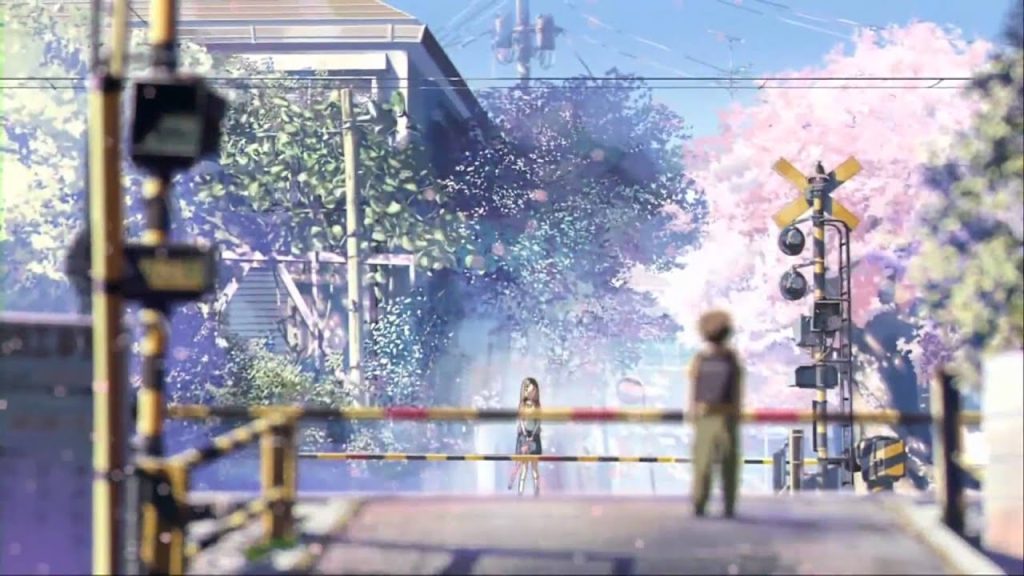
The narrative culminates in a brief, wordless encounter between Takaki and Akari at a railway crossing – an echo of their childhood connection and a symbolic convergence of past and present. As trains pass between them, the moment of recognition dissolves without resolution. Akari moves on, while Takaki hesitates before ultimately turning away. This understated conclusion reinforces the central motif of the work: that time advances regardless of human longing, and that some relationships, once lost, cannot be reclaimed.
3. Themes and Ideological Concerns in 5 Centimeters per Second
3.1. Distance as an Inescapable Condition of Human Relationships
One of the central thematic pillars of 5 Centimeters per Second is the concept of distance – not merely as a physical separation, but as a multifaceted condition encompassing space, time, and emotional consciousness. Throughout the work, distance operates as an invisible yet decisive force that gradually reshapes human relationships. The narrative demonstrates that separation does not arise solely from dramatic events or personal failings, but often from ordinary circumstances such as relocation, changes in life stage, and the slow divergence of individual trajectories.
By presenting distance as a structural element rather than a narrative obstacle to be overcome, the work challenges romantic conventions that frame love as inherently resilient or triumphant. Instead, 5 Centimeters per Second suggests that emotional connections are contingent and vulnerable, subject to erosion even in the absence of conflict. This perspective situates the work within a realist tradition that acknowledges the limitations of human agency in preserving intimacy over time.
3.2. Time and the Limits of Human Control
Time in 5 Centimeters per Second functions not as a neutral backdrop, but as an active and irreversible force that shapes character development and emotional outcome. The gradual passage of years – from childhood to adolescence and into adulthood – marks a series of losses that cannot be undone or revisited in their original form. Memories persist, yet the emotional contexts in which they were formed no longer exist.
The title metaphor – the falling speed of cherry blossom petals – encapsulates this thematic concern. It conveys a sense of quiet inevitability: movement that is gentle yet unstoppable. The work emphasizes the disparity between human emotional attachment, which seeks permanence, and temporal reality, which allows no repetition. In doing so, the narrative articulates a fundamental tension between longing and acceptance, highlighting the inherent limitations of human control over time and circumstance.
3.3. Maturity as a Process of Emotional Displacement
Rather than portraying maturity as a linear progression toward fulfillment or self-realization, 5 Centimeters per Second frames growing up as a process marked by emotional displacement and gradual detachment. As Takaki advances through different stages of life, his inability to reconcile past attachments with present realities results in a persistent sense of stagnation. His emotional development is characterized less by resolution than by accumulation – of memories, regrets, and unspoken feelings.
This portrayal complicates conventional narratives of personal growth. The work suggests that adulthood does not necessarily bring clarity or closure, but often demands the acceptance of unresolved loss. Maturity, in this context, is defined by the recognition that certain relationships belong irrevocably to the past, and that moving forward requires relinquishing the expectation of emotional completion.
Through these thematic explorations, 5 Centimeters per Second transcends the boundaries of a romantic narrative and emerges as a contemplative examination of modern existence. Its ideological framework reflects a broader social reality in which mobility, fragmentation, and emotional isolation are increasingly common, lending the work a lasting relevance beyond its immediate narrative scope.
4. Artistic Value and Cultural Influence of 5 Centimeters per Second
4.1. Artistic and Narrative Value
From an artistic standpoint, 5 Centimeters per Second is distinguished by its restrained narrative structure and its emphasis on atmosphere over plot-driven progression. The work deliberately avoids conventional storytelling techniques such as dramatic conflict, clear antagonism, or cathartic resolution. Instead, it relies on a slow, contemplative rhythm that mirrors the internal states of its characters. This narrative restraint allows subtle emotional shifts to take precedence over overt action, inviting the audience to engage with the work on a reflective rather than consumptive level.
Visually and structurally, the work employs recurring symbols – trains, rail crossings, falling cherry blossoms, and expansive skies – to externalize emotional distance and temporal flow. These motifs function not as decorative elements, but as integral components of the storytelling process, reinforcing the thematic coherence of the narrative. In both its animated and literary forms, 5 Centimeters per Second demonstrates a sophisticated interplay between form and content, where visual composition and textual introspection operate in mutual reinforcement.
The episodic structure further enhances the work’s artistic integrity. By fragmenting the narrative into discrete yet interconnected segments, the story reflects the way personal memories are experienced: incomplete, selective, and emotionally weighted rather than chronologically exhaustive. This approach contributes to the work’s literary quality, aligning it more closely with modernist narrative traditions than with mainstream romantic storytelling.
4.2. Cultural and Societal Influence
Beyond its artistic merits, 5 Centimeters per Second has exerted a significant influence on both Japanese and international audiences, particularly among younger generations navigating the emotional complexities of contemporary life. Its portrayal of emotional isolation within densely populated urban environments resonates strongly in societies characterized by mobility, technological mediation, and increasingly fragmented interpersonal relationships.
The work also played a pivotal role in establishing Makoto Shinkai’s reputation as a creator deeply concerned with themes of distance and emotional disconnection. In this sense, 5 Centimeters per Second can be seen as a foundational text that anticipates and informs the thematic developments of his later works. Its success contributed to the broader recognition of anime as a medium capable of conveying nuanced psychological and philosophical ideas, rather than merely serving as entertainment or genre fiction.
Within the broader context of Japanese popular culture, 5 Centimeters per Second helped legitimize a quieter, more introspective mode of storytelling. It influenced subsequent creators who sought to explore everyday melancholy, unfulfilled longing, and the emotional costs of modern living through understated narrative techniques. As a result, the work occupies an enduring position within the canon of contemporary anime and narrative fiction, valued not for spectacle, but for its emotional precision and intellectual subtlety.
5. Conclusion
5 Centimeters per Second is not a work that seeks to satisfy expectations of dramatic resolution or emotional fulfillment. Its significance lies precisely in its restraint – in its refusal to offer reunion, redemption, or narrative closure in the conventional sense. Through the quiet trajectory of Takaki Tōno’s life, the work presents a measured reflection on the nature of human relationships, emphasizing their vulnerability to time, distance, and changing circumstances.
Rather than framing loss as a singular event, 5 Centimeters per Second depicts it as a gradual, almost imperceptible process. Connections fade not through conflict or betrayal, but through silence, hesitation, and the steady advance of everyday life. In this regard, the work articulates a deeply realistic view of emotional experience, one that resonates with the conditions of modern existence, where mobility and emotional fragmentation have become increasingly common.
Ultimately, the enduring value of 5 Centimeters per Second lies in its ability to transform ordinary moments into a broader meditation on impermanence and acceptance. By confronting the limits of memory and the impossibility of fully reclaiming the past, the work invites readers and viewers to reconsider the meaning of maturity – not as emotional completion, but as the capacity to acknowledge loss and continue forward. It is this quiet, unembellished insight that secures 5 Centimeters per Second a lasting place within contemporary Japanese anime and narrative literature.