
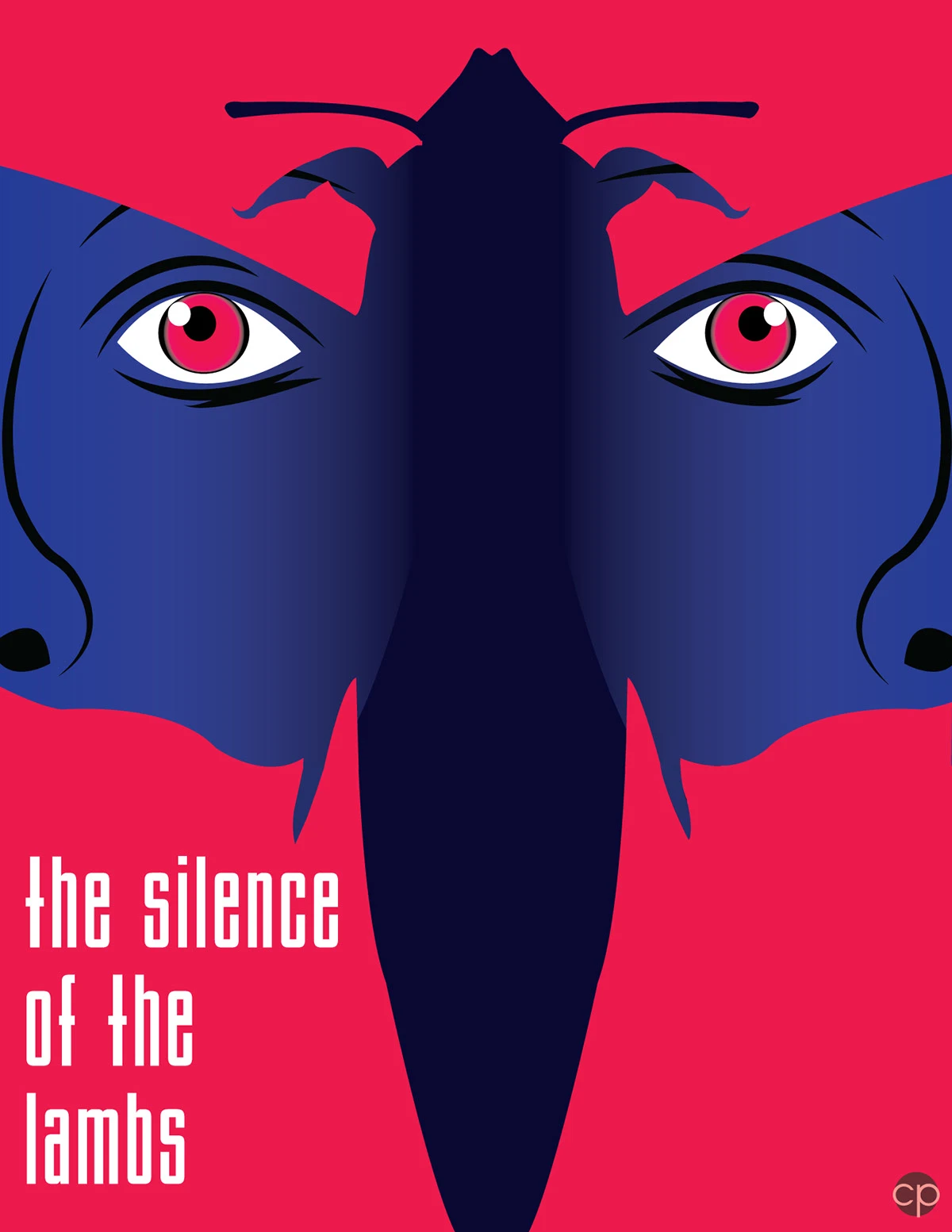
In the realm of crime fiction and psychological thrillers, there are works that go far beyond the mere function of telling a detective story to become profound examinations of human nature itself. The Silence of the Lambs is one of the rare works of this kind. Rather than exploiting fear through graphic violence or shocking bloodshed, the novel instills in the reader a lingering, persistent unease—a fear born of silence, of the hidden recesses concealed deep within the human psyche.
From the moment of its release, the novel quickly garnered widespread attention, not only because of its tense investigative plot, but also due to its exceptional depth of psychological analysis, rarely seen in popular literature. It is a story of an intense confrontation between good and evil, between the desire for redemption and the instinct for destruction; at the same time, it is a painful coming-of-age journey of a young individual forced to confront the most deeply buried fears within herself. For this reason, The Silence of the Lambs is not merely a crime novel, but a probing exploration of the fragile, complex, and deeply contradictory nature of human beings under extreme circumstances.
1. Introduction to the Author and the Work
The author of The Silence of the Lambs is Thomas Harris, one of the most prominent and influential writers of American crime and psychological fiction in the latter half of the twentieth century. At a time when modern crime literature increasingly favors fast pacing, sensational plot twists, and immediate entertainment value, Thomas Harris stands out as a distinctive exception: he does not write prolifically, nor does he cater to mass tastes, but each of his works is meticulously crafted and marked by a clear depth of thought.

Unlike many crime writers who follow an almost industrial mode of production, Thomas Harris writes at a slow, even exacting pace. He devotes considerable time to researching criminal psychology, human behavior, and modern investigative methods, thereby constructing narratives that are tightly structured and logically coherent without becoming rigid or mechanical. His prose does not flaunt narrative技巧; instead, it concentrates on creating a dark, tense atmosphere, in which even the smallest details contribute to shaping the psychological states of the characters. This restraint gives his works enduring weight and lasting psychological impact.
Thomas Harris’s name is inextricably linked to the series of novels centered on the character Hannibal Lecter—a psychiatrist who is also a serial killer, endowed with extraordinary intelligence and a terrifying ability to manipulate the human mind. This figure stands as one of the most complex and successful antagonists in modern crime fiction. Hannibal Lecter does not merely embody pure evil; he represents cold intellect and profound insight into human nature, thereby challenging traditional notions of morality, law, and justice.
The Silence of the Lambs is the second novel in the Hannibal Lecter series and the work that firmly established Thomas Harris’s status as a canonical figure in modern crime and psychological literature. Beyond its commercial success, the novel has been highly praised by critics for its innovative approach: rather than focusing exclusively on the question of “who the killer is,” it delves into more unsettling inquiries such as “why do human beings become monsters?” and “what sustains the existence of evil in modern society?”
From a genre perspective, The Silence of the Lambs seamlessly blends detective fiction, psychological horror, and behavioral crime analysis. However, the novel’s most striking quality does not lie in shocking plot twists or superficial sensationalism. Thomas Harris deliberately restrains depictions of violence, choosing instead to explore the inner worlds of his characters—their obsessions, psychological wounds, and silent yet persistent inner conflicts. As a result, readers are not swept along by sheer speed, but held in place by the depth of reflection the novel demands.
It is precisely this approach that allows The Silence of the Lambs to transcend the limits of a conventional entertainment novel and attain lasting value. The book not only satisfies readers’ desire for suspense and discovery, but also raises philosophical and humanistic questions about the origins of evil, the hidden fears within the human soul, and the fragile boundary between normality and deviation. This is the foundation upon which the novel is regarded as a significant milestone in modern psychological crime literature.
2. Summary of the Plot
The central character of the story is Clarice Starling, a promising young trainee at the FBI Academy. Clarice possesses keen intelligence, sharp observational skills, and a strong sense of discipline; nevertheless, she is still at the beginning of her career and burdened with doubts about her own competence and place within a professional environment dominated by power structures and gender bias. This blend of capability, ambition, and inner insecurity renders Clarice a character who is both resilient and vulnerable.
Clarice is assigned a special and highly dangerous mission: to approach Hannibal Lecter, a former psychiatrist imprisoned under strict security measures for a series of brutal crimes. The FBI’s objective is to exploit Lecter’s extraordinary ability to analyze criminal psychology in order to track down another serial killer, known to the media as Buffalo Bill—a man who kidnaps, murders, and skins women to satisfy his pathological obsessions. This criminal is particularly dangerous not only because of the savagery of his actions, but also because of his complex and deeply distorted psychological structure, which renders conventional investigative methods ineffective.
From their very first encounters, the relationship between Clarice Starling and Hannibal Lecter takes the form of a tense and profoundly unbalanced battle of wits. Lecter refuses to assume the role of a passive inmate being interrogated; instead, he swiftly seizes control, observing, analyzing, and steering each conversation according to his own design. Armed with a razor-sharp intellect and a frightening capacity to read others’ minds, Lecter turns every meeting into a psychological chess match, in which Clarice is simultaneously the interrogator and the subject under dissection.
Lecter refuses to cooperate unconditionally. He establishes a manipulative “bargain”: each fragment of information he provides about Buffalo Bill must be exchanged for deeply personal memories from Clarice’s past. Forced into a corner, Clarice has no choice but to open herself, recounting a childhood marked by loss, loneliness, and a haunting memory of lambs being slaughtered on the farm where she once lived.
The memory of the “lambs” is not merely a narrative detail; it becomes the central symbol of the entire novel. Their desperate cries represent the enduring guilt and helplessness in Clarice’s soul, her pain at being unable to save the innocent and the vulnerable. This unresolved trauma drives her decision to pursue a career as an FBI agent—not solely as a means of self-affirmation, but as a desperate attempt to save other “lambs,” in the hope that one day those cries will finally fall silent.
Parallel to Clarice’s forced confrontation with her own inner world, the investigation into Buffalo Bill gradually advances through Lecter’s cryptic, suggestive, and at times mocking clues. Yet the FBI does not always interpret these hints correctly. Institutional arrogance, hierarchical thinking, and deeply rooted gender bias repeatedly lead the agency astray, while Clarice—despite her keen intuition—is often underestimated or excluded from critical decisions.
In this context, time relentlessly runs out for the victims, plunging the narrative into a state of sustained tension. Psychological pressure arises not only from the threat posed by Buffalo Bill, but also from the subtle manipulation of Hannibal Lecter, who appears to stand outside the investigation while nevertheless controlling its rhythm through his intellect and profound understanding of human nature.
The climax is reached when Clarice, almost entirely alone and without timely support from her colleagues, arrives at the actual hiding place of Buffalo Bill. The confrontation unfolds in a dark, suffocating environment where every sense is pushed to its limits. In this moment of life and death, Clarice faces not only a dangerous killer, but also her own deepest fears.
The final confrontation is not merely a physical struggle; it is a collision between will and instinct, between the desire to preserve life and the destructive force of evil. Clarice’s victory thus transcends the success of solving a case: it signifies the triumph of courage, inner growth, and the belief that human beings—however fragile—can still stand firm against the deepest darkness.
3. Thematic and Artistic Values
The most enduring and essential value of The Silence of the Lambs lies in its profound, incisive, and convincing analysis of character psychology. In the novel, Thomas Harris does not treat evil as an irrational or purely pathological phenomenon, nor does he reduce it to meaningless acts of violence. Instead, evil is consistently presented as the result of a formative process: it has origins, history, and is nurtured by prolonged psychological trauma and distorted perception. This approach compels readers not merely to feel fear, but to reflect on the deeper roots of violence and crime in modern society.
The character of Hannibal Lecter embodies this ideological dimension most clearly. Lecter is not a killer who acts on blind impulse; he is the manifestation of cold, lucid intelligence and full awareness of his own actions. He possesses an unsettling ability to penetrate the human psyche, discerning fear, pride, and the most concealed vulnerabilities of others. It is precisely this clarity and intentionality in his evil that make Lecter more dangerous than any other murderer: he does not merely destroy bodies, but invades, manipulates, and fractures the inner worlds of those he encounters.

In contrast, Clarice Starling represents the modern woman seeking her place and voice within a professional environment dominated by authority and gender prejudice. She holds neither institutional power nor the extensive experience of her male colleagues; she must continually prove her competence while enduring doubt and condescension. Yet it is her sensitivity, capacity for listening, empathy, and refined intuition—qualities often dismissed as “weaknesses”—that become decisive strengths, enabling her to approach the truth and confront evil effectively. Through Clarice, the novel affirms that strength arises not only from authority or physical force, but also from empathy and moral resilience.
From an artistic standpoint, Thomas Harris employs a restrained, cold, and precise narrative style, well suited to the novel’s psychological focus. The language avoids emotional excess, yet creates a dark, tense, and deeply unsettling atmosphere. Dialogue—particularly between Clarice and Lecter—is constructed as psychological duels, in which every utterance carries multiple layers of meaning, serving simultaneously as information exchange, probing, and manipulation. Although the pacing is relatively slow, it never feels stagnant, as the psychological weight of the characters sustains prolonged suspense.
Moreover, the image of the “lambs” functions as a powerful symbol that encapsulates the novel’s humanistic message. The lambs represent innocence, fragility, and vulnerability—those who are most easily victimized in a violent and unjust society. “The silence of the lambs” thus signifies not only the resolution of Clarice’s personal trauma, but also a broader aspiration: a hope for a world in which evil is restrained, the vulnerable are protected, and human beings do not turn away from the cries of others.
4. Memorable Quotations
Alongside its carefully constructed plot and richly developed characters, The Silence of the Lambs leaves a lasting impression through its philosophically resonant lines of dialogue. The following quotations distill the novel’s central reflections on fear, desire, memory, and the fragile boundary between good and evil:
- “We covet what we see every day.”
- “The greatest fear is not death, but failing to save others.”
- “Memories do not disappear; they merely learn how to remain silent.”
- “To understand a killer, look at what he loves.”
- “Silence can sometimes be more terrifying than a scream.”
- “We begin with desire, and we end by pursuing.”
- “The most frightening thing is not the monster, but its calmness.”
- “Human beings can endure great pain, as long as they believe it has meaning.”
- “Not every cage is made of iron.”
These quotations contribute to the novel’s intellectual depth and somber atmosphere, leaving a lasting resonance in the reader’s mind.
5. Conclusion
The Silence of the Lambs is one of the rare crime novels that transcends the boundaries of a conventional detective story to become a profound inquiry into human nature. By tightly interweaving a tense investigative narrative with subtle psychological analysis, Thomas Harris creates an artistic world in which evil is not simplified, fear is not overtly displayed, but instead quietly infiltrates and takes root within the thoughts and memories of the characters.
The novel’s enduring value lies not only in the suspense of its plot or the haunting presence of its antagonists, but in the way it forces readers to confront unsettling questions: what gives rise to evil, how far human beings can go when driven by trauma and desire, and whether empathy can truly counterbalance violence. Through Clarice Starling’s journey, the novel affirms that courage is not the absence of fear, but the capacity to move forward even while fear remains.
The image of the “lambs” closes the novel as a hauntingly humanistic symbol. Their silence marks not only the end of a personal obsession, but also an aspiration for a moral order in which the vulnerable are protected and cries for help are not lost in indifference. It is this layer of meaning that elevates the novel beyond entertainment, granting it philosophical and human depth.
Thus, The Silence of the Lambs is not simply a book meant to thrill, but an experience that demands concentration, reflection, and inner dialogue. Its lasting impact comes from the fact that it does not merely tell the story of capturing a serial killer, but confronts readers with a fundamental question: to restrain evil, one must sometimes have the courage to face the darkness within one’s own soul. It is precisely here that the novel’s enduring value lies, securing its place as a classic of modern psychological crime literature.