
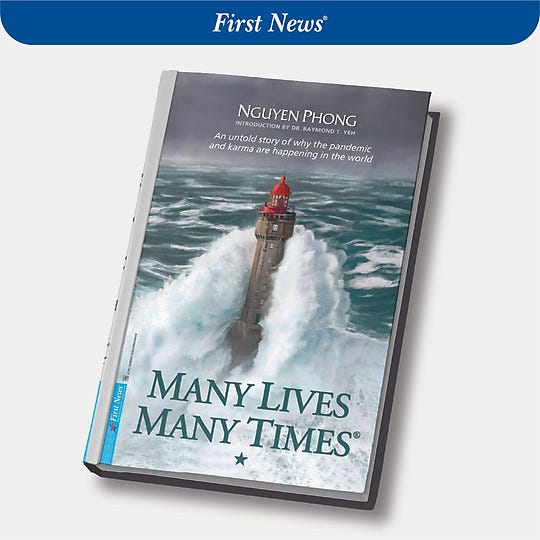
In the course of modern human life, as the pace of living becomes increasingly hurried and material values are often placed at the forefront, fundamental questions about the meaning of existence seem to be pushed into the background. People relentlessly pursue success, status, and comfort, yet not infrequently find themselves overwhelmed by a sense of emptiness and uncertainty, as if something essential were missing. It is within this context that Many Lives, Many Times emerges as a gentle yet profound reminder, guiding individuals back toward spiritual values and the enduring laws that govern human existence.
More than merely a spiritual or philosophical book, Many Lives, Many Times opens a vast contemplative space concerning the law of cause and effect, reincarnation, and human responsibility for one’s own actions. Through narratives of past lives and the rise and fall of civilizations, the work raises universal questions: Where do humans come from? Why does suffering exist? And can individuals alter their own destiny? It is precisely this depth of reflection that allows Many Lives, Many Times to transcend the boundaries of a book meant simply to be read for information, becoming instead a work intended for contemplation and self-examination.
1. Introduction to the Author and the Work
Nguyen Phong is a pen name well known to multiple generations of Vietnamese readers, particularly in the fields of Eastern philosophy, spirituality, and cognitive science. He is a researcher, translator, and author whose academic background is closely tied to many years of study and professional work in the United States. Through direct exposure to Western educational systems, combined with a deep understanding of Eastern thought such as Buddhism, Hinduism, and ancient philosophy, Nguyen Phong has developed a distinctive writing style that bridges modern science with ancient wisdom.
Prior to Many Lives, Many Times, Nguyen Phong made a significant mark through numerous influential works and translations, including Journey to the East, The Way of the White Clouds, and The Radiance of the Lotus. These works share a common objective: enabling readers to approach spiritual knowledge not through blind belief, but through inquiry, comparison, and reasoned reflection. This intellectual foundation serves as an important premise for the emergence of Many Lives, Many Times, a work that synthesizes both philosophical thought and lived experience.
In terms of form, Many Lives, Many Times is presented as a true story, documenting conversations between the author and a character named Thomas – a successful businessman experiencing a profound spiritual crisis. Rather than adopting a rigid academic presentation, the book employs narrative storytelling, combining recollections of past lives, philosophical dialogue, and explanatory analysis. This approach renders abstract concepts such as reincarnation, karma, and causal relationships more accessible to a general readership.
Regarding its context of publication, Many Lives, Many Times appeared during a period marked by major global upheavals: environmental crises, pandemics, economic instability, and a widespread erosion of trust. Within this setting, the book extends beyond questioning the fate of an individual, addressing broader human concerns: why once-glorious civilizations declined, and whether modern humanity is repeating the same historical mistakes. From this perspective, Many Lives, Many Times transcends the scope of a personal spiritual narrative to become a work of social reflection and collective warning.
It can be said that through the integration of personal experience, historical material, and Eastern philosophical systems, Nguyen Phong constructs Many Lives, Many Times as a bridge between knowledge and lived reality. The work does not impose belief, but instead invites readers to compare, question, and derive interpretations suitable to their own spiritual journeys.
2. Summary of the Main Narrative
At the heart of Many Lives, Many Times lies the story of Thomas – a businessman of Asian descent living in the United States, successful both financially and socially. On the surface, Thomas’s life exemplifies conventional success: a thriving company, substantial assets, and a stable family. Beneath this exterior, however, lies a deeply unsettled inner world. Thomas frequently experiences emptiness, unexplained anxiety, recurring dreams, and the persistent sensation of carrying memories that do not belong to his present life.
The encounter between Thomas and Nguyen Phong establishes the central axis of the narrative. Through a series of illuminating conversations, the author gradually guides Thomas toward meditation practices and inner recollection. From this point, the journey of exploring past lives begins – not in a linear sequence, but through an interweaving of present consciousness and distant pasts belonging to vanished civilizations.

One of the most significant past lives described is set during the era of Atlantis – a legendary civilization possessing scientific and energetic knowledge far exceeding that of modern humanity. In this lifetime, Thomas held a position of high status, wielding considerable knowledge and authority. However, the misuse of power and the prioritization of personal ambition over collective well-being ultimately contributed to the civilization’s destruction. The fall of Atlantis functions not merely as a narrative episode, but as a metaphor for the dangers facing contemporary society.
In another past life, Thomas lived in ancient Egypt, where science, religion, and political authority were deeply intertwined. As a scholar-priest, he witnessed how knowledge was manipulated to serve the interests of the ruling elite. Decisions driven by fear or self-preservation – though seemingly minor – became “causes” generating consequences that extended into subsequent lives. This narrative reinforces a central thesis of Many Lives, Many Times: karma arises not only from action, but also from silence and the avoidance of moral responsibility.
Alongside these historically colored past lives, the work repeatedly returns to the present to examine Thomas’s personal crises. Failures in relationships, profound loneliness amid material success, and vague anxieties about the future are interpreted as outcomes of a long chain of causes and effects spanning multiple lifetimes. Through this process, Nguyen Phong leads both the character and the reader to recognize that the present life is not an isolated phenomenon, but a continuation of an extended existential journey.
Notably, the narrative does not treat each past life as an independent anecdote. Instead, each is closely connected to the present, forming a continuous flow of karma and consciousness. Past mistakes are not depicted as punishments, but as lessons that demand recognition, understanding, and transformation.
Toward the conclusion, Thomas’s personal story expands into a collective message. By examining the rise and decline of ancient civilizations, Many Lives, Many Times poses a critical question for modern humanity: with unprecedented scientific and technological advancement, are we retracing the same path that led past civilizations to collapse? Environmental destruction, self-centered lifestyles, and the prioritization of short-term gains over long-term balance are presented as dangerous “causes” capable of producing irreversible consequences.
Thus, the narrative of Many Lives, Many Times is not merely the exploration of one individual’s past lives, but a comprehensive portrayal of the laws governing human existence across eras. Through Thomas’s journey, the work encourages readers to reflect upon themselves, to question personal responsibility in the present, and to consider humanity’s role within the broader current of history.
3. Content Value and Artistic Value
The core value of Many Lives, Many Times lies in its coherent philosophical framework, centered on the law of cause and effect and the cycle of reincarnation as objective principles governing human existence. Unlike doctrinal approaches common in many spiritual texts, Nguyen Phong does not present karma as a closed belief system or an imposed truth. Instead, he embeds it within concrete narratives tied to history, individuals, and societies, allowing readers to observe, compare, and reason independently.
On the level of content, the work expands the concept of karma beyond a simplistic notion of reward and punishment. Karma is depicted not as supernatural retribution, but as the natural outcome of human awareness, choices, and actions over extended periods. Significantly, karma arises not only from overt deeds, but also from attitudes, indifference, avoidance of responsibility, and the misuse of knowledge. This interpretation moves the book beyond personal spirituality toward moral philosophy and social ethics.
Another notable value of Many Lives, Many Times is its positioning of individual fate within the collective destiny. Through stories of ancient civilizations such as Atlantis and Egypt, the work reveals unsettling parallels between past and present: rapid scientific development, concentration of power, and humanity’s gradual loss of harmony with nature. These civilizations are not portrayed as distant myths, but as mirrors reflecting contemporary society. Here, karma operates not only at the individual level, but across entire communities and civilizations.

Ideologically, the work demonstrates a clear effort to reconcile science and spirituality. Nguyen Phong does not frame them as opposing domains, but as complementary paths toward understanding reality. Science explains the material world through laws and data, while spirituality explores consciousness, inner experience, and the human spirit. This balance allows Many Lives, Many Times to avoid extremes – neither rejecting science nor reducing human existence to material components alone.
From an artistic perspective, the book adopts a narrative-dialogue structure instead of rigid theoretical exposition. The interweaving of present life and past incarnations creates an open structure that enables multiple layers of interpretation. Dialogues between the author and Thomas serve as bridges, translating abstract concepts into contemporary concerns such as crises of belief, pressures of success, and existential loneliness.
The language of the work is restrained and explanatory rather than emotionally dramatic. This restraint contributes to its seriousness and intellectual depth. Rather than relying on climactic tension, the book derives its weight from sustained reasoning, symbolic imagery of civilizational decline, and long-term consequences of unbalanced lifestyles.
Overall, the value of Many Lives, Many Times does not lie in providing definitive answers, but in its ability to provoke reflective thinking. The work compels readers to reconsider the relationship between the individual and society, humanity and nature, knowledge and ethics. This depth of contemplation enables Many Lives, Many Times to transcend the limits of a conventional spiritual book, establishing itself as a lasting reference for reflection on human existence and the journey of civilization.
4. Notable Quotations
One of the factors contributing to the influence of Many Lives, Many Times is its collection of contemplative statements embedded within narrative and philosophical dialogue. The following quotations not only encapsulate the core themes of karma and reincarnation, but also serve as conceptual anchors, encouraging readers to pause, reflect, and relate them to their own lives.
1. “Nothing happens by chance; everything is the result of causes that were sown before.”
→ This quotation affirms the law of cause and effect as an objective principle, rejecting the notion of pure randomness in human life.
2. “Karma is not the punishment of an invisible force, but the inevitable consequence of awareness and action.”
→ The work redefines karma in rational terms, encouraging a sense of responsibility rather than fear.
3. “Human suffering does not stem from an unjust fate, but from a failure to understand the deeper causes of one’s experiences.”
→ This statement emphasizes awareness, suggesting that suffering is rooted not only in circumstance but in misunderstanding oneself.
4. “A civilization declines when power and self-interest are placed above harmony with nature.”
→ This quotation serves as a social warning, linking past-life narratives with global issues such as environmental degradation and sustainability.
5. “Knowledge not guided by ethics becomes a double-edged sword.”
→ A central argument of the work, reflecting both the collapse of ancient civilizations and modern societal challenges.
6. “Human beings do not live only for the present, but continue what they have set in motion long ago.”
→ This expands individual life into a broader temporal dimension, reinforcing the concept of reincarnation.
7. “Every thought is a seed, and we ourselves determine what it will grow into.”
→ The quotation highlights the role of consciousness, showing that karma arises not only from outward action but from inner life.
8. “Science helps humanity understand the external world, but only awareness allows one to understand oneself.”
→ This reflects the book’s effort to harmonize scientific inquiry with spiritual insight.
9. “Awakening is not an escape from life, but a more responsible way of living with one’s choices.”
→ This clarifies the work’s perspective on spirituality, rejecting the misconception that spiritual practice means withdrawal from reality.
Overall, the quotations in Many Lives, Many Times are not designed for rhetorical effect, but function as conceptual touchstones, continually directing readers back to the essential question: how are we living, and what kinds of “causes” are we creating for the future?
5. Conclusion
Overall, Many Lives, Many Times is not a work intended to provide ready-made answers, but one that initiates an extended process of self-inquiry. Through narratives of past lives, karma, and the rise and fall of civilizations, the book confronts readers with fundamental questions about personal responsibility, awareness, and the long-term consequences of choices made in the present.
The value of Many Lives, Many Times lies in its balanced approach between spirituality and rational thought. The work does not demand absolute belief, but invites observation, reflection, and comparison with one’s own lived experience. This restraint helps the book avoid dogmatism while opening a serious dialogue on karma, reincarnation, and the relationship between humanity, society, and nature.
On a personal level, Many Lives, Many Times leaves the impression of a text capable of slowing readers down amid the rush of modern life, prompting them to reassess the values they pursue and reconsider the meaning of success and happiness. Without requiring agreement with every argument, the work offers a clear reminder: every thought and action carries consequences that extend beyond the present moment, unfolding across a longer journey of human existence.
With its depth of thought and accessible presentation, Many Lives, Many Times can be regarded as one of the representative works of contemporary spiritual-reflective literature in Vietnam. The book does not close with a final conclusion, but leaves space for readers to continue thinking, choosing, and assuming responsibility for the paths they walk – an enduring quality that defines the lasting value of the work.