In the course of world literary development, the nineteenth century marked the strong rise of the realist novel as a means of reflecting social life and the human condition amid profound historical transformations. Within this broad landscape, Charles Dickens emerged as one of the most influential and enduring writers, not only in English literature but also in world literature as a whole. His name is closely associated with works of remarkable vitality that vividly portray the social realities of the Victorian era while addressing universal issues of justice, morality, and human dignity.
Charles Dickens was not merely a gifted storyteller; he was also a writer with a deep sense of social responsibility. His works were shaped by meticulous observation of urban life, turbulent personal experiences, and a strong desire to use literature as a voice for the marginalized and disadvantaged. Through the serialized novel – a defining literary form of his time – Dickens reached a broad readership, creating a rare convergence between artistic value and social influence.
Even today, as historical contexts have changed, the works of Charles Dickens continue to retain their relevance and lasting appeal. The issues he explored – ranging from poverty and class inequality to the moral responsibilities of individuals and society – remain subjects of scholarly study, teaching, and reinterpretation across disciplines. Therefore, examining the life, career, artistic style, and literary legacy of Charles Dickens not only deepens our understanding of a great writer, but also helps illuminate the core values of realist literature and humanistic thought in the history of world literature.
1. A Brief Introduction to Charles Dickens
Charles John Huffam Dickens was born on February 7, 1812, in Portsmouth, a port city in southern England. He was the second of eight children in his family. His father, John Dickens, worked in the naval administration, earning an unstable income and frequently falling into debt due to poor financial management. His mother, Elizabeth Dickens, was an educated woman with a love for literature but lacked the ability to manage household affairs effectively. These unstable family circumstances placed Charles Dickens in an insecure living environment from an early age, profoundly shaping his social awareness and artistic sensibility in later life.
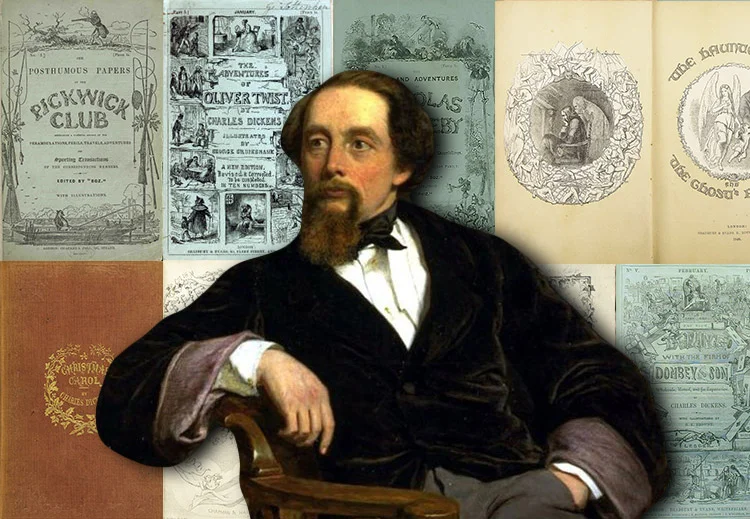
Dickens’s childhood was far from peaceful. When he was only twelve years old, his father was imprisoned in Marshalsea Prison for unpaid debts – an event that marked a major turning point in Dickens’s life. During this period, he was forced to leave school and work at a shoe-polish factory in London to support himself. The harsh labor conditions, combined with feelings of abandonment, left deep psychological scars and fostered a lasting empathy for the poor, particularly for children forced into labor at a young age.
After his father’s release, Dickens returned to school briefly, but his education was neither systematic nor long-lasting. Instead, he cultivated his knowledge through extensive reading, close observation of social life, and practical experience. This largely self-directed education contributed to a literary style that was grounded in reality, rich in observation, and accessible to a wide readership.
Upon reaching adulthood, Charles Dickens worked first as a legal clerk and later as a parliamentary reporter and journalist. Journalism brought him into direct contact with social institutions such as courts, parliament, prisons, and the public administrative system – settings that would later recur frequently in his novels. His ability to record events swiftly, his vivid prose, and his sharp realist perspective soon earned him recognition within London’s journalistic circles.
His sketches of urban life were published under the pseudonym “Boz” and later collected in Sketches by Boz (1836). This work marked Dickens’s official entry into the English literary scene, revealing a voice that was both humorous and satirical, while clearly demonstrating his concern for ordinary people in modern urban society.
From these early foundations, Charles Dickens gradually established himself as a writer capable of harmoniously combining personal experience, social observation, and creative imagination. The hardships of his life – poverty, child labor, and direct exposure to the machinery of English society – not only shaped his worldview but also became the core material for his entire literary career. This foundation enabled him to become one of the most influential realist writers in the history of world literature.
2. The Literary Career of Charles Dickens
The literary career of Charles Dickens stands as one of the most remarkable phenomena in nineteenth-century English literature, distinguished by its scope, reach, and social impact. Over more than three decades of writing, he produced numerous novels, short stories, and journalistic pieces, most of which were published in serialized form – a common method at the time but one that achieved unprecedented influence under Dickens’s pen. This format allowed him to establish a unique relationship with his readers and transformed literature into a forum for reflecting upon and engaging directly with contemporary social issues.
2.1. Early Period: From Journalism to the Novel
Dickens began his literary journey in journalism, a background that played a crucial role in shaping his style and creative mindset. As a parliamentary reporter and urban journalist, he regularly encountered political life, the legal system, and the everyday experiences of London’s citizens. These experiences honed his keen observational skills and his ability to capture social reality through vivid, image-rich language.
His early writings under the pseudonym Boz quickly attracted readers with their approachable, humorous, yet substantive narrative style. The publication of Sketches by Boz (1836) paved the way for Dickens’s transition into novel writing, marking a shift from journalistic sketches to more structured and ideologically driven literary works.
The enormous success of The Pickwick Papers (1836–1837) transformed Dickens into a literary sensation. The novel not only achieved record-breaking circulation but also demonstrated his mastery of storytelling, character creation, and audience engagement. From this point onward, Dickens firmly established himself as a professional writer of broad and lasting influence.
2.2. Developmental Period and the Formation of Social Thought
Following his early success, Dickens entered a period of sustained and prolific creativity, producing a series of significant novels that directly addressed social problems in Victorian England. Works such as Oliver Twist, Nicholas Nickleby, and The Old Curiosity Shop reveal his deep concern for children, education, and social welfare systems.
During this phase, Dickens’s writing moved beyond storytelling to assume a clearly critical social function. His novels exposed the cruelty of workhouses, the hypocrisy of bourgeois morality, and the indifference of bureaucratic institutions. At the same time, they retained their narrative appeal through dramatic plots, vivid characters, and dynamic pacing.
2.3. Mature Period: Artistic Depth and Realist Thought
The period from the late 1840s to the early 1860s is widely regarded as the mature and peak phase of Charles Dickens’s literary career. During these years, his novels achieved a balance between ideological depth, artistic structure, and social realism.
Works such as David Copperfield, Bleak House, Hard Times, and Great Expectations demonstrate significant advances in narrative technique, character development, and critical perspective. Dickens moved beyond depicting isolated social phenomena to analyzing broader social structures, including the legal system, education, class relations, and moral values within industrial society.
Notably, David Copperfield is often considered his most autobiographical work, synthesizing personal experience with broader reflections on human development. Bleak House, meanwhile, marked a formal innovation through its multi-layered narrative structure and complex narrative voice.
2.4. Late Period: Shifts in Tone and Perspective
In the later years of his life, despite declining health, Dickens continued to write and participate actively in cultural and social activities. Works from this period, such as A Tale of Two Cities and Our Mutual Friend, adopt a more restrained and occasionally darker tone. The narrative voice becomes more mature and reflective, engaging deeply with history, violence, and human nature.
Nevertheless, even in these more somber works, Dickens maintained his fundamental belief in humanity’s capacity for moral renewal and compassion, demonstrating ideological consistency throughout his career.
2.5. Overview of His Career
Overall, Charles Dickens’s literary career represents a rare synthesis of artistic talent, social consciousness, and mass appeal. His works not only depicted reality but also shaped public opinion, encouraged reform, and elevated the social role of literature. Through persistence, consistency, and continual innovation, Dickens secured his position as one of the most prolific and influential writers in the history of world literature.
3. Artistic Style and Thought of Charles Dickens
The artistic style and literary thought of Charles Dickens represent a unique synthesis of social realism, profound humanistic inspiration, and masterful storytelling. His works not only portray nineteenth-century English society but also transcend their historical context to address universal questions concerning humanity, morality, and social responsibility. This harmonious integration of realism and humanistic ideals underpins his distinctive position in world literary history.
3.1. Social Realism Grounded in Human Experience
Charles Dickens is regarded as one of the foremost representatives of critical realism in Victorian English literature. However, realism in his works is not a mere surface depiction of life; it involves careful selection, organization, and generalization to highlight fundamental social contradictions.
His novels present a broad panorama of nineteenth – century English society, encompassing overcrowded slums in London, harsh industrial factories, workhouses, prisons, and a cumbersome legal system detached from human concerns. Through these settings, Dickens exposed the negative consequences of the Industrial Revolution, including poverty, labor exploitation, class inequality, and moral degradation.
A defining feature of Dickens’s realism is his consistent focus on the relationship between social conditions and individual destinies. Social reality is never an inert backdrop; it directly shapes personal psychology, character formation, and life prospects, particularly for society’s most vulnerable members.
3.2. Characterization and Social Typology
One of Dickens’s greatest contributions to the novel lies in his creation of a rich, vivid, and enduring gallery of characters. His characters often possess exaggerated traits, yet they remain socially representative and symbolically powerful.
He excelled in portraying:
- Child characters, embodying innocence and vulnerability within an uncaring society;
- Impoverished individuals, who, despite social marginalization, retain moral integrity and compassion;
- Antagonistic figures, representing greed, hypocrisy, and irresponsible authority.
Through these figures, Dickens conveyed not only individual narratives but also systemic social issues. Many of his characters have become cultural archetypes, recognized as emblematic of particular social types or moral conditions.
3.3. Narrative Technique and Distinctive Voice
Dickens’s storytelling is highly engaging, characterized by flexible pacing, multi – strand plots, and strong dramatic tension. Influenced by serialized publication, he paid particular attention to climactic moments and compelling chapter endings to sustain reader interest.
His narrative voice combines:
- Humor and satire, to critique social absurdities and moral failings;
- Seriousness and empathy, when depicting human suffering;
- Restrained lyricism, to convey emotional depth without sentimentality.
This tonal versatility enabled his works to appeal to general readers while maintaining lasting academic value.
3.4. Humanistic Thought and Moral Renewal
The central ideological thread throughout Dickens’s oeuvre is humanism. He believed that individuals, even when shaped by oppressive social conditions, retain the potential for moral awakening and transformation under appropriate circumstances.
Unlike many realist writers with pessimistic outlooks, Dickens consistently affirmed:
- The value of compassion and empathy;
- The formative role of family and community;
- The moral responsibility of individuals within society.
Accordingly, his literature moves beyond critique toward envisioning social improvement through moral awareness and ethical change.
3.5. A Harmonizing Artistic Approach
A defining feature of Dickens’s style is his ability to harmonize entertainment with intellectual and moral depth. His works captivate readers through vivid plots and memorable characters while conveying clear social and ethical messages. This balance allowed Dickens to reach diverse audiences and ensured the enduring vitality of his literary achievements.
Overall, the artistic style and thought of Charles Dickens reflect a humanistic, realist, and progressive literary vision. His works not only depict society as it was, but also interrogate what society ought to become, affirming literature’s role as a spiritual force capable of shaping human awareness and action.
4. Legacy and Contributions of Charles Dickens
The legacy of Charles Dickens extends far beyond nineteenth-century England, exerting a profound influence on global cultural and intellectual life. Through a prolific literary career and enduring impact across generations, Dickens is recognized not only as a major writer but also as a key figure in shaping social consciousness, expanding the function of literature, and advancing humanistic values in modern society.
4.1. Contributions to the Development of the Modern Novel
One of Dickens’s most significant contributions lies in his role in refining and advancing the modern novel. Through serialized publication, he expanded narrative scale, developed multi-threaded plots, constructed expansive casts of characters, and created socially comprehensive fictional worlds.
By linking individual destinies to broader social structures – law, education, economics, and morality – Dickens helped establish the novel as a literary form capable of representing society in its entirety, laying the groundwork for later realist and social novels.
4.2. The Social Role of the Writer and Influence on Reform
Charles Dickens was among the first writers to articulate clearly and consistently the social and moral responsibilities of authorship. Through his works, he addressed pressing issues of Victorian society, including child labor, workhouse conditions, industrial exploitation, legal injustice, and elite indifference.
His novels not only depicted social realities but also influenced public discourse, stimulated debate, and indirectly contributed to reforms in education and social welfare. Literature, in Dickens’s hands, transcended aesthetic boundaries to become a powerful medium of social communication.
4.3. Long-Term Influence on Later Writers
Dickens’s legacy is evident in his lasting influence on subsequent generations of writers, both in England and internationally. Many realist and modern authors drew inspiration from his:
- Techniques of socially representative characterization;
- Integration of engaging narrative with humanistic thought;
- Use of fiction as a tool for social critique and reform.
His narrative methods helped shape the evolution of social and realist fiction across cultures.
4.4. Cultural Endurance and Popular Adaptations
The enduring relevance of Dickens’s work is further demonstrated by its continual republication and adaptation into film, television, theater, musicals, and graphic narratives. His stories and characters have become part of a shared cultural memory, transcending linguistic and national boundaries.
Such adaptability does not diminish their intellectual depth; rather, it attests to the flexibility and universal appeal of Dickens’s literary vision across historical and cultural contexts.
4.5. Dickens’s Place in World Literary History
Today, Charles Dickens is regarded as a central pillar of nineteenth-century world literature and a leading symbol of modern literary humanism. His name is closely associated with the expansion of the novel’s capacity to reflect, critique, and guide society.
His legacy resides not merely in the volume or popularity of his works, but in his demonstration that literature can be intellectually profound, widely accessible, aesthetically rich, and socially transformative at once. This synthesis secures Charles Dickens a permanent and distinguished place in the history of world literature.
5. Major Works of Charles Dickens
In the broader context of world literature, the works of Charles Dickens occupy a central position in nineteenth-century English literature and play a foundational role in the development of the modern novel. His major works consistently reflect humanistic ideals, social critique, and narrative mastery.
5.1 Selected Major Works
- The Pickwick Papers (1836–1837): Dickens’s debut novel brought him immediate public recognition, distinguished by its humor, flexible narration, and vivid depiction of contemporary English society.
- Oliver Twist (1837–1839): One of the earliest English novels to focus on impoverished children, exposing the brutal realities of workhouses and urban criminal life.
- David Copperfield (1849–1850): Often regarded as Dickens’s most autobiographical novel, tracing an individual’s development amid social change and expressing his educational and humanistic ideals.
- Bleak House (1852–1853): A powerful critique of the English legal system, notable for its complex structure, innovative narrative techniques, and philosophical depth.
- A Tale of Two Cities (1859): Set during the French Revolution, this novel explores themes of sacrifice, redemption, and revolutionary violence, marking a significant development in Dickens’s historical perspective.
- Great Expectations (1860–1861): One of Dickens’s most artistically refined novels, examining social ambition, class illusion, and moral self-awareness.
5.2 Evaluation of Their Place in World Literature
The works of Charles Dickens have transcended their historical context to become enduring classics of realist fiction. By harmonizing artistic excellence with humanistic thought, his novels not only reflect nineteenth – century English society but also address universal human concerns. This enduring relevance secures Dickens a firm place in the canon of world literature and in the global history of humanistic thought.
6. Conclusion
Overall, Charles Dickens stands as one of the most influential and enduring writers in the history of world literature. Through a life marked by hardship, a prolific literary career, and a distinctive artistic vision, he created a body of work that faithfully reflects nineteenth – century English society while expressing progressive humanistic ideals of universal significance. His literature documents the tensions of the Industrial Revolution and consistently places human beings – especially the marginalized – at the center of literary discourse.
As a realist writer with a strong sense of social responsibility, Dickens expanded the function of the novel, transforming it into a medium for social critique and moral guidance. His works combine engaging narrative, representative characters, and profound critical insight, enabling them to reach a broad readership while retaining lasting academic value.
Today, the legacy of Charles Dickens continues to be preserved, taught, and reinterpreted across diverse cultural contexts. This enduring presence affirms his position as a defining figure of literary humanism and realism. Studying Charles Dickens not only clarifies a crucial chapter in English literary history but also deepens our understanding of literature’s essential role in reflecting society, shaping thought, and nurturing humanistic values.