
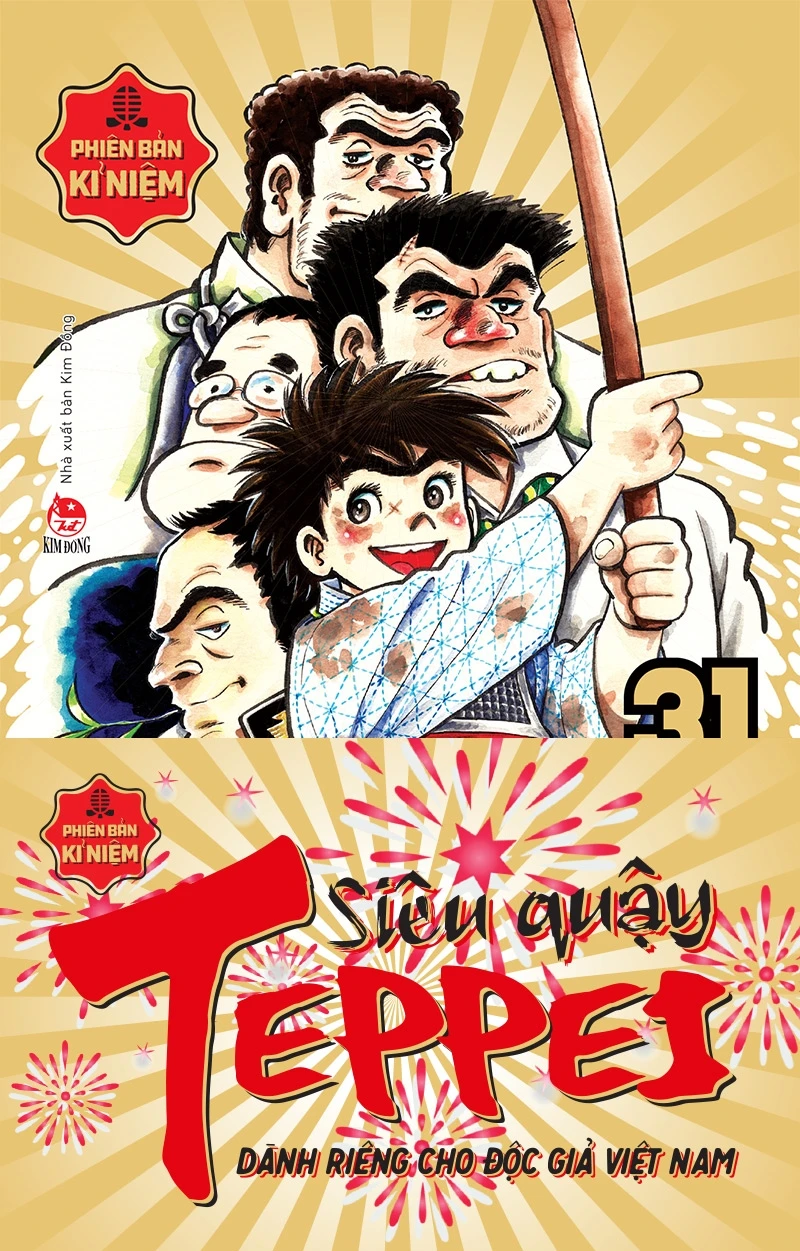
In the course of the development of Japanese manga, works created for children and adolescents have consistently played a foundational role, shaping reading habits while contributing to the formation of early values related to character, discipline, and resilience. Beyond their function as entertainment, many manga titles have transcended the boundaries of popular culture to become works of intellectual depth, reflecting the process of human growth from the earliest stages of life. Super Troublemaker Teppie stands as one of the most representative works within this tradition.
Created at a time when Japanese manga was gradually asserting its position on the international stage, Super Troublemaker Teppie quickly left a strong impression through its approach to childhood that is both accessible and thoughtfully constructed. By choosing a mischievous, stubborn, and highly energetic boy as its central figure, the work opens a narrative centered on training, confrontation, and self-improvement. Rather than presenting an idealized “well-behaved” child from the outset, Super Troublemaker Teppie focuses on portraying a turbulent childhood, in which mistakes and impulsiveness become inevitable components of the journey toward maturity.
With its brisk narrative pace, vivid situations, and a tightly organized cast of characters, Super Troublemaker Teppie appeals not only to young readers but also attracts the attention of adult audiences – particularly those interested in the role of manga in education and character formation. It is precisely this harmonious combination of entertainment, intellectual depth, and optimism that has allowed Super Troublemaker Teppie to maintain its lasting vitality, becoming a manga deeply associated with the childhood memories of multiple generations of readers.
1. Introduction to the Author and the Work Super Troublemaker Teppie
Author: Chiba Tetsuya
Super Troublemaker Teppie is one of the representative works of Chiba Tetsuya, a prominent Japanese manga artist widely regarded as one of the most influential figures in the formation and development of modern manga, particularly in the fields of children’s manga and sports manga. Born in 1939, Chiba Tetsuya began his career during the period when Japanese manga was entering a stage of professionalization, expanding beyond a purely child-oriented medium to reach a broader readership.
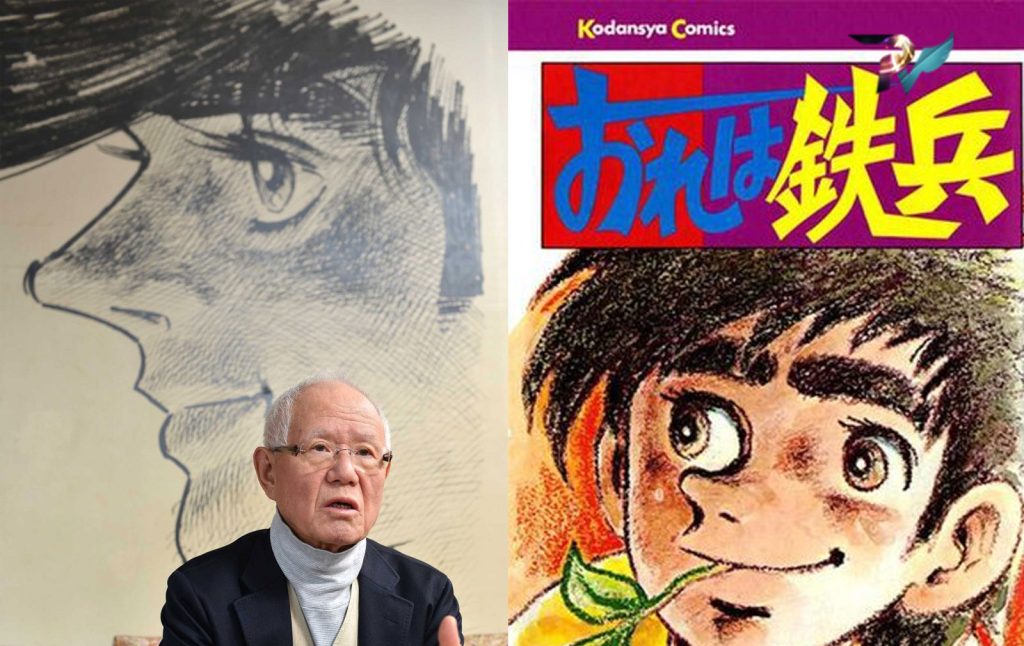
Chiba Tetsuya is well known for his ability to construct characters grounded in everyday life, reflecting the process of growth through labor, discipline, and confrontation with challenges. His works often focus on protagonists of ordinary origins – sometimes even with problematic traits – who nonetheless possess great potential when placed in the right environment. Rather than idealizing his characters, Chiba Tetsuya adopts a realistic narrative approach, allowing characters to reveal their true nature through action and conflict, thereby creating a natural and convincing process of development.
In addition to Super Troublemaker Teppie, Chiba Tetsuya is widely recognized for other classic works such as Ashita no Joe, a manga considered foundational to the sports–social manga genre in Japan. This creative philosophy directly influences Super Troublemaker Teppie, where sports and discipline function not merely as background elements but as central driving forces behind the protagonist’s transformation.
The Work: Super Troublemaker Teppie
Super Troublemaker Teppie (original Japanese title: Ore wa Teppei) belongs to the genre of children’s manga combined with sports elements, depicting the daily life and training experiences of Japanese children in a modern social context. From its title alone, the work clearly establishes the image of its central character: a mischievous, stubborn boy who frequently disrupts conventional norms, yet possesses an intense life force and an indomitable spirit.
Unlike many children’s manga that rely on direct moral instruction, Super Troublemaker Teppie adopts a more flexible and subtle narrative approach. The work does not impose rigid ethical standards; instead, it allows the story itself to guide readers through a series of vivid, everyday situations. Humor and mischief are interwoven with moments of seriousness, creating a balanced rhythm between entertainment and reflection.
In terms of content, Super Troublemaker Teppie focuses on the transformation from a child driven purely by instinct into an individual capable of accepting discipline, responsibility, and clearly defined goals. Sports within the story are not merely physical activities but serve as an educational environment for character formation, where the protagonist learns self-control, respect for the collective, and how to face failure.
With its coherent plot structure, well-developed characters, and naturally conveyed message, Super Troublemaker Teppie transcends the boundaries of a conventional children’s manga. The work stands as a clear demonstration of manga’s capacity to address issues of education and human development, while also affirming Chiba Tetsuya’s lasting influence in the history of Japanese manga.
2. Summary of the Plot of Super Troublemaker Teppie
The narrative of Super Troublemaker Teppie centers on Teppie, a boy raised in a unique environment where near-absolute freedom allows his personality to develop in a wild and difficult-to-control direction. From the very first chapters, Teppie is portrayed as a mischievous and stubborn child who frequently causes trouble for adults and refuses to accept imposed rules. His pranks, impulsive actions, and indifferent attitude create a series of situations that are both humorous and psychologically accurate portrayals of a child lacking clear guidance.
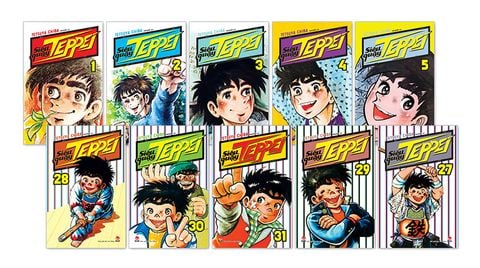
However, Super Troublemaker Teppie does not stop at depicting superficial mischief. As the story progresses, it increasingly reveals the abundant life energy and strong survival instincts hidden beneath the protagonist’s “troublemaker” exterior. Teppie is unafraid of confrontation, undeterred by hardship, and always responds directly to challenges. These traits, though initially problematic, ultimately become essential foundations for his later development.
A major turning point in the plot occurs when Teppie begins to engage with a more disciplined environment, particularly through physical training and sports. In this setting, his hyperactivity and natural stamina are no longer seen as weaknesses but as potential strengths to be properly cultivated. Training sessions, competitions, and relationships with peers and coaches become spaces where Teppie learns self-regulation, acceptance of limitations, and adherence to shared rules.
This transformation does not occur smoothly or linearly. Super Troublemaker Teppie constructs the protagonist’s growth through a series of failures, conflicts, and tensions. Teppie repeatedly encounters opposition from adults, skepticism from peers, and moments of helplessness when facing his own limitations. These experiences play a crucial role in shaping his character, helping him realize that physical strength only gains meaning when accompanied by discipline and responsibility.
Alongside Teppie’s personal development, the work skillfully builds a supporting cast that functions as reflective mirrors. Family members, teachers, friends, and rivals not only generate dramatic conflict but also actively contribute to the evolution of the protagonist’s awareness. Each relationship carries its own emotional tone – from open confrontation to quiet empathy – highlighting a gradual, non-abrupt process of maturation.
Overall, the plot of Super Troublemaker Teppie is structured as a long-term developmental narrative, focusing on gradual changes in the protagonist’s behavior and thinking. Rather than presenting an idealized conclusion, the work emphasizes process, where every mistake and setback contributes to the formation of a new self. This storytelling approach sustains the work’s enduring appeal and provides the depth necessary for a manga that transcends simple entertainment.
3. Themes and Ideas of Super Troublemaker Teppie
Instinctive Childhood and Undirected Energy
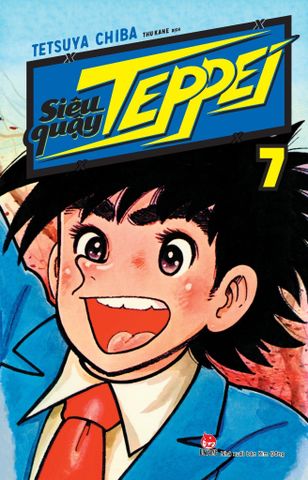
One of the central themes of Super Troublemaker Teppie is the portrayal of childhood as a phase filled with energy yet lacking defined awareness and discipline. Teppie represents children who act primarily on instinct, responding directly to their surroundings without the capacity for self-regulation. Within this framework, mischief and impulsiveness are not treated as moral failings but as natural expressions of a personality still in formation.
The work rejects simplistic perspectives that equate obedience with value. Instead, Super Troublemaker Teppie demonstrates that strong, even rebellious personalities – when properly guided – can become foundations for sustainable growth. This perspective reflects a progressive educational mindset that prioritizes understanding and guidance over suppression and control.
The Relationship Between Freedom and Discipline
Another key idea consistently developed in Super Troublemaker Teppie is the reciprocal relationship between freedom and discipline. Teppie initially embodies absolute freedom, acting without constraint or responsibility. The work does not idealize this state, instead illustrating its inevitable consequences: conflict, failure, and isolation.
Through his participation in disciplined environments – particularly in sports – Teppie gradually recognizes that discipline is not the negation of freedom but a necessary condition for its effective expression. With discipline, personal energy becomes focused rather than scattered. This foundational idea allows Super Troublemaker Teppie to transcend a simple childhood story and engage with broader questions of self-management and personal growth.
Growth Through Experience and Failure
Rejecting idealized narratives, Super Troublemaker Teppie emphasizes the role of experience and failure in the process of maturation. Teppie does not change through direct instruction but by confronting the consequences of his own actions. Failures, rejection, and doubt function not as punishments but as necessary pauses for self-reflection.
This idea reflects a realistic view of human development: growth does not result from advice alone, but from learning to take responsibility for one’s choices. In Super Troublemaker Teppie, each confrontation contributes to a restructuring of the protagonist’s awareness, gradually forming a sense of limits, goals, and personal values.
The Value of Environment and Community
Beyond the individual journey, Super Troublemaker Teppie emphasizes the role of environment and community in shaping human development. Family, school, sports teams, and social relationships are not mere backdrops but active forces influencing Teppie’s growth. The work illustrates that personal change is always intertwined with interaction and feedback from the surrounding environment.
Through its diverse supporting cast, Super Troublemaker Teppie affirms that no maturation occurs in isolation. Individuals reach fulfillment only within communities capable of both challenging and supporting them. This humanistic perspective contributes significantly to the work’s depth and explains its enduring resonance with readers.
4. Value and Influence of Super Troublemaker Teppie
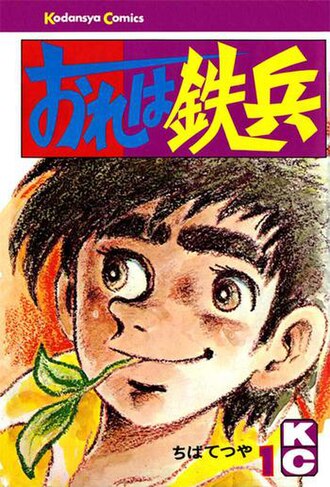
Artistic Value in Storytelling and Character Design
From an artistic standpoint, Super Troublemaker Teppie clearly reflects Chiba Tetsuya’s distinctive style – simple in line work yet rich in expressive power. The work does not rely on elaborate layouts or complex visual effects, instead focusing on storytelling through movement, rhythm, and character expression. Panel composition remains fluid, especially in scenes involving physical activity and sports competitions.
Character design in Super Troublemaker Teppie carries strong symbolic value. Teppie’s small stature combined with explosive energy effectively captures the spirit of a restless childhood. Facial expressions range from mischievous and stubborn to serious and determined, allowing readers to easily follow the character’s psychological development. This consistency in design and narrative progression establishes the work’s unique identity.
Narrative Value and Educational Significance
One of the most prominent strengths of Super Troublemaker Teppie lies in its ability to convey educational messages naturally, without overt moralization. Rather than delivering ethical lessons through direct instruction, the work allows the protagonist to learn through experience, failure, and self-transformation. This approach facilitates empathy and accessibility, particularly for younger readers.
Super Troublemaker Teppie demonstrates that education is not merely about correcting misbehavior but about recognizing and cultivating individual potential. Through the portrayal of a “troublemaker” child, the work raises questions about how society perceives difference and how environments can transform instinctive energy into positive developmental momentum. This value transcends the specific context of manga.
Influence on Children’s and Sports Manga
Within the history of manga, Super Troublemaker Teppie is considered a formative work in shaping the children’s sports manga genre. It established a narrative model centered on protagonists with flawed beginnings yet strong potential, influencing numerous later works that explore growth through discipline and training.
By balancing everyday life with serious training environments, Super Troublemaker Teppie provided a storytelling framework that prevents sports manga from becoming rigid or overly focused on achievement. Instead, sports are presented as tools for character education, fostering discipline, teamwork, and perseverance.
Reception and Impact on Readers
Across many Asian countries, including Vietnam, Super Troublemaker Teppie was warmly received by young readers. Beyond cultivating reading habits, the work became closely associated with childhood memories centered on a mischievous boy striving to improve himself.
For adult readers, Super Troublemaker Teppie offers reflective insights into education and human development. The fact that the work continues to be revisited years after its publication attests to its enduring vitality and timeless value within manga culture.
5. Conclusion
Super Troublemaker Teppie serves as a compelling example of manga’s capacity to address fundamental aspects of human growth, particularly during childhood and adolescence. Through the portrayal of a mischievous yet energetically driven boy, the work not only narrates a story of turbulent youth but also invites deeper reflection on education, discipline, and the role of environment in shaping character.
What distinguishes Super Troublemaker Teppie is its avoidance of overt moral instruction. Instead, the protagonist’s transformation is built upon experience, challenge, and failure, allowing the maturation process to unfold naturally and convincingly. This quality grants the work enduring appeal, making it meaningful not only for young readers but also for adults seeking thoughtful perspectives on personal development.In an era where manga continues to diversify in form and content, Super Troublemaker Teppie maintains a distinct position through its harmonious blend of entertainment, intellectual depth, and humanistic values. The work affirms that children’s manga, when crafted with seriousness and direction, can function as an effective educational medium while enriching the broader landscape of reading culture. From this perspective, Super Troublemaker Teppie deserves recognition as a work of lasting value within Japanese manga and within the collective memory of generations of readers.