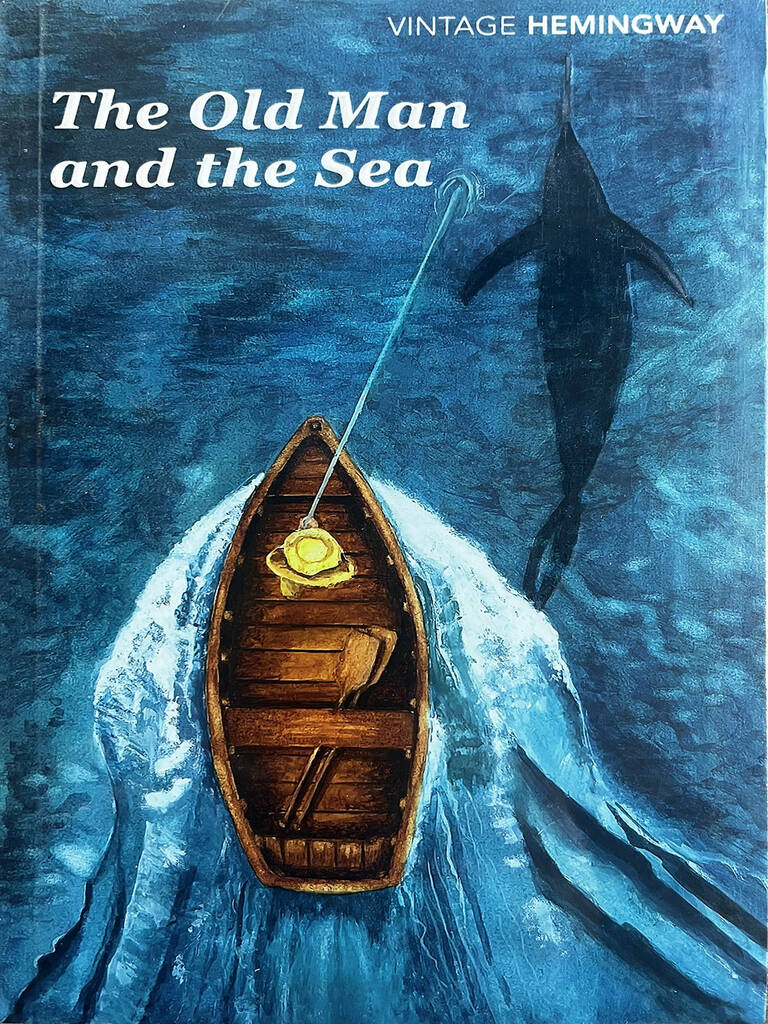
Not every great work needs a complex plot or a series of dramatic events. There are books that tell the story of only one person, one solitary journey, yet still possess the power to make readers reflect for a lifetime. The Old Man and the Sea is such a work.
Amid the vast expanse of the ocean and an almost absolute stillness, Ernest Hemingway creates the image of a poor, aging fisherman facing the sea with unwavering faith, pride, and an indomitable will. This short novel is not merely a story about fishing; it is a profound manifesto on human dignity in the face of failure and fate.
Published in the mid-twentieth century, The Old Man and the Sea has retained its value to this day, becoming one of the classics of world literature, widely taught and loved in many countries.
1. Introduction to the Author Ernest Hemingway
Ernest Hemingway (1899–1961) was one of the most influential American writers of the twentieth century. He is renowned for his minimalist style – concise, restrained, and sparing in words, yet rich in layers of meaning – a style often referred to as the “iceberg theory.”
Hemingway participated in World War I, worked as a war correspondent, and lived for many years in Europe, Cuba, and Africa. These harsh experiences shaped his literary worldview: that human beings must confront pain and loss while still preserving courage and dignity.

The Old Man and the Sea was published in 1952, when Hemingway was in the later stage of his career. The work earned him the Pulitzer Prize in 1953 and is considered one of the key reasons he was awarded the Nobel Prize in Literature in 1954. It is also the most representative work of Hemingway’s spirit and philosophy of life.
2. Summary of the Plot
The Old Man and the Sea tells the story of Santiago, a poor old fisherman who lives alone in a small fishing village on the coast of Cuba. He has spent his entire life with the sea, treating it as a close companion. However, for eighty – four consecutive days, Santiago catches no fish at all. This long streak of bad luck causes the villagers to regard him as “the unluckiest man,” and Manolin – the boy who once learned the trade from him – is forced by his parents to leave and fish on another boat.
Despite his old age, physical weakness, and repeated failures, Santiago never loses faith in himself. On the eighty – fifth day, he sets out early and sails farther than usual, steering his boat toward the deep waters where he believes luck and great fish await. Carrying only meager provisions and worn fishing gear, the old man faces the vast sea alone.
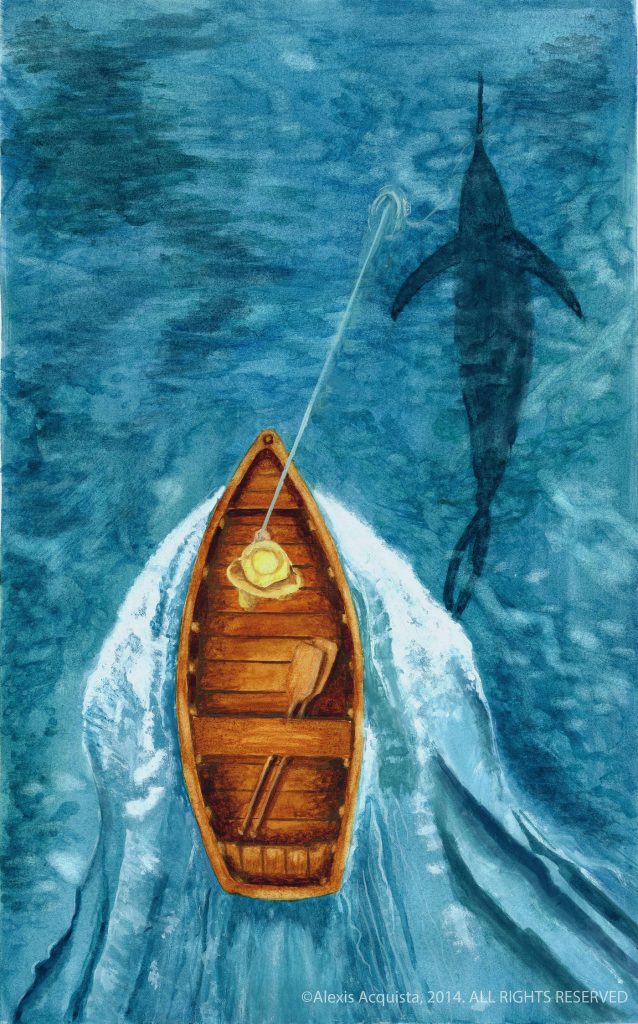
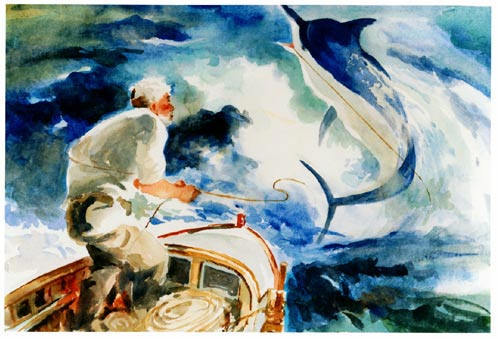
In the deep waters, Santiago hooks an enormous marlin. From the very first moment, he realizes that this is an extraordinary opponent. The powerful fish pulls the boat for day and night, forcing the old man to hold the line with all his strength and concentration. The struggle lasts for three days and two nights, during which Santiago endures hunger, thirst, intense pain, and bleeding wounds on his hands.
Throughout the battle, the old man not only fights the fish but also struggles against his own limits. Santiago speaks to the fish as a noble being, admiring its strength and regarding it as a brother sharing the same fate in the middle of the ocean. He understands that although he loves and respects the fish, he must kill it to survive and to affirm his own worth.
In the end, through perseverance and a lifetime of experience at sea, Santiago succeeds in killing the marlin. Because the fish is too large to bring aboard, he ties it alongside the boat and begins his journey back to shore. However, the return trip presents an even harsher trial. The scent of blood attracts sharks, which repeatedly attack the marlin. Santiago fights them desperately with his harpoon, knife, and even a broken oar, but faced with their number and strength, he gradually becomes exhausted.
One by one, the sharks tear the flesh from the marlin, leaving Santiago with a profound sense of pain and helplessness. When the boat finally reaches shore at night, all that remains is the fish’s enormous skeleton. The old man stumbles back to his small shack, so exhausted that he can do nothing but lie down and fall into a deep sleep.
The next morning, the villagers are astonished by the massive skeleton on the beach. Deeply moved by Santiago’s extraordinary effort, the boy Manolin decides to return and care for him, and to go fishing with him again. The story ends quietly, yet conveys a powerful message: a person may fail in terms of results, but still triumph if he does not surrender to fate.
3. Thematic and Artistic Values
Thematic Value
On the surface, The Old Man and the Sea is a story about failure: the old man does not bring the fish home. At a deeper level, however, it is a story of spiritual victory.
Hemingway affirms that a person can be defeated materially but cannot be conquered as long as he retains self-respect and willpower. Santiago loses the fish, but he does not lose faith in himself. He has fought with all his strength, and that alone is enough to preserve his dignity.
The sea in the novel is not merely nature; it is also a symbol of life itself—vast, harsh, and full of trials. The marlin represents lofty dreams and ideals, while the sharks symbolize obstacles and adversities that constantly threaten people on their journey toward their goals.
Artistic Value
Artistically, the work is a clear demonstration of Hemingway’s minimalist style. The language is simple, the sentences short, and direct emotional descriptions are limited, yet every detail carries symbolic weight.
The “iceberg theory” is vividly expressed: the visible part is the fishing story, while beneath the surface lies a profound philosophy of life concerning humanity, loneliness, pride, and the meaning of existence.
The narrative rhythm is slow and steady, like the breathing of the sea itself, creating a contemplative atmosphere that allows readers not only to read but to “live alongside” the character.
4. Memorable Quotations from The Old Man and the Sea
One of the factors that gives The Old Man and the Sea its lasting vitality is its concise and simple sentences that nonetheless contain profound reflections on humanity, willpower, and dignity. Below are several representative quotations that leave a deep impression on readers.
“A man can be destroyed but not defeated.”
This is the most famous line in the work and is often regarded as its spiritual core. Hemingway asserts that material failure does not equal spiritual collapse. As long as a person maintains willpower and self-respect, he remains victorious.
“He was not born to be defeated.”
This short sentence reflects Santiago’s strong belief in himself. Despite his old age, poverty, and loneliness, he believes that human beings are born to fight, not to surrender to fate.
“I’ll show him what a man can do and what a man endures.”
Santiago’s inner resolve reveals that his journey is not only a battle with the fish, but also a test of his own limits. Here, willpower surpasses physical strength.
“The sea is a friend, but it can also be very cruel.”
This line expresses the complex relationship between humans and nature. Santiago loves and respects the sea, yet he understands that nature is never gentle or indulgent.
“Fish, I love you and respect you very much. But I will kill you before this day ends.”
This is one of the most humane passages in the novel. Santiago does not regard the fish as an enemy but as a noble creature. His struggle is not driven by hatred, but by the necessity of survival and personal pride.
“Only those who dare to do nothing truly fail.”
The underlying message of this statement emphasizes that failure lies not in the outcome, but in whether one dares to act and confront challenges.
“Old age does not make a man weak if his spirit remains strong.”
Through Santiago, Hemingway shows that spiritual strength can transcend the limits of age and physical condition.
“Each day is a new day. It is better to be lucky. But I would rather be exact.”
This quietly optimistic line reflects Santiago’s attitude toward life: no complaints, no resentment, but an acceptance of challenge as an essential part of human existence.
These quotations enrich the intellectual depth of The Old Man and the Sea and make it a book worth rereading. Each return to the text reveals a new layer of meaning and offers a gentle yet persistent reminder of how humans stand firm in the face of adversity.
5. Suitable Readers and Effective Reading Advice
Suitable Readers
The Old Man and the Sea is suitable for a wide range of readers:
- Students who need to read classic works to develop literary thinking
- People facing failure or stagnation in life
- Those who love life philosophy and enjoy reflecting on effort and pride
- Writers and creative individuals who wish to learn a minimalist yet profound style
Effective Reading Advice
To fully appreciate the value of the work, readers should not rush through it. Read slowly, paying attention to small details such as Santiago’s dreams of lions, the way he speaks to the sea, and his conversations with the fish.
It is advisable to read the book at least twice: the first time to follow the story, and the second time to reflect on its symbols and messages. If possible, read it in moments of quiet, when the mind is calm enough to engage in dialogue with oneself.
6. Conclusion
The Old Man and the Sea is not a book that delivers instant excitement, but it is a work with enduring vitality in the hearts of readers. Through the image of the solitary old man Santiago in the vast ocean, Ernest Hemingway composed a silent epic of human will, dignity, and pride.
The book reminds us that failure is not frightening; what is truly frightening is abandoning faith in oneself. And sometimes, as long as we have fought to the very end, regardless of the outcome, we are still the victor.
If you are looking for a work that is concise yet profound, simple yet haunting, The Old Man and the Sea is undoubtedly a book not to be missed.