
In the course of the development of modern Japanese manga, alongside works centered on action, adventure, or superhuman abilities, there has always existed a quieter yet enduring current that persistently explores the darkest corners of human life. Kaiji: Ultimate Survivor (賭博黙示録カイジ) by Nobuyuki Fukumoto stands as a representative example of this tradition – a manga in which tension does not arise from physical strength, but is instead constructed through psychological pressure, crushing debt, and life-or-death choices within a ruthless world of gambling.
First published in 1996, Kaiji: Ultimate Survivor quickly drew attention for its approach, which differed fundamentally from the mainstream manga of its time. Rather than portraying its protagonist as an idealized hero or an all-powerful genius, the work presents an ordinary individual – indeed, a failure – left behind by society. From this very starting point, Kaiji’s story becomes a journey that confronts the raw realities of modern society, where the rules are set by those in power, and the weak are forced to wager everything simply to survive.
More than a gambling manga, Kaiji: Ultimate Survivor carries the qualities of a social parable, reflecting class stratification, mechanisms of exploitation, and the moral paradoxes that emerge when human beings are pushed to the brink. Through games that appear simple on the surface yet entail brutal consequences, Nobuyuki Fukumoto expands the expressive boundaries of Japanese manga, transforming Kaiji into a work that is both highly engaging and rich in intellectual depth – worthy of sustained analysis and reflection.
1. Introduction to the Author and the Work Kaiji: Ultimate Survivor
Nobuyuki Fukumoto – A Distinctive Voice in Psychological and Gambling Manga
Born in 1958 in Japan, Nobuyuki Fukumoto is one of the rare mangaka who has built his entire creative career around themes of gambling, mind games, and the extreme psychological conflicts of human beings. At a time when Japanese manga has often been associated with action, fantasy, or adventure, Fukumoto chose a markedly different path: examining the harsh realities of social life through games defined by absolute stakes of gain and loss.

Before the publication of Kaiji, Fukumoto had already established a solid foundation with works such as Ten: Tenhōdōri no Kaidanji and Gin to Kin. These earlier creations clearly reveal his enduring concerns: the operation of power, class disparity, and human behavior when individuals are driven into situations with no retreat. However, it was not until Kaiji that Fukumoto’s style reached full maturity, both in ideological depth and narrative technique.
Visually, Fukumoto does not conform to conventional aesthetic standards. His characters often possess angular faces and exaggerated expressions, at times appearing rough or even unsettling to new readers. Yet this deliberate “ugliness” functions as an effective tool for depicting fear, despair, and intense inner conflict – core elements of his narrative world.
Kaiji: Ultimate Survivor – The Work That Defined Fukumoto’s Style and Reputation
Kaiji: Ultimate Survivor (賭博黙示録カイジ – Tobaku Mokushiroku Kaiji) began serialization in 1996 in Weekly Young Magazine, published by Kodansha. From its earliest chapters, the manga distinguished itself through its uncompromising treatment of social issues such as debt, unemployment, financial exploitation, and class division.
Unlike earlier gambling manga that often focused on prodigies or characters with extraordinary abilities, Kaiji places at its center Itō Kaiji – a completely ordinary young man, and in many respects a genuine social failure. This narrative choice is highly strategic: Kaiji does not embody dreams of success achieved through exceptional talent, but rather reflects the lived reality of those at the bottom of society, individuals who easily become victims of unjust financial systems.
The series is structured into multiple consecutive arcs, each centered on a new gambling game or survival challenge with increasingly complex and ruthless rules. Despite changes in setting and format, Kaiji consistently maintains its core ideological axis: human beings are forced into situations where they must wager everything – money, dignity, trust, and even life itself – simply to retain the right to continue existing.
The Position of Kaiji: Ultimate Survivor in Manga History
From a historical perspective, Kaiji: Ultimate Survivor is widely regarded as a foundational work of modern psychological gambling manga. Its success cannot be measured solely by sales figures or adaptations into anime and live-action films, but rather by its long – lasting influence on the creative mindset of Japanese manga.
Following Kaiji, works such as Liar Game, One Outs, Akagi, and numerous other mind-game narratives have all, to varying degrees, drawn inspiration from Fukumoto’s approach to psychological tension and deliberate pacing. In this sense, Kaiji is not only the defining work of Nobuyuki Fukumoto’s career, but also a significant milestone that expanded manga’s capacity as a medium for social reflection and analysis of human nature.
2. Summary of the Plot of Kaiji: Ultimate Survivor
At the heart of Kaiji: Ultimate Survivor lies the survival journey of Itō Kaiji, an unemployed young man living precariously within modern urban society. Kaiji lacks clear ideals, stable employment, and any special abilities. He survives through temporary jobs, spends money recklessly, and avoids responsibility – until he is dragged into a spiral of debt after signing as a guarantor for an acquaintance. This seemingly minor decision becomes a turning point, plunging Kaiji into a merciless gambling world from which escape proves nearly impossible.

Hounded by financial companies, Kaiji is forced to accept an invitation to a so-called “chance at redemption” aboard the gambling ship Espoir. There, debtors like him are promised the opportunity to erase their debts through gambling games. Behind this alluring promise, however, lies a system meticulously designed to exploit those in vulnerable positions. The first game – a card-based variation of Rock-Paper-Scissors – quickly exposes its true nature: the rules are simple, yet a single mistake can cost players all their money and plunge them into even deeper debt.
As the story progresses, Kaiji steadily expands the scale and severity of its challenges. Kaiji must confront not only unfair rules, but also engage in constant psychological warfare with other players – individuals who, like himself, have been driven to desperation. In such an environment, trust becomes a luxury, and betrayal an understandable choice. Every decision Kaiji makes carries life-or-death consequences, affecting not only himself but also the fate of those around him.
Subsequent arcs push Kaiji into increasingly extreme situations: games that demand sacrifices of both body and mind, wagers where failure means loss of freedom, dignity, and even basic human rights. A notable example is the challenge of crossing steel beams suspended between skyscrapers – a scenario in which primal fear is fully exposed and all strategic calculation must contend with raw survival instinct.
A defining feature of Kaiji’s narrative is its refusal to grant the protagonist a series of uninterrupted victories. Kaiji frequently fails, loses money, is deceived, and falls into utter despair. Yet these repeated setbacks force him to think, to observe, and to understand more deeply both the mechanics of the games and the nature of human behavior. Gradually, Kaiji evolves from someone who reacts purely on instinct into a figure capable of exploiting loopholes in rules and psychological weaknesses in opponents.
Throughout its many arcs, Kaiji does not follow a conventional success narrative. Instead, it portrays a brutal cycle: victory, defeat, consequence, and renewed entrapment in another game. This cycle mirrors a harsh social reality, in which those at the bottom struggle endlessly to escape debt and exploitation, even when they achieve temporary wins.
By structuring its narrative around life-or-death gambling games, Kaiji: Ultimate Survivor generates intense dramatic appeal while simultaneously confronting readers with profound questions about choice, responsibility, and the cost of every decision. This narrative foundation allows the work to expand into deeper explorations of society and humanity in its subsequent developments.
3. Themes and Ideology in Kaiji: Ultimate Survivor
Rather than merely recounting a thrilling gambling story, Kaiji: Ultimate Survivor is constructed as a coherent ideological system concerning society, humanity, and the mechanisms of power. Through life-or-death games, Nobuyuki Fukumoto transforms gambling into a means of reflecting reality, where individual choices are perpetually constrained by economic conditions and social position.
3.1. Gambling as a Metaphor for Modern Society
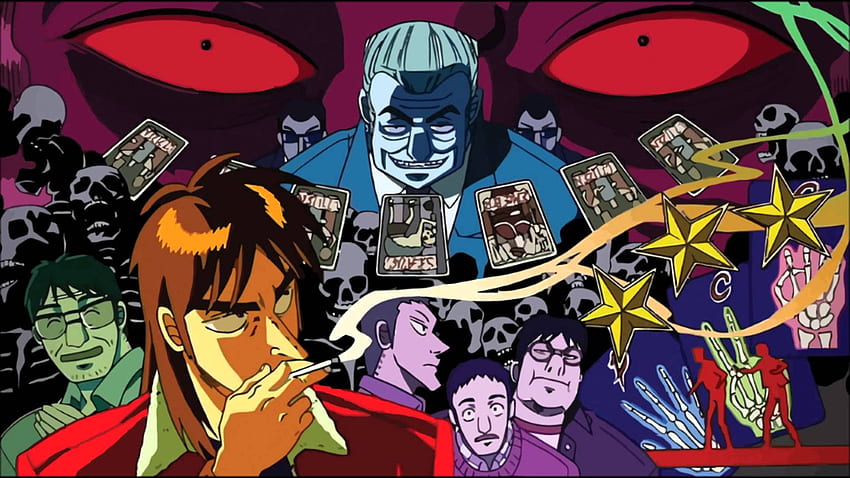
In Kaiji, gambling is not merely entertainment or a test of luck, but a microcosm of modern society. The games operate under clearly defined rules, yet control over those rules remains firmly in the hands of the wealthy – those who possess capital, information, and authority. Participants, especially debtors like Kaiji, are left with a single option: play by the rules or be eliminated.
This metaphor reflects a familiar social reality, in which “formal fairness” conceals structural inequality. No matter how hard players strive, failure remains more likely, as their starting positions are fundamentally disadvantaged. Kaiji thus transcends the story of one individual, representing instead those trapped within systems where risk is consistently shifted onto the weak.
3.2. Debt as a Tool of Control and Exploitation
One of the central ideological threads running through Kaiji is the role of debt as an instrument of control. Debt is not merely a financial issue, but a mechanism that strips individuals of freedom. Once indebted, characters lose genuine choice; every decision is dictated by the pressure to repay, regardless of how severe the cost may be.
Fukumoto portrays debt as an invisible chain that forces individuals to sacrifice dignity, morality, and personal safety. In the world of Kaiji, organizers need not rely on overt violence – debt alone is sufficient to turn people into willing participants in deadly games.
3.3. Human Nature Under Extreme Pressure
A distinctive strength of Kaiji lies in its portrayal of human beings pushed to their limits. When faced with the prospect of losing everything, conventional moral values rapidly erode. Greed, selfishness, fear, and survival instinct rise starkly to the surface.
Yet Fukumoto does not depict humanity as wholly corrupt. Instead, he reveals internal contradictions: in the same circumstances, individuals may betray others to survive while simultaneously yearning for trust and understanding. Kaiji embodies this contradiction most clearly – a character perpetually oscillating between selfishness and altruism, fear and courage, not from moral idealism, but from compulsion imposed by circumstance.
3.4. Trust and Betrayal as Two Sides of Survival
In Kaiji, trust is never an absolute value. It is both a prerequisite for cooperation and survival, and the very source of devastating collapse. Kaiji repeatedly places trust in others, only to pay a heavy price. Yet without trust, he cannot overcome games designed to force collaboration.
This tension reflects a fundamental social paradox: humans cannot survive alone, yet dependence on others always carries the risk of betrayal. Kaiji offers no definitive resolution to this paradox, leaving it as an open question that compels readers to reflect on the fragile boundary between cooperation and self-preservation.
3.5. Free Will and the Limits of Individual Choice
Another crucial theme in Kaiji concerns the nature of free will. On the surface, Kaiji and the other players appear to have choices: to participate or refuse, to wager more or less. In reality, these choices are severely constrained by economic conditions and social standing. When refusal equates to total loss, choice ceases to be truly free.
Through this framework, Fukumoto raises a philosophical question: can individuals be said to possess free will when every decision is coerced by survival conditions? Kaiji does not answer directly, but the relentless repetition of gambling cycles and debt traps serves as a deeply unsettling response.
4. The Value and Influence of Kaiji: Ultimate Survivor
More than two decades after its debut, Kaiji: Ultimate Survivor is recognized not merely as a commercially successful gambling manga, but as a work of enduring value within the history of Japanese comics. Its significance manifests across multiple dimensions: narrative artistry, social ideology, and far-reaching influence on subsequent creators.

4.1. Artistic Value in Storytelling and Tension Construction
One of Kaiji’s most significant contributions lies in its redefinition of tension in manga. Rather than relying on fast-paced action or spectacular visuals, Fukumoto builds suspense through deliberate pacing, dense reasoning, and extensive inner monologue. Moments that appear static – a glance, a pause before a decision – become the story’s most explosive points of tension.
This approach allows Kaiji to delve deeply into character psychology, giving each decision substantial weight. Readers are not merely observers of victory or defeat, but participants in the characters’ thought processes. This narrative method is a key factor behind the series’ enduring appeal, even when outcomes are already known.
4.2. Ideological Value and Social Reflection
Beyond entertainment, Kaiji functions as a sharp critique of modern society. Through gambling, Fukumoto exposes social mechanisms such as class inequality, the dominance of capital, and the systematic transfer of risk onto society’s most vulnerable members.
The work’s strength lies in its refusal to moralize explicitly. Instead, it allows circumstances and consequences to speak for themselves. Readers witness how debt transforms individuals into tools, how greed and fear shape behavior, and thus develop their own awareness of the social issues at stake. This subtle yet uncompromising realism defines Kaiji’s ideological value.
4.3. Influence on Psychological and Mind-Game Manga
Kaiji’s most visible impact can be seen in the proliferation of psychological and mind-game manga that followed. Works such as Liar Game, One Outs, Akagi, and many modern survival narratives clearly bear the imprint of Fukumoto’s methods – particularly in their construction of rules, pacing, and psychological depth.
The “game – rules – loopholes – human psychology” model established by Kaiji has become a familiar framework adopted and adapted by later creators. Yet what preserves Kaiji’s distinct status is its ideological consistency: its games are never isolated spectacles, but are inseparably linked to social context and character identity.
4.4. Impact on Popular Culture and Adaptations
Beyond manga, Kaiji has made a strong impression on Japanese popular culture through anime adaptations and live-action films. These versions expanded the series’ audience and demonstrated that narratives driven primarily by psychology and dialogue can remain compelling across multiple media formats.
The figure of Kaiji – a failed man repeatedly pushed to the brink yet refusing to stop struggling – has become an iconic symbol in popular culture, representing ordinary individuals confronting an unforgiving system. This cultural resonance further reinforces Kaiji’s status as a work that transcends conventional entertainment manga.
4.5. Enduring Relevance and Longevity
The most significant factor behind Kaiji’s lasting value is its sustained relevance. The issues it addresses – debt, social injustice, financial manipulation – have not diminished over time, but have arguably grown more pronounced in contemporary society. As a result, Kaiji continues to be read, analyzed, and discussed as a work of depth, rather than merely a gambling manga.

5. Conclusion
Kaiji: Ultimate Survivor is not simply a manga centered on gambling, but an artistic work that offers a stark reflection of the fundamental contradictions of modern society. Through the perilous journey of Itō Kaiji, Nobuyuki Fukumoto constructs a world in which individuals are forced into life-or-death choices, constrained by debt, financial power, and ostensibly fair yet profoundly unequal rules.
The work’s enduring strength lies in its seamless integration of dramatic tension with ideological depth. The gambling games do not function as isolated spectacles, but as social metaphors that expose mechanisms of power and the processes by which individuals are drawn into moral degradation once genuine choice is stripped away. As a marginalized figure, Kaiji provides a vantage point from which readers can observe this system from within – without idealization or embellishment.
On a broader level, Kaiji: Ultimate Survivor expands the expressive potential of Japanese manga, affirming that the medium can serve as a serious vehicle for social critique, scholarly inquiry, and lasting cultural influence. The work is not merely meant to be read, but to provoke reflection on freedom, morality, and the cost attached to every decision within a society governed by risk and profit.
Through its ideological consistency, distinctive narrative style, and enduring relevance, Kaiji: Ultimate Survivor maintains its position as one of the most significant psychological gambling manga in Japanese comic history, and as a cultural text deserving continued study and dialogue in the contemporary context.