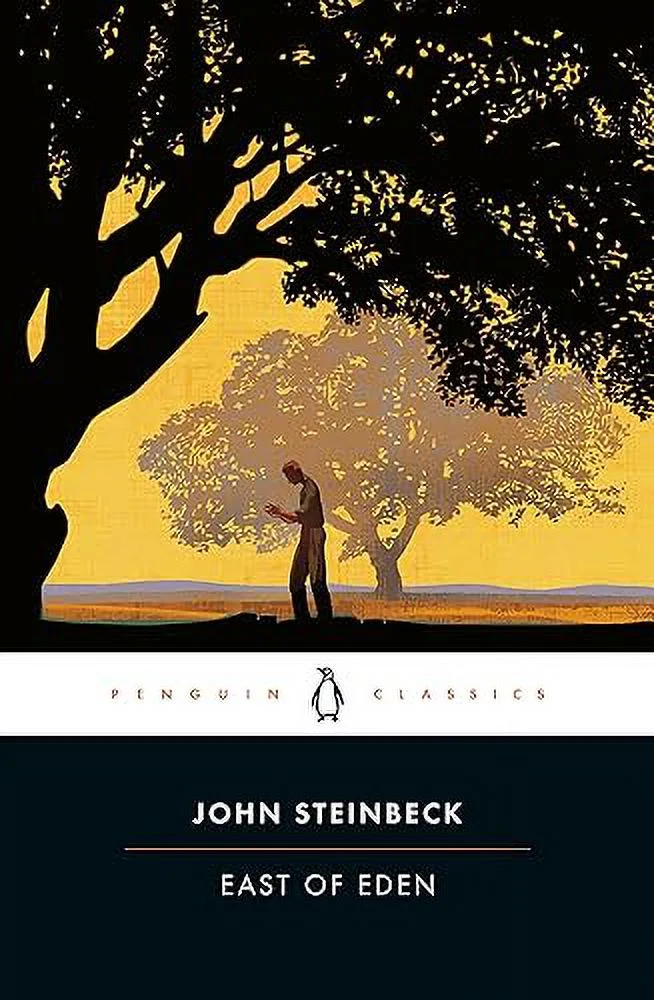
In the history of twentieth-century American literature, few novels dare to place human beings at the center of a fundamental ethical question: are people truly free in the face of good and evil, or are all human actions determined by heredity, circumstances, and the past? It is from this very question that East of Eden was conceived as a literary work with a distinctly philosophical ambition.
Rather than recounting a family story in the conventional sense, the novel constructs a multi-generational narrative structure in order to examine the operation of human morality over time. By repeatedly portraying conflicts between fathers and sons, brothers and brothers across generations, Steinbeck demonstrates that evil is neither an isolated phenomenon nor a permanent sentence, but a potential that always exists within each individual.
Set in California’s Salinas Valley – a land both fertile and harsh – East of Eden places human beings at the “edge” of paradise, where the absolute protection of faith or traditional morality no longer applies. In this space, each character is forced to confront personal choice, and it is precisely the act of choosing that determines the moral value of a human life.
With its epic structure, psychological depth, and consistent ideological framework, East of Eden transcends the boundaries of realist fiction to become a contemplative text, in which literature functions as a tool for exploring the nature of humanity in the modern world.
1. The Author and the Work
John Steinbeck (1902–1968) is one of the most influential writers in twentieth – century American literature. He came of age during a period of profound upheaval in the United States, shaped by industrialization, economic crisis, and deep structural changes in society. These historical forces significantly informed Steinbeck’s literary worldview: a realist and humanistic perspective centered on ordinary people and the ethical conflicts embedded in everyday life.
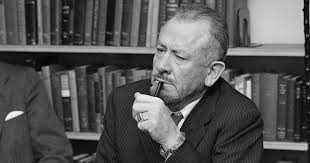
Steinbeck did not pursue ornate language or formal experimentation. His prose is characterized by clarity and restraint, yet it carries considerable philosophical depth. He was particularly concerned with the relationship between the individual and the community, between instinct and morality, between social conditions and human agency. These themes recur throughout his career, from works depicting the working class to novels imbued with philosophical and symbolic dimensions.
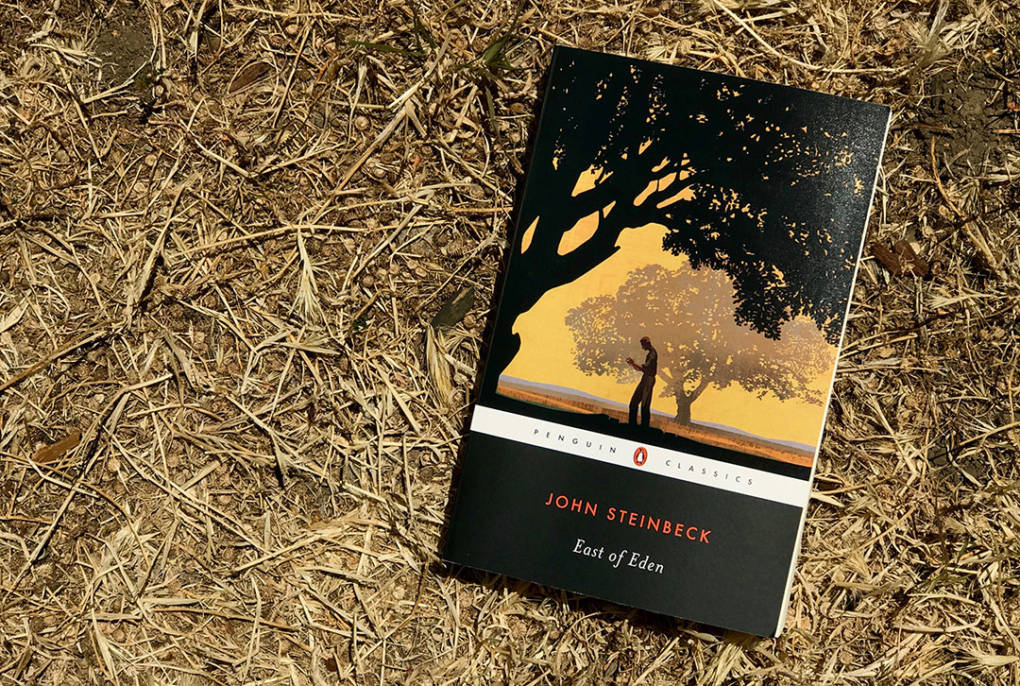
Within Steinbeck’s body of work, East of Eden (published in 1952) is widely regarded as his most ambitious and ideologically comprehensive novel. Unlike many of his earlier works, which focus on specific periods or social groups, East of Eden is structured as a multi-generational chronicle, allowing Steinbeck to explore ethical questions on a broader and more profound scale.
Steinbeck himself stated that this was the book into which he consciously poured “everything that was most important” to him. This intention is evident in the way the novel not only reflects American social reality but also directly engages with foundational texts of Western civilization, particularly the Old Testament. The story of Cain and Abel is reinterpreted not as a fixed religious myth, but as a moral pattern capable of recurring in modern life.
The Salinas Valley – Steinbeck’s birthplace and a landscape deeply connected to his identity – serves not merely as a geographical setting but as a powerful symbol. It represents a space between abundance and hardship, hope and disappointment, mirroring humanity’s ongoing search for meaning. This choice of setting underscores that East of Eden is not purely fictional, but rather a synthesis of personal experience, social observation, and philosophical reflection.
Through its intellectual depth, layered narrative structure, and highly symbolic character system, East of Eden is considered one of the most important novels of modern American literature, as well as a defining expression of Steinbeck’s humanistic vision of humanity and moral choice.
2. Summary of the Plot
East of Eden is constructed as a multi-layered narrative spanning several generations, in which each generation inherits not only bloodlines but also unresolved moral conflicts from the previous one. The novel centers on two families – the Hamiltons and the Trasks – set primarily in the Salinas Valley, a space that witnesses the formation, collapse, and redefinition of family values, morality, and individual freedom.
The narrative opens with the Hamilton family, particularly Samuel Hamilton, an Irish immigrant embodying industriousness, intellectual curiosity, and firm religious faith. Though materially poor, the Hamiltons function as a moral and intellectual anchor within the novel. Through Samuel’s character, Steinbeck establishes a value system grounded in knowledge, compassion, and personal responsibility – serving as a counterbalance to the tragedies unfolding within the Trask family.
Running parallel is the story of Adam Trask, a man deeply scarred by childhood trauma, especially his violent relationship with his father and the death of his half-brother. These psychological wounds leave Adam passive and indecisive, prone to simplistic beliefs and idealized notions of absolute goodness.
The true tragedy begins when Adam marries Cathy Ames, one of the novel’s most controversial and central figures. Cathy is portrayed as cold, manipulative, and devoid of empathy, representing an extreme manifestation of human darkness. Their marriage is not founded on love, but on illusion and misjudgment. Shortly after giving birth to twin sons, Cathy shoots Adam and abandons the family, triggering a prolonged cycle of emotional devastation.
In the aftermath, Adam falls into psychological paralysis, leaving his sons – Aron and Caleb – to be raised by servants and friends. The absence of a mother and the emotional distance of their father create a deeply imbalanced upbringing. Aron is idealized and sheltered, growing into a pure yet fragile individual who consistently avoids reality. Cal, by contrast, is sensitive and suspicious, acutely aware of his father’s favoritism, and gradually develops a belief that he is inherently “bad.”
As he matures, Cal embarks on a search for the truth about his mother. Discovering that Cathy is still alive and running a brothel shatters his illusions and confronts him with his greatest fear: that he has inherited her cruelty. Aron, unable to withstand this harsh reality, collapses psychologically, with irreversible consequences.
The novel’s climax centers on the conflict between the two brothers, directly reenacting the Cain and Abel pattern in a modern context. However, Steinbeck refuses to conclude the story with a simple, fatalistic tragedy. Through the character of Lee – the Trask family’s moral guide – the concept of “Timshel” is introduced as the novel’s ideological key. Meaning “thou mayest,” Timshel affirms that human beings are not condemned by heredity, the past, or instinct, but always retain the ability to choose their moral path.
The novel’s ending does not resolve all conflicts definitively, but instead opens a reflective space. Forgiveness, self-awareness, and choice emerge as central themes, reinforcing that East of Eden is not a story of victory or defeat, but of humanity learning to take responsibility for its moral life.
3. Thematic and Artistic Value
At the ideological level, East of Eden addresses a fundamental question of moral philosophy: the relationship between instinct, circumstance, and ethical choice. Rather than treating good and evil as fixed opposites, the novel presents them as coexisting possibilities within every individual. This approach allows Steinbeck to move beyond simplistic moral judgment and to frame humanity as a responsible moral agent rather than a passive victim of fate.
One of the novel’s most significant thematic achievements lies in its deconstruction of determinism. By repeating the Cain – Abel pattern across generations, Steinbeck demonstrates that moral history may be cyclical, but it is not predetermined. Characters may share similar traumas and environments, yet their outcomes differ. It is the divergence in choice – however small – that ultimately shapes human destiny. Through this, the novel articulates a powerful humanistic assertion: individuals are not sentenced by their origins or their past.

Psychologically, East of Eden showcases Steinbeck’s refined ability to analyze inner conflict. His characters are not purely symbolic figures, but complex individuals torn between the desire to be loved and the fear of rejection, between moral aspiration and the pull of darkness. Cal, in particular, illustrates the mechanics of moral insecurity: the belief that one is “born wrong” can itself drive destructive behavior if left unacknowledged. Steinbeck thereby underscores the importance of understanding, dialogue, and education in moral development.
Artistically, the novel stands out for its fusion of epic structure and psychological realism. Steinbeck avoids relentless dramatic peaks, allowing the narrative to unfold gradually and cumulatively. This pacing enables moral conflicts to emerge organically over time, revealing that tragedy is not sudden but built through neglected or avoided choices. The multi-generational framework further grants the novel historical depth, illustrating the evolution of moral values within a changing society.
Steinbeck’s prose in East of Eden is marked by restraint and precision. He rarely indulges in decorative imagery, favoring instead a simple, suggestive style. This restraint allows philosophical meanings to permeate the narrative, particularly in reflective dialogue. Short, decisive sentences often appear at pivotal moments, functioning as ideological anchors for the novel.
The Salinas Valley itself is a crucial artistic element. More than a familiar landscape, it serves as a metaphor for humanity’s liminal condition: no longer within the innocence of Eden, yet not entirely lost. Those living “east of Eden” must construct their own moral frameworks rather than rely on inherited faith or tradition. This setting reinforces the novel’s central thesis that freedom of choice is inseparable from moral responsibility.
The synthesis of thematic depth and disciplined narrative craft enables East of Eden to transcend the category of family realism. The novel becomes a lasting text that not only reflects a specific historical moment in American society but also poses enduring questions for modern readers: how we are born matters less than who we choose to become.
4. Notable Quotations
One of the key sources of East of Eden’s intellectual depth lies in its philosophically charged statements, placed precisely at moments of psychological and ethical tension. The following quotations function not merely as memorable lines, but as ideological signposts that clarify Steinbeck’s conception of humanity, morality, and choice.
1. “Timshel – thou mayest.”
→ This is the central quotation of the entire novel. Timshel affirms that human beings are neither compelled toward sin nor goodness, but always retain the capacity to choose. This capacity forms the ethical foundation of human life.
2. “A man is not condemned by what he is born with.”
→ This statement directly rejects biological determinism. Steinbeck suggests that heredity creates potential, not destiny, and that moral responsibility lies in choice.
3. “Evil is strongest when a man believes he has no choice.”
→ This quotation identifies the mechanism of evil: it arises not from instinct alone, but from the surrender of moral agency.
4. “There is nothing more dangerous than misplaced love.”
→ Steinbeck critiques emotional imbalance within families, particularly parental favoritism, as a profound source of psychological harm and moral distortion.
5. “Truth may hurt, but concealment destroys.”
→ This line affirms the ethical necessity of truth. In the novel, concealment does not protect individuals, but deepens tragedy.
6. “What frightens people most is discovering the evil within themselves.”
→ This quotation captures the core of internal conflict, especially in Cal’s character. Fear of self-recognition becomes the greatest barrier to moral growth.
7. “Forgiveness does not erase guilt, but it opens the possibility of change.”
→ Forgiveness is presented not as sentimentality, but as a conscious moral act enabling transformation.
8. “No one is born belonging to the darkness.”
→ This line concludes the novel’s humanistic vision: evil is not an immutable essence, but a controllable possibility.
9. “The hardest path is the path of responsibility.”
→ Steinbeck affirms that freedom has meaning only when paired with responsibility, and moral maturity requires self-confrontation.
5. Conclusion
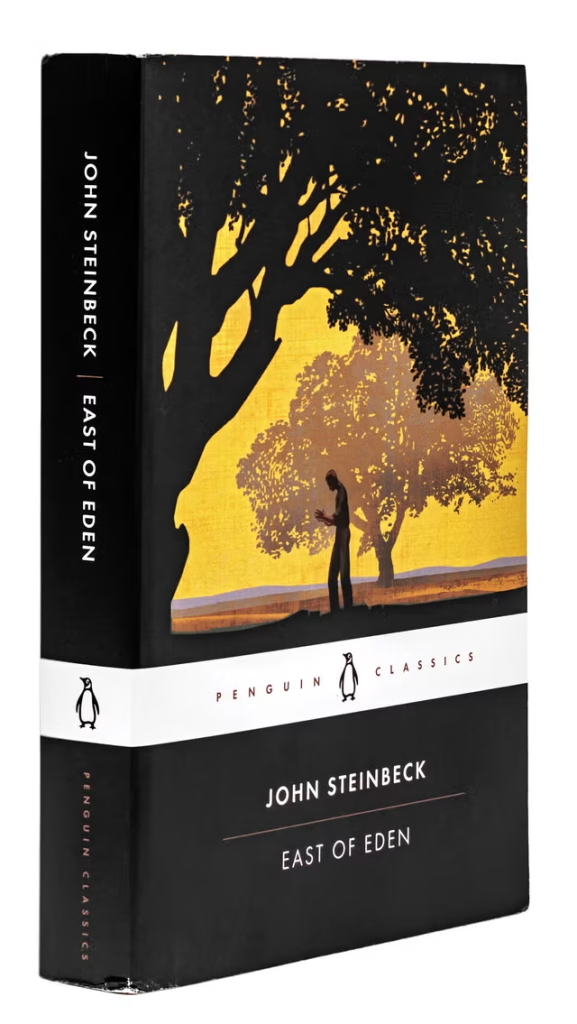
East of Eden stands as one of the most representative novels of twentieth-century American literature, not merely because of its multi – generational scope, but because of the intellectual depth it constructs. Through the intertwined histories of families and recurring moral conflicts, Steinbeck develops a coherent discourse on human nature, in which good and evil are not absolute opposites but concurrent potentials within every individual.
The novel’s enduring value lies in its affirmation of moral choice as the foundation of human existence. By placing characters in morally demanding situations, Steinbeck demonstrates that people are not wholly determined by heredity, the past, or social conditions. Self-awareness, responsibility, and ethical decision-making ultimately define human worth. This perspective allows East of Eden to transcend family narrative and emerge as a text of lasting philosophical and humanistic significance.
From an artistic standpoint, the novel achieves a careful balance between epic structure, psychological realism, and restrained prose. These elements do not serve technical display, but instead support the development of the novel’s central ideas. The Salinas Valley, the system of mirrored characters, and the measured narrative rhythm together form a cohesive whole that invites thoughtful moral engagement.In the modern context – where individuals often attribute responsibility to circumstance or nature – East of Eden remains a serious reminder of personal accountability. The novel does not provide simple answers, but creates a space for reflection, compelling readers to question their own choices. This capacity to provoke sustained ethical self-examination is the clearest testament to the novel’s enduring significance in literary and intellectual history.