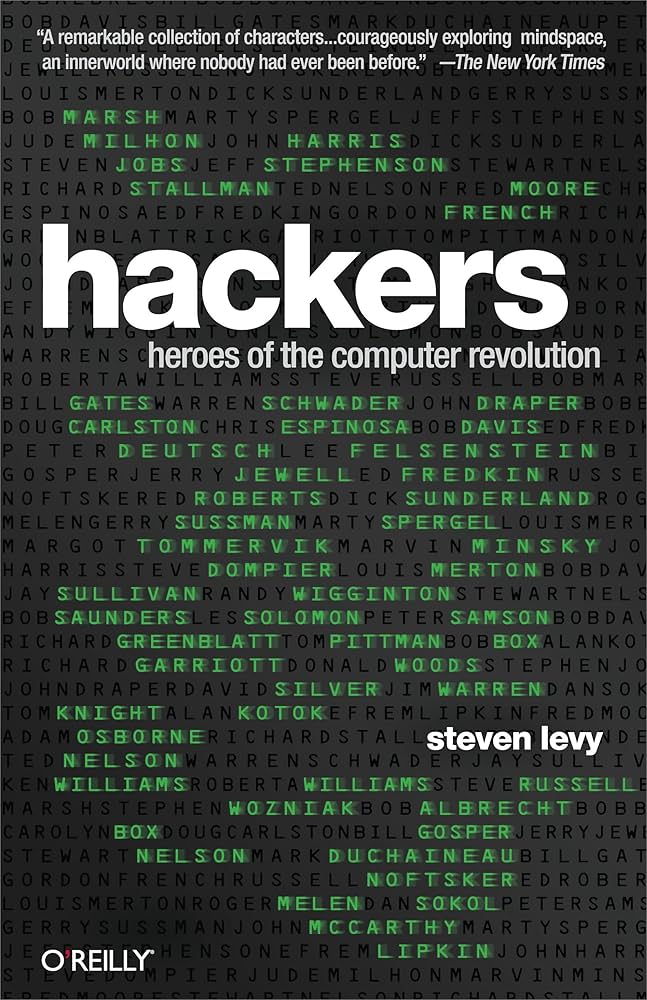
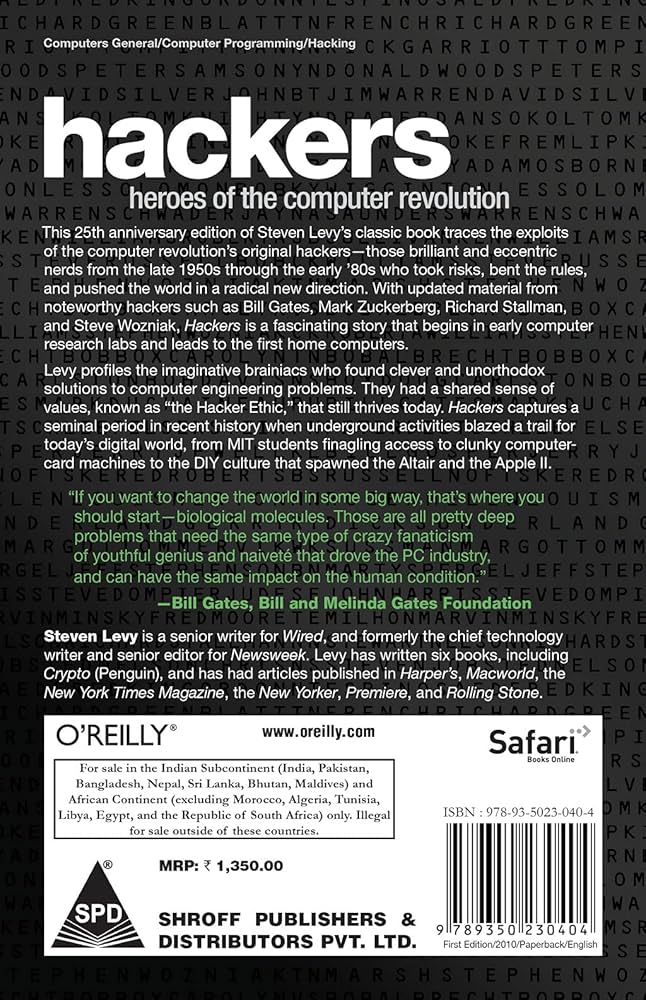
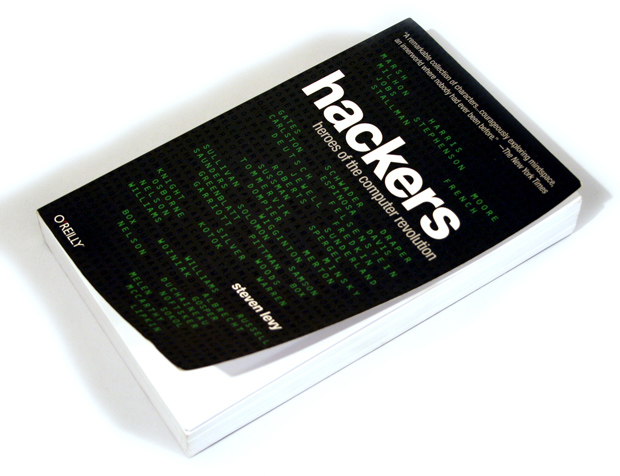
In the historical flow of information technology, there are books that do more than record the evolution of machines and software; they explain how people think, create, and establish the foundational values of the modern digital world. Hackers: Heroes of the Computer Revolution by Steven Levy is such a work. First published in 1984, the book appeared at a pivotal moment when the computer industry was undergoing a major transformation – from large-scale systems confined to academic laboratories to the era of personal computers and mass-market software.
In today’s context, where the term “hacker” is often associated with illegal intrusions, cyberattacks, or high-tech crime, Hackers: Heroes of the Computer Revolution serves as a particularly valuable foundational text. The book takes readers back to a time when a “hacker” primarily referred to individuals with deep technical passion, an enthusiasm for exploring computer systems, a belief in free access to information, and a view of programming as a form of intellectual creativity. Through the lens of investigative journalism and historical research, Steven Levy redefines the concept of the hacker according to its original meaning.
Beyond recounting the biographies of a group of individuals, Hackers: Heroes of the Computer Revolution paints a comprehensive picture of the formation of the computer revolution – from the academic environment at MIT, to the free-spirited creative communities of Silicon Valley, and to the earliest debates surrounding software, intellectual property, and the commercialization of technology. The book demonstrates that the development of computing was not merely a matter of technical progress, but the result of an ideology, a culture, and a community of people who believed that technology could transform the way society operates.
For these reasons, Hackers: Heroes of the Computer Revolution is regarded not only as a history of technology, but also as a foundational text for understanding hacker culture, technological ethics, and the values that laid the groundwork for the Internet, open-source software, and today’s information technology industry. It is a work of enduring significance, especially for readers who wish to approach technology not only from a technical perspective, but also through the depth of history and intellectual thought.
1. Introduction to the Author and the Work
Steven Levy – a journalist chronicling the history of technological culture
Steven Levy is one of the earliest and most enduringly influential technology journalists in the United States. Although he does not come from a purely technical background, he is highly regarded for his interdisciplinary approach to technology, combining investigative journalism, the history of science, and cultural analysis. This foundation has enabled Steven Levy to become a reliable chronicler of the formative stages of modern information technology.

Throughout his career, Steven Levy served as a senior editor at Newsweek, where he was responsible for coverage of technology, science, and society. He later joined Wired as Editor at Large, contributing to the shaping of a style of technology journalism that emphasizes in-depth analysis rather than short-term products or trends. Levy’s works are consistently praised for their factual accuracy, direct access to key figures, and their ability to situate technology within a broader social context.
A defining feature of Steven Levy’s methodology is his direct engagement with the central figures of technological history. He interviewed engineers, programmers, founders, and individuals who were directly involved in the early development of computing. As a result, his works are not speculative or secondhand interpretations, but are grounded in firsthand accounts, lived experiences, and primary-source documentation.
Hackers: Heroes of the Computer Revolution – redefining the concept of the “hacker”
Hackers: Heroes of the Computer Revolution was first published in 1984, at a time when the computer industry was entering a critical transitional phase. This was the period when personal computers were becoming widespread, software was increasingly treated as a commercial product, and the term “hacker” had not yet acquired the negative connotations it later would. Steven Levy’s decision to publish the book at this moment clearly reflects his intention: to document hacker history while the original values of the community were still clearly visible.
The book is structured as a technological chronicle divided into three major phases, corresponding to three generations of hackers. Each phase reflects not only technical changes, but also shifts in mindset, culture, and the relationship between humans and computers. Through this structure, Hackers: Heroes of the Computer Revolution illustrates the continuous evolution of the hacker concept – from academic environments, to independent creative communities, and eventually into the sphere of commercialization.
One of the book’s most significant contributions is Steven Levy’s articulation and naming of the concept of the Hacker Ethic. Although these principles already existed in the practical activities of hacker communities, the book helped formalize, disseminate, and establish them as an academic reference point for later studies of technological culture, free software, and the Internet.
The book’s place in the history of technology literature
Hackers: Heroes of the Computer Revolution is often grouped with foundational works on the history of computing, alongside other classic books that explore the rise of Silicon Valley and the software industry. However, what distinguishes this book is its focus: rather than centering on companies, products, or markets, it places people and technical thinking at the heart of the narrative.
Because of this approach, the book is not constrained by technological obsolescence. Despite being written more than four decades ago, Hackers: Heroes of the Computer Revolution remains highly relevant, particularly in explaining the origins of concepts such as hacker culture, information freedom, knowledge sharing, and open creativity. This enduring relevance is why the book continues to be cited in research on computer science, digital media, and Internet history.
2. Hackers: Heroes of the Computer Revolution
Hackers: Heroes of the Computer Revolution is constructed by Steven Levy as a clearly structured chronicle, divided into three major sections corresponding to three generations of hackers and three critical stages in the development of modern computing. Rather than presenting a dry list of events, the book weaves together personal stories, social context, and technical progress, demonstrating that hackers are not merely exceptional individuals, but products of a distinctive cultural and intellectual environment.
The first generation: MIT and the birth of hacker culture
The opening section of Hackers: Heroes of the Computer Revolution takes readers back to the late 1950s and early 1960s at the Massachusetts Institute of Technology (MIT), the birthplace of many foundational ideas in computer science. Here, a group of young students and engineers gained access to large computer systems such as the TX-0 and PDP-1, machines that were extremely rare and expensive at the time.
Steven Levy describes in detail how MIT hackers approached computers not as administrative tools, but as open systems to be explored and improved. They wrote code to optimize performance, developed experimental programs, and even created some of the earliest computer games. In this environment, the term “hack” referred to a clever, elegant, and efficient technical solution, rather than any act of destruction.
From the real-world practices of the MIT hackers, the book clarifies the formation of the core principles later known as the Hacker Ethic: a belief in free access to computers, opposition to unnecessary bureaucratic restrictions, the evaluation of individuals based on technical skill rather than status, and the conviction that computers could be tools for creativity and social improvement. This section lays the ideological foundation for the entire book.
Hardware hackers: from laboratories to creative communities
The second section shifts the focus to the U.S. West Coast, particularly Silicon Valley in the early 1970s. During this period, hackers were no longer confined to research institutions or universities, but began forming independent creative communities. Steven Levy devotes significant attention to the role of clubs such as the Homebrew Computer Club, where engineers, inventors, and technology enthusiasts gathered to share ideas and hardware components.
The book shows how hardware hackers played a decisive role in transforming computers from massive machines serving large organizations into personal tools accessible to the general public. Designing circuit boards, assembling machines, optimizing costs, and sharing technical schematics were all seen as integral aspects of the hacker spirit. Steven Levy emphasizes that this culture of sharing accelerated innovation far beyond what closed development models could achieve.
The author also explores the close relationship between hackers and video games. Games were not merely entertainment, but environments for testing hardware limits, algorithms, and human–computer interaction. Through concrete examples, the book demonstrates how hackers used games as a medium for technical learning and creative experimentation.
Software hackers: the tension between ideals and commercialization
The final section of Hackers: Heroes of the Computer Revolution focuses on the early era of personal computers and commercial software, where the most profound conflicts within hacker culture began to emerge. Steven Levy introduces figures who had a lasting impact on software history, including Richard Stallman, Bill Gates, and early PC programmers.
Here, the book analyzes the opposition between two approaches: one that viewed software as shared knowledge, and another that treated software as commercial property requiring protection through copyright. Steven Levy does not take sides, instead presenting this conflict as an inevitable consequence of technology’s entry into the marketplace.
Through detailed case studies, this section illustrates how hacker culture evolved under economic, legal, and scaling pressures. It also marks the period when the term “hacker” began to acquire multiple and sometimes conflicting meanings, laying the groundwork for ongoing debates about free software, open source, and technological ethics.
A coherent narrative of humans and machines
Across all three sections, Hackers: Heroes of the Computer Revolution does not simply recount computer history in chronological order, but constructs a coherent narrative about the relationship between humans and technology. Steven Levy demonstrates that every technical advancement is tied to cultural choices, value systems, and how people perceive the role of computers in society.
This structure allows the book to remain accessible to general readers while offering sufficient depth to serve as a serious reference for those seeking to understand the origins of the computer revolution.
3. Value and Key Contributions of the Book
Historical value: a definitive chronicle of the computer revolution
The most immediate and evident value of Hackers: Heroes of the Computer Revolution lies in its status as a highly reliable historical document of technological development. Steven Levy wrote the book while many of the events were still recent and many key figures were actively involved in the industry. As a result, the work is based on direct interviews, primary documents, and firsthand observation rather than retrospective reinterpretation.
The book does not merely trace the technical evolution of computers, but also clarifies the social, academic, and economic conditions that enabled the computer revolution to unfold. From research environments at MIT to grassroots hacker communities in Silicon Valley and the emergence of the software industry, all are presented within a continuous historical narrative. This approach allows the book to transcend the limitations of conventional technology storytelling and become a lasting chronicle.
Defining and systematizing the “Hacker Ethic”
One of the book’s most influential contributions is Steven Levy’s systematization of the Hacker Ethic. Prior to this work, hacker values existed largely in practice and oral tradition, without a clearly articulated conceptual framework.
Levy identifies and articulates core hacker principles, including belief in free access to computers, resistance to unnecessary bureaucratic barriers, evaluation based on technical competence rather than credentials, and the idea that information should be shared to promote progress. This conceptualization not only helps readers understand hacker culture, but also provides a foundation for later movements such as free software and open source.
To this day, the Hacker Ethic is frequently cited in studies of technological ethics, Internet culture, and computer science, demonstrating the book’s enduring influence.
A human-centered rather than technology-centered perspective
Another distinguishing feature of Hackers: Heroes of the Computer Revolution is Steven Levy’s decision to place people at the center of the narrative rather than machines or technical specifications. Technology is presented not as a neutral entity, but as the product of human choices, thinking, and values.
Through personal stories, the book reveals creative motivations, internal conflicts, and the very human limitations of hackers. This perspective underscores that technological development is neither linear nor inevitable, but shaped by individuals and specific social contexts – an insight particularly valuable in today’s increasingly automated technological landscape.
A balanced view of ideals and commercialization
Steven Levy does not idealize hackers as flawless heroes, despite the book’s title. Instead, Hackers: Heroes of the Computer Revolution offers a balanced perspective, especially in its analysis of the commercialization of software.
The book highlights the tensions between ideals of knowledge sharing and the need to protect intellectual property, between open creativity and economic pressures. Rather than imposing judgment, Levy allows events, viewpoints, and actions to reveal their inherent complexity. This restraint helps the work avoid ideological extremes and maintain objectivity.
Enduring relevance for the present and future
Although written more than four decades ago, Hackers: Heroes of the Computer Revolution remains highly relevant to contemporary technological debates. Issues such as information freedom, open source, software ownership, and the responsibilities of technologists can all be traced back to the historical moments and ideas presented in the book.
This ability to connect past and present makes the book not only a historical account, but also a tool for critical reflection on the role of technology in modern society.
4. Who This Book Is For
Thanks to its historical and cultural approach, Hackers: Heroes of the Computer Revolution appeals to a wide range of readers, particularly those who wish to understand technology from its intellectual foundations rather than purely technical skills.
First, the book is especially suitable for students of information technology and computer science. It provides historical context for technical knowledge and explains why principles such as knowledge sharing, code optimization, and merit-based evaluation became industry norms. This context is essential for developing a long-term professional mindset.
For programmers and software engineers, Hackers: Heroes of the Computer Revolution offers a systemic perspective on the cultural origins of the technology industry. The book helps readers better understand familiar debates surrounding open source, software licensing, and the relationship between creativity and commercialization.
The work is also well suited to researchers, educators, and technology content creators. With reliable documentation and clear presentation, it serves as a trustworthy reference for studying and teaching computer history, hacker culture, and technological ethics.
Finally, the book is accessible to general readers interested in the history of technology and digital culture, even without a deep technical background. It provides insight into how technology emerged, evolved, and shaped modern society.
5. Conclusion
Hackers: Heroes of the Computer Revolution is a rare work that both accurately documents the historical formation of the computer industry and clarifies the values and thinking that shaped modern technological culture. Through rigorous journalistic methods and reliance on primary sources, Steven Levy portrays hackers as creative individuals with technical discipline, deeply influenced by the social environments in which technology emerged.
The book’s enduring value lies not in detailed descriptions of specific technologies, but in its ability to explain why computers and software developed in the way they did. Issues such as information freedom, knowledge sharing, open source, and the tension between ideals and commercialization are all situated within a clear historical context, demonstrating that today’s technological debates have deep roots.
In an era when technology is increasingly intertwined with social life, Hackers: Heroes of the Computer Revolution serves as a foundational text that enables readers to approach technology with clarity and depth. It is not merely a book about the past of computing, but an essential starting point for anyone seeking to understand the true nature of hackers and the computer revolution that shaped the modern digital world.
6. References
[1] F. P. Brooks Jr., The Mythical Man-Month: Essays on Software Engineering, Anniversary Edition, Boston, MA, USA: Addison-Wesley, 1995.
[2] F. P. Brooks Jr., “No Silver Bullet – Essence and Accidents of Software Engineering,” Computer, vol. 20, no. 4, pp. 10–19, Apr. 1987.
[3] R. C. Martin, Clean Code: A Handbook of Agile Software Craftsmanship, Upper Saddle River, NJ, USA: Prentice Hall, 2008.
[4] R. C. Martin, The Clean Coder: A Code of Conduct for Professional Programmers, Upper Saddle River, NJ, USA: Prentice Hall, 2011.
[5] S. McConnell, Code Complete: A Practical Handbook of Software Construction, 2nd ed., Redmond, WA, USA: Microsoft Press, 2004.
[6] A. Hunt and D. Thomas, The Pragmatic Programmer: From Journeyman to Master, Reading, MA, USA: Addison-Wesley, 1999.
[7] D. E. Knuth, The Art of Computer Programming, vol. 1–4. Reading, MA, USA: Addison-Wesley, 1968–2011.
[8] F. Brooks, The Mythical Man-Month: Essays on Software Engineering, Anniversary ed. Boston, MA, USA: Addison-Wesley, 1995.
[9] A. Tanenbaum and H. Bos, Modern Operating Systems, 4th ed. Boston, MA, USA: Pearson, 2015.
[10] B. W. Kernighan and D. M. Ritchie, The C Programming Language, 2nd ed. Englewood Cliffs, NJ, USA: Prentice Hall, 1988.