
Within the development of modern Japanese manga, Hunter x Hunter stands out as one of the rare works capable of surpassing the limitations of traditional shōnen conventions to construct a narrative discourse rich in intellectual depth. First serialized in 1998, at a time when action – adventure manga were largely dominated by familiar heroic tropes, Yoshihiro Togashi’s work deliberately chose a different path. Rather than centering the story on an uninterrupted trajectory of victories, the manga places its emphasis on world-building, human complexity, and the ethical consequences that accompany power.
At first glance, Hunter x Hunter appears to follow the structure of a classic adventure tale: a young boy leaves his hometown to search for his father, undergoes grueling trials, and gradually matures through dangerous confrontations. However, as the narrative unfolds, it becomes evident that this adventurous surface functions merely as an entry point. Beneath it lies a world organized by intricate systems of power, where strength never exists in isolation but is always bound to responsibility, limitation, and cost.

The fundamental distinction of Hunter x Hunter lies in its persistent subversion of reader expectations. The protagonist is never idealized without reservation; antagonists are not reduced to simplistic embodiments of evil; and conflicts rarely conclude with definitive moral affirmations. Instead, each story arc operates as a conceptual experiment, placing individuals in extreme circumstances to reveal the underlying nature of choice, instinct, and belief.
Through this approach, Hunter x Hunter is recognized not only as a successful entertainment product but also as a work of enduring analytical value. It raises universal questions concerning maturation, power, violence, and the fragile boundary between humanity and inhumanity. Within the broader landscape of contemporary manga, Hunter x Hunter is thus regarded as a major milestone that expands the expressive and intellectual potential of Japanese comics.
1. Author and Work Overview
Hunter x Hunter is a representative work closely associated with the name Yoshihiro Togashi, one of the most distinctive creative minds in the Japanese manga industry. Born in 1966 in Yamagata Prefecture, Togashi graduated from the Faculty of Fine Arts at Yamagata University before embarking on his professional manga career. From his early works, he demonstrated a tendency to deviate from established narrative formulas, prioritizing psychological depth and conceptual structure over purely entertainment-driven pacing.
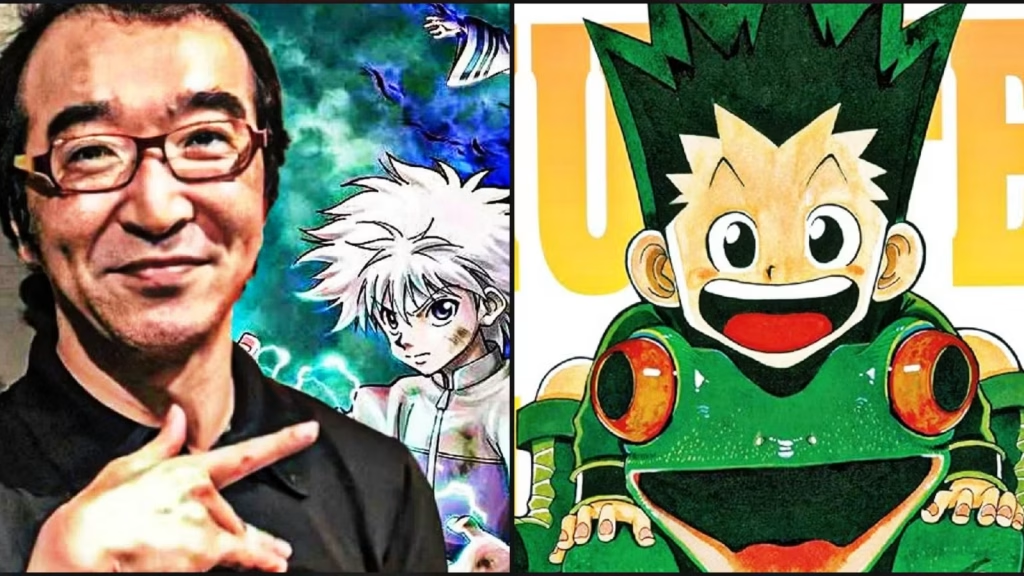
Prior to Hunter x Hunter, Togashi achieved remarkable success with Yu Yu Hakusho (1990 – 1994), one of the most influential shōnen manga of the 1990s. However, while Yu Yu Hakusho largely operated within the familiar framework of supernatural action manga, Hunter x Hunter is widely regarded as a decisive turning point in Togashi’s career. In this work, he consciously expanded the scope of experimentation in both form and content, making it the clearest expression of his independent creative identity and critical engagement with the shōnen genre itself.
First serialized in Weekly Shōnen Jump in 1998, Hunter x Hunter quickly attracted attention not only for its compelling adventure narrative but also for its distinctive world-building. In the series, a “Hunter” is not merely an occupational title but a privileged social class recognized by international law. Hunters are granted access to classified information, vast resources, and exceptional autonomy, allowing them to operate beyond conventional norms in pursuit of personal objectives. This concept forms the foundation for many of the ideological conflicts that permeate the entire work.
Another defining feature of Hunter x Hunter is its Nen power system, often regarded as one of the most intricate and coherent ability systems in manga history. Nen functions not merely as a combat mechanism but as a direct reflection of the user’s personality, desires, limitations, and ethical stance. By linking power to conditions, vows, and tangible costs, Togashi transforms battles into contests of intellect and psychology rather than simple comparisons of strength.
Despite frequent publication hiatuses caused by the author’s health issues, Hunter x Hunter has maintained a lasting influence for over two decades. Beyond its commercial success, the series is frequently cited in academic discussions on Japanese manga as a prime example of the fusion between popular entertainment and philosophical inquiry.
Overall, Hunter x Hunter is not only a central work in Yoshihiro Togashi’s career but also a clear demonstration of manga’s potential as a serious narrative form. Through this series, Togashi has established himself as a creator who persistently questions human nature, society, and the inherent limitations of the genre in which he works.
2. Plot Summary
The narrative of Hunter x Hunter unfolds through an open-ended journey structure, in which each phase not only expands the fictional world but also fundamentally reshapes the perceptions, motivations, and value systems of the central characters. The story begins with Gon Freecss, a boy raised on Whale Island who grows up believing that his father is dead. The revelation that Ging Freecss is alive and is a legendary Hunter becomes the initial driving force that compels Gon to leave his home and participate in the Hunter Exam – a gateway to a vast and complex world beyond.
The Hunter Exam – he Origin of a Harsh World
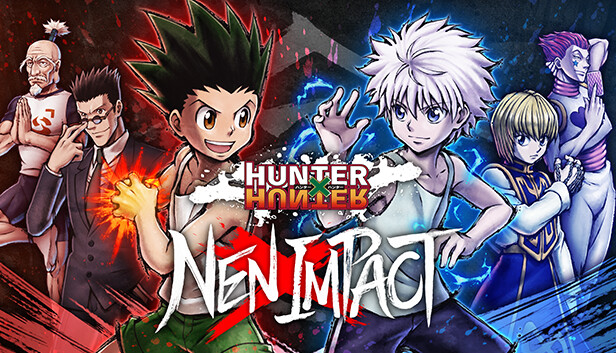
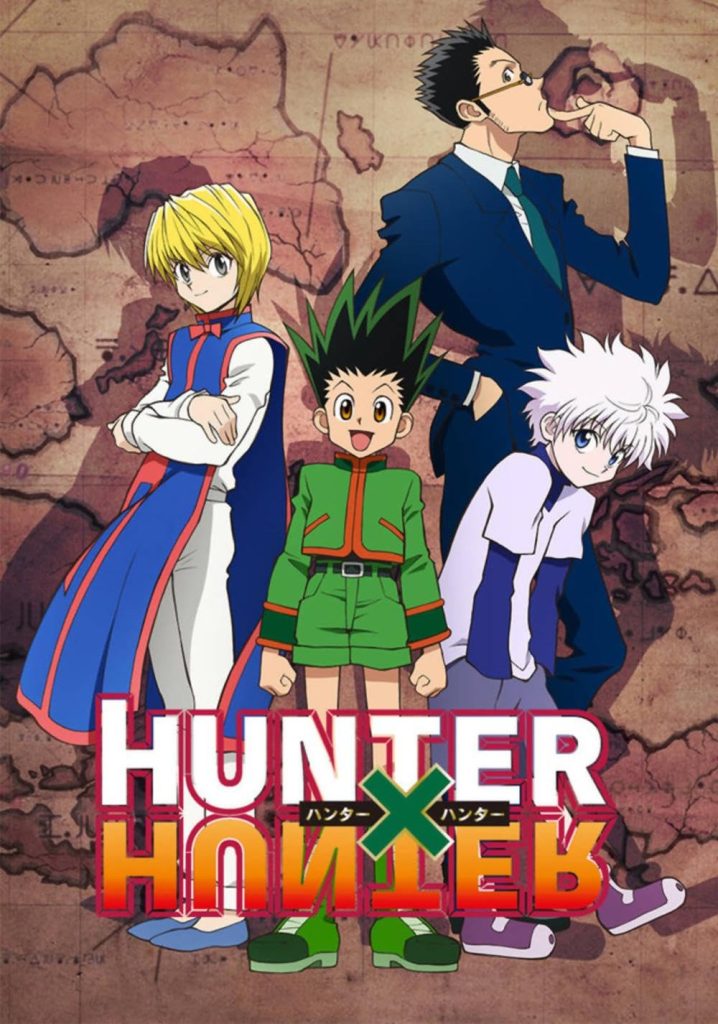
The Hunter Exam arc serves as the foundational introduction to the setting, rules, and governing philosophy of the Hunter x Hunter universe. Through survival-oriented trials, the arc vividly depicts the brutality and inherent irrationality of the Hunter selection system, where intelligence, physical ability, adaptability, and even ruthlessness can all function as advantages. It is here that Gon meets Killua Zoldyck, Kurapika, and Leorio, four individuals representing vastly different backgrounds and life goals.
The Hunter Exam is not merely a test of competence but also a space in which Togashi poses his first critical questions regarding the value of success and the cost of acquiring power. Passing the exam does not equate to moral victory; it merely confirms one’s ability to survive within a fiercely competitive system.
Heavens Arena and Nen – The Formation of the Power Axis
After becoming Hunters, Gon and Killua enter Heavens Arena, where they are first introduced to Nen, the core power system of the series. This arc marks a significant transition, shifting Hunter x Hunter from a conventional adventure narrative to a highly strategic and intellectual form of storytelling.
Nen is presented not only as a combat tool but as a system that reflects human nature itself. Learning Nen requires self-awareness, mental discipline, and acceptance of one’s inherent limitations. It is here that Gon and Killua begin to diverge clearly in their approaches to power and personal goals, laying the groundwork for future psychological conflicts.
Yorknew City – The Underworld and Personal Tragedy
The Yorknew City arc represents a crucial turning point in the narrative structure of Hunter x Hunter. The focus shifts from Gon’s journey to Kurapika’s tragic quest for revenge as the last survivor of the Kurta Clan. The emergence of the Phantom Troupe reveals an underworld where conventional law and morality lose their absolute authority.
This arc demonstrates Togashi’s refusal to simplify antagonists. The Phantom Troupe is portrayed simultaneously as a brutal criminal organization and as a tightly bonded community governed by its own internal principles. Meanwhile, Kurapika gradually erodes his moral boundaries as he becomes consumed by vengeance, illustrating that revenge is not a path to liberation but a controlled form of self-destruction.
Greed Island – Game Mechanics and Conditional Growth
Greed Island is a highly experimental arc in which the narrative world is structured as a massive role-playing game. Here, Gon and Killua must apply Nen within a rigid rule-based system where success depends not only on strength but also on strategy, cooperation, and an understanding of systemic mechanics.
This arc functions as an intellectual training phase, preparing the characters for the existential conflicts that follow. It also allows Gon to move closer to his original goal: understanding Ging through the traces his father deliberately left behind.
Chimera Ants – The Ideological Climax of the Series
The Chimera Ant arc is widely regarded as the pinnacle of both narrative scale and philosophical depth in Hunter x Hunter. The conflict between humanity and the Chimera Ants is not framed as a simple battle between good and evil, but as a philosophical examination of life, power, and humanity itself.
Meruem, the Chimera Ant King, evolves from a being who rules through violence into an individual capable of reflection, empathy, and existential inquiry. In contrast, Gon—representing humanity—reveals the darker side of extremism by prioritizing personal objectives over ethical boundaries. This inversion renders the Chimera Ant arc one of the most debated chapters in manga history.
An Open Horizon – The Dark Continent and an Incomplete World
Following the Chimera Ant climax, Hunter x Hunter expands its narrative scope with the introduction of the Dark Continent, a realm beyond humanity’s capacity for control. This phase demonstrates Togashi’s ambition to construct an unbounded world, shifting the story away from individual journeys toward global structures of power, politics, and survival.
Consequently, Hunter x Hunter does not aim for a closed conclusion but exists as an ongoing process of inquiry. Each arc functions as a fragment of the world and a conceptual experiment on human behavior under extreme conditions.
3. Themes and Ideology
Unlike many shōnen manga that center on victorious progression, Hunter x Hunter is constructed as an open intellectual space in which each arc serves as a forum for Yoshihiro Togashi to examine human nature under extreme circumstances. The themes of the work do not exist in isolation; instead, they intersect, interact, and occasionally conflict, creating a level of depth rarely seen in mainstream manga.

3.1. Non – Linear Maturation and the Cost of Personal Choice
One of the most significant ideological axes of Hunter x Hunter is its redefinition of “maturity.” Rather than portraying growth as the accumulation of strength, experience, or prestige, the series emphasizes the ability to bear the consequences of one’s choices. Characters do not mature by becoming more complete but by confronting internal contradictions and irreversible outcomes.
Gon Freecss exemplifies this form of non-linear growth. His initial optimism and innocence are not replaced by wisdom but pushed to an extreme when he refuses to acknowledge ethical limits in pursuit of his goal. Through this trajectory, the series issues a cautionary message: innocence unchecked by self-awareness can lead to destructive decisions.
3.2. Power, Systems, and Social Mechanisms
Hunter x Hunter approaches power not as an isolated personal attribute but as the product of tightly organized systems. From the Hunter Association and the Yorknew underworld to the Chimera Ant hierarchy, each structure operates according to its own rules, often placing universal morality secondary to efficiency and self-interest.
The Nen system lies at the center of this ideological framework. Nen is not merely power but a direct manifestation of personality, ambition, and psychological limitation. By binding strength to conditions, vows, and sacrifice, the series frames power as a contractual exchange: the greater the desired power, the greater the required loss. This philosophical approach reflects the relationship between power and responsibility in modern society.
3.3. The Ambiguity Between Good and Evil
A major ideological contribution of Hunter x Hunter is its dismantling of the binary opposition between good and evil. The series rejects a moral structure in which humans inherently represent justice and adversaries embody pure evil. Instead, individuals and groups are contextualized within specific circumstances, where actions are shaped by environment, instinct, and value systems.
The Chimera Ant arc exemplifies this ambiguity. The Chimera Ants – initially portrayed as an absolute threat – gradually demonstrate the capacity for reflection and empathy. Conversely, humans repeatedly resort to violence and annihilation as rational solutions. The series offers no moral verdict, allowing this contrast to raise fundamental questions about the nature of humanity.
3.4. Instinct, Reason, and the Limits of Morality
Throughout Hunter x Hunter, there is a persistent tension between survival instinct and moral reasoning. In extreme situations, characters must choose between self-preservation and adherence to fragile ethical standards. Togashi does not idealize any particular choice but focuses on the consequences they produce.
Through characters such as Killua, Kurapika, and Meruem, the series illustrates that morality is not a fixed system but one continually tested by circumstance and power. When survival thresholds are pushed to their limits, even the most seemingly stable ethical frameworks can collapse.
3.5. Humanity in a Vast and Uncontrollable World
At a deeper level, Hunter x Hunter situates humanity within a world far beyond its capacity for absolute control. The introduction of the Dark Continent expands the narrative from individual experience to the survival of humanity as a whole. Despite possessing knowledge and power, humans remain small and vulnerable in the face of natural laws and incomprehensible threats.
This perspective undermines the myth of total human dominance and emphasizes the finitude of power and knowledge. Consequently, Hunter x Hunter does not glorify final victory but instead directs attention toward unresolved questions without definitive answers.
4. Value and Influence
Within the evolution of contemporary Japanese manga, Hunter x Hunter is recognized not only as a commercial success but also as a cultural phenomenon of lasting value. Its significance does not reside in a single element but emerges from the convergence of narrative innovation, ideological depth, and broad influence on both the manga industry and reader perception.

4.1. Artistic Value and Narrative Innovation
One of the most important contributions of Hunter x Hunter is Yoshihiro Togashi’s restructuring of the traditional shōnen storytelling model. Rather than maintaining a constant action-driven pace, the series allows each arc to shift dramatically in tone, tempo, and thematic focus. Some arcs emphasize combat, while others devote extensive space to dialogue, internal monologue, and strategic exposition.
Formally, Togashi is willing to abandon conventional aesthetic standards to prioritize conceptual clarity. The panel composition in Hunter x Hunter is often minimalist or even rough, yet this approach facilitates the transmission of ideas and complex information. In doing so, the series expands the expressive capacity of manga, demonstrating that the medium can function as a sophisticated vehicle for thought rather than mere visual spectacle.
4.2. Nen and Its Influence on Power System Design
The Nen system of Hunter x Hunter is widely regarded as one of the most rigorous and influential power systems in manga history. Unlike linear strength hierarchies, Nen is built upon classification, conditional use, and trade-offs, rendering each ability a unique personal expression.
Its influence can be clearly observed in later manga and anime, particularly in series that emphasize strategy and psychology, such as Jujutsu Kaisen, later arcs of JoJo’s Bizarre Adventure, and Chainsaw Man. By tying power to risk and limitation, Nen has helped elevate battles from physical confrontations to intellectual duels.
4.3. Ideological Impact and Character Depth
Hunter x Hunter has significantly altered approaches to character construction in shōnen manga. Characters are no longer confined to fixed roles such as “hero,” “ally,” or “villain,” but exist as complex individuals capable of transformation through circumstance and choice.
Characters such as Kurapika, Killua, and Meruem are frequently examined in studies of character psychology and moral philosophy. The series demonstrates that manga can engage with serious themes – including revenge, systemic violence, the corruption of power, and identity crises – without sacrificing mass appeal.
4.4. Influence on Readers and Popular Culture
Beyond its status as a manga series, Hunter x Hunter has become an integral part of both Japanese and global popular culture. Anime adaptations, video games, novels, and extensive merchandise have allowed the work to reach multiple generations of audiences.
More importantly, Hunter x Hunter has maintained its relevance despite prolonged publication hiatuses. This longevity suggests that its core value does not depend on narrative continuity alone but on ideological depth and its capacity to stimulate ongoing dialogue. For many readers, engaging with Hunter x Hunter is not merely an act of entertainment but an evolving process of reflection and reinterpretation across different stages of life.
4.5. The Position of Hunter x Hunter in Modern Manga History
Considering these factors collectively, Hunter x Hunter is often classified among the most transformative works that have expanded the boundaries of the shōnen genre. The series demonstrates that mainstream manga can embrace experimentation, complexity, and even structural imperfection.
In the history of modern manga, Hunter x Hunter functions not only as a successful work but also as a crucial point of reference for both creators and scholars. Its value and influence lie not in the number of chapters or narrative completeness, but in its sustained capacity to raise enduring questions about humanity, power, and the limitations of the medium itself.
5. Conclusion
Hunter x Hunter is not a work designed to provide immediate gratification or neatly resolved conclusions. Instead, Yoshihiro Togashi’s series exists as an open narrative structure in which every journey, conflict, and decision contributes to questioning rather than answering. This defining characteristic enables Hunter x Hunter to transcend the boundaries of conventional shōnen manga and achieve lasting reflective value.
Through its multilayered world-building, complex power systems, and psychologically rich characters, Hunter x Hunter illustrates that individuals are not defined by titles or strength but by how they confront their limits and the consequences of their choices. The series does not glorify absolute victory nor assert a single moral framework; rather, it allows contradictions to emerge organically through the narrative’s progression.
On a broader level, Hunter x Hunter affirms the potential of manga as a serious narrative form capable of engaging with complex issues such as power, ethics, instinct, and the fragility of human nature. Its enduring influence, despite interruptions in its creation, serves as evidence that its core value lies in intellectual depth rather than formal completeness.
For these reasons, Hunter x Hunter deserves recognition as one of the most important works of modern manga – not only for readers of comics, but also for those interested in narrative technique, character analysis, and the capacity of popular culture to sustain meaningful intellectual dialogue.