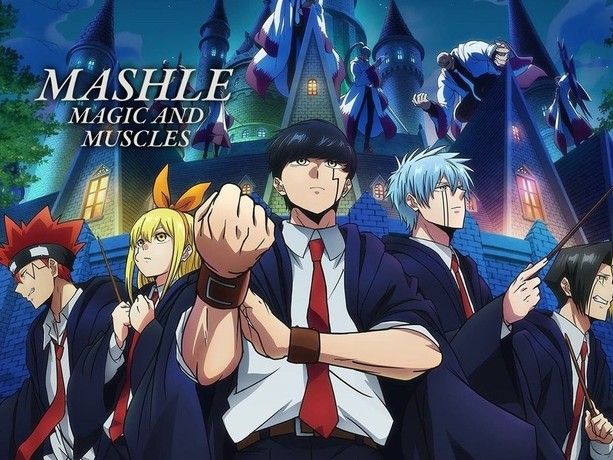
In the context of contemporary Japanese manga, which is increasingly diversified in both subject matter and ideological approaches, Magic and Muscles emerges as a particularly noteworthy case. The work not only draws upon familiar motifs of the fantasy genre – most notably the magic academy setting – but also deliberately problematizes these conventions through a clear strategy of inversion. Instead of continuing to glorify supernatural power as the ultimate symbol of strength, Magic and Muscles adopts a paradoxical narrative approach: it constructs a world in which magic reigns supreme, yet assigns the central role to a character who possesses no magical ability whatsoever.
This fundamental contrast establishes the core axis of conflict in Magic and Muscles, while simultaneously opening up a space for the work to develop multiple layers of meaning that extend beyond pure entertainment. Beneath its comedic surface and exaggerated action sequences, the manga raises essential questions concerning how societies define human value, the injustice inherent in hierarchical systems based on innate ability, and the role of individual effort in challenging norms that appear immutable.
Rather than relying solely on absurd humor for comic effect, Magic and Muscles employs laughter as a sharp tool of social critique. Through the exaggeration of social rules and the repeated collapse of the so-called “truths” governing the magical world, the work compels readers to re-examine familiar power structures in real life. For this reason, Magic and Muscles can be regarded as a modern allegory, in which apparent narrative simplicity conceals a carefully structured and intentional ideological framework.
With this approach, Magic and Muscles is not merely a commercially successful shōnen manga, but also a representative example of a broader trend in contemporary manga: the balanced integration of popular appeal and critical depth. The opening section thus serves as a foundation, guiding readers into the world of the work while preparing them to engage with both its entertainment value and its underlying ideological significance.
1. Introduction to the Author and the Work Magic and Muscles
Magic and Muscles is a long-running manga written and illustrated by Hajime Komoto, marking a significant turning point in his career as well as within the contemporary shōnen manga landscape. Komoto belongs to a generation of young mangaka who came of age at a time when Japanese manga had reached a saturation point in terms of motifs and genres, compelling new creators to seek distinctive approaches in order to stand out. Within this context, Komoto chose to rework familiar elements through inversion, placing emphasis on satire and exaggeration.

Prior to Magic and Muscles, Hajime Komoto produced several short works published in specialized magazines, which already revealed his concise storytelling style, fast pacing, and tendency to employ physical comedy as a narrative device. Nevertheless, these early works remained experimental in nature and had yet to crystallize into a coherent ideological system. It was only with Magic and Muscles that Komoto fully established a stable creative identity, combining traditional shōnen structures with a modern sensibility of social critique.
In terms of publication, Magic and Muscles was serialized in Weekly Shōnen Jump, one of the most influential manga magazines in Japan and the birthplace of numerous globally recognized classics. Its selection for serialization in this platform demonstrates its compatibility with a mass readership, while also situating Magic and Muscles within an intensely competitive environment where only works capable of sustaining long-term appeal can survive. The manga’s success derives not only from its entertainment value, but also from its ability to maintain a clear and consistent central idea throughout its chapters.
Genre-wise, Magic and Muscles is classified as a fantasy–action–comedy manga set within a magic academy, a motif that has become highly familiar in Japanese manga and light novels. The distinctive feature lies in Hajime Komoto’s use of this motif as a critical framework rather than a mere narrative backdrop. The magical world of Magic and Muscles is not constructed to glorify supernatural power, but to expose the authoritarian nature of a society that reduces human worth to a single criterion.
Hajime Komoto’s artistic style in Magic and Muscles is likewise highly recognizable. His drawings do not prioritize elaborate detail, but instead focus on bodily form, facial expression, and the visual contrast between brute physical strength and flamboyant magic. This approach serves not only comedic purposes, but also reinforces the core message of the work: simplicity, at times, can dismantle even the most rigid and complex systems.
Overall, Magic and Muscles is not only Hajime Komoto’s most commercially successful work, but also a testament to the possibility of innovation within the framework of traditional shōnen manga. Through this work, Komoto establishes himself as a mangaka with a clear intellectual orientation, capable of using popular entertainment as a medium to convey socially universal concerns. This introductory section thus provides a foundation for understanding the origins, creative direction, and lasting significance of Magic and Muscles within the evolution of modern Japanese manga.
2. Summary of the Plot of Magic and Muscles
Magic and Muscles is set in a fantasy world where magic plays an absolute role in determining social order. In this world, the ability to use magic is not merely a means of survival, but the sole criterion by which an individual’s value, status, and right to exist are judged. Those born without magical ability are regarded as aberrations, even as threats to social stability, and may be eliminated from society altogether. This system produces a harshly stratified society in which power is concentrated in the hands of elite magic users.

Within this context, the central character Mash Burnedead appears as an “absolute anomaly.” Mash is born completely incapable of using magic, yet possesses extraordinary physical strength developed through rigorous training from an early age. To avoid persecution, Mash lives in seclusion with his adoptive father on the outskirts of society, maintaining a life removed from the magical world. However, when his identity risks exposure, Mash is forced to make a singular choice to survive: to enter the very system that excludes him.
Mash subsequently enrolls in Easton Magic Academy, an institution that trains elite magic users and functions as a microcosm of the broader magical society. The academy’s ultimate goal is to select individuals worthy of becoming “Divine Visionaries,” figures who embody supreme authority and social ideals. Mash’s presence – an entirely non-magical individual within this environment – immediately generates intense conflict, not only with fellow students but also with the ideological foundations of the academy itself.
Throughout his time at Easton, Mash faces a series of challenges designed specifically for magic users: aptitude exams, combat duels, and ruthless elimination trials. While other students rely exclusively on magic, Mash confronts every obstacle through physical strength, reflexes, and pragmatic reasoning. This contrast produces a sequence of situations that are both dramatic and humorous, as the supposedly inviolable “laws” of the magical world are repeatedly overturned in unexpected ways.
The narrative of Magic and Muscles does not remain confined to episodic trials, but gradually expands the scope of its conflict. Mash confronts figures representing various layers of authority – from elite students who place absolute faith in bloodline and innate ability, to clandestine organizations that safeguard the existing social order. Each encounter functions not only as a physical confrontation, but also as a clash between two opposing value systems: one that regards magic as the sole measure of humanity, and another that affirms personal worth through effort and determination.
Parallel to Mash’s journey, Magic and Muscles progressively reveals the internal contradictions of the magical society. Beneath the academy’s glamorous facade and exalted titles lies a system rife with prejudice, where difference is suppressed and power is maintained through legitimized violence. Mash’s continued existence and repeated victories act as fissures within this system, forcing both individual characters and society at large to confront the legitimacy of the prevailing order.
Through its escalation-based narrative structure, Magic and Muscles maintains a fast, accessible pace while preserving ideological depth. The plot summary thus reflects not only Mash Burnedead’s personal journey, but also the process by which a single “exception” becomes a catalyst capable of destabilizing an entire system long deemed unassailable.
3. Themes and Ideological Framework of Magic and Muscles

3.1. Critique of Social Order Based on Innate Ability
The central theme of Magic and Muscles is its critique of a society organized around innate ability, represented here by magic. The world of the manga operates according to an exclusionary logic, in which human value is reduced to a single criterion. This construction clearly reflects the extremity of hierarchical social systems, where individuals who fail to meet dominant standards are marginalized or denied the right to exist.
By positioning Mash Burnedead – a person without magic – at the center of the narrative, Magic and Muscles exposes the internal contradictions of such a system. Mash’s existence is not merely a personal anomaly, but evidence that the magical society’s evaluative framework lacks comprehensiveness. The work therefore goes beyond recounting a story of overcoming adversity, instead questioning the legitimacy of power structures founded on a single, immutable standard.
3.2. Individual Effort as a Form of Resistance
Alongside its critique of social structure, Magic and Muscles strongly emphasizes individual effort as a constructive form of resistance. Mash’s physical strength is not a product of natural talent, but the result of disciplined and repetitive training. This sharply contrasts with other characters who possess magic as an inherent advantage.
However, the manga does not idealize effort as a universal solution. Rather, through exaggeration, it demonstrates that even extraordinary effort only becomes meaningful when it is capable of challenging rigid norms. In doing so, Magic and Muscles poses a critical question: will society change when “exceptions” repeatedly prove their worth, or will it attempt to eliminate them to preserve the existing order?

3.3. Humor and Exaggeration as Tools of Critique
One of the most distinctive ideological features of Magic and Muscles lies in its use of humor and exaggeration as instruments of social critique. Situations are often pushed to absurd extremes, with complex magical techniques nullified by sheer physical force in ways that contradict the internal logic of the world. This deliberate absurdity produces a strong satirical effect.
Rather than issuing direct condemnation, Magic and Muscles allows readers to perceive the irrationality of the social system through laughter. Humor here does not trivialize the issues at stake; instead, it exposes the rigidity and self-contradiction of an ostensibly flawless order. This narrative strategy enables the manga to convey critical ideas without sacrificing mass appeal.
3.4. Deconstruction of Traditional Shōnen Tropes
At a deeper ideological level, Magic and Muscles undertakes a deconstruction of conventional shōnen tropes. Instead of allowing the protagonist to awaken hidden powers or discover a special lineage, the work steadfastly maintains Mash’s status as a non-magical individual. This choice disrupts reader expectations and forces character development to follow an alternative trajectory.
Through this approach, Magic and Muscles re-examines the concept of “strength” in shōnen manga. Strength is no longer understood solely as supernatural superiority, but as a symbol of discipline, perseverance, and resistance to imposed norms. This redefinition contributes significantly to the work’s freshness within an otherwise saturated genre.
3.5. The Message of Human Value Diversity
Synthesizing these themes, the core ideological message of Magic and Muscles is the affirmation of diverse forms of human value. The work demonstrates that any society recognizing only a single type of ability inevitably risks exclusion and injustice. Mash’s existence functions as a disruptive element, forcing the system to confront its own limitations.
This message allows Magic and Muscles to transcend the boundaries of action-comedy manga, becoming a reflective discourse on how societies define and maintain norms. It is precisely this ideological depth that grants the work enduring relevance in both reader reception and contemporary manga criticism.
4. Value and Influence of Magic and Muscles
4.1. Artistic Value and Formal Expression
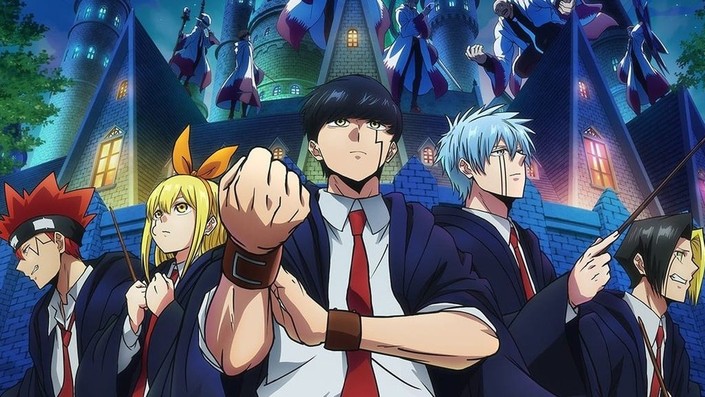
From an artistic perspective, Magic and Muscles exhibits a highly functional visual style that directly serves the work’s narrative and ideological intentions. Hajime Komoto’s art does not pursue ornamental detail or maximalist backgrounds, but instead focuses on bodily form, movement, and expression. This approach emphasizes the contrast between raw physical strength and ornate magical displays, producing a visual effect aligned with the manga’s satirical spirit.
Panel composition in Magic and Muscles tends toward simplicity and rapid pacing, with minimal reliance on technically elaborate spreads. Instead, the manga prioritizes immediacy and readability. This restraint helps maintain narrative momentum while accentuating climactic moments in which the rules of the magical world are subverted through seemingly irrational actions.
4.2. Innovation within the Fantasy – Magic Academy Motif
One of the most significant contributions of Magic and Muscles lies in its renewal of the fantasy magic academy motif, which has become increasingly formulaic in Japanese manga and light novels. Rather than expanding the magical system into greater complexity, Hajime Komoto adopts an inverse strategy: simplifying the magical world to highlight its authoritarian tendencies.
By placing a non-magical protagonist at the center of the academy, Magic and Muscles transforms the elite training institution into a microcosm of social stratification. This enables the manga to use a familiar setting as a platform for explicit critique, demonstrating the potential of reusing established motifs as analytical tools rather than merely replicating successful formulas.
4.3. Ideological Value within Popular Manga
At the ideological level, Magic and Muscles affirms that popular manga can function as a medium for addressing complex social issues without forfeiting entertainment value. While humor and action serve as the external layer, the internal structure engages themes of inequality, social norms, and mechanisms of exclusion.
Notably, the manga avoids a tragic tone, opting instead for lightness and absurdity. This choice broadens its audience while enabling multiple modes of reading: casual readers may enjoy it as pure entertainment, whereas critical readers can extract deeper social meanings embedded within the narrative form.
4.4. Influence on Readers and the Manga Market
In terms of reception, Magic and Muscles quickly established a strong presence within the readership due to its clear central concept and consistent execution. It appeals to younger readers through fast pacing, humor, and expectation-subverting battles, while also attracting older readers interested in ideological depth within shōnen manga.
Its commercial success indicates a growing demand for works that challenge established formulas while retaining mass accessibility. This, in turn, exerts indirect influence on the industry, encouraging emerging mangaka to experiment with alternative narrative strategies, particularly within well-defined genres.
4.5. Position within Contemporary Manga Development
Within the broader trajectory of modern Japanese manga, Magic and Muscles can be regarded as a transitional work. It neither entirely dismantles traditional shōnen structures nor mechanically reproduces them. Instead, it demonstrates the genre’s adaptability in response to changing reader expectations and social contexts.
The long-term value of Magic and Muscles thus lies not only in its immediate popularity, but also in its contribution to expanding the expressive range of popular manga. The work illustrates that formal simplicity, when grounded in creative and critical thinking, can exert significant influence within a highly competitive cultural industry.
5. Conclusion
Magic and Muscles stands as a representative example of shōnen manga’s capacity for self-renewal in a context where the genre has reached saturation in motifs and structures. By placing a non-magical character at the center of a society that worships magic, the work establishes a coherent, compelling axis of conflict. Through this, Magic and Muscles transcends simple entertainment, creating space to interrogate foundational assumptions about strength, human value, and the operation of power.
Across the preceding analysis, it becomes evident that Magic and Muscles operates on multiple levels simultaneously. On the surface, it is a fast-paced action-comedy accessible to a broad readership. At a deeper level, however, it articulates a system of social critique, exposing the injustice of hierarchical structures based on innate ability and the exclusion of difference. The use of humor and exaggeration does not dilute this depth; rather, it enhances the clarity and flexibility of the message.
From a genre perspective, Magic and Muscles demonstrates a noteworthy direction: it does not abandon traditional shōnen tropes, but actively deconstructs them to generate new interpretive possibilities. Strength is no longer framed as supernatural privilege, but redefined as the product of discipline, effort, and will. This approach preserves familiarity while offering a refreshed reading experience.
In the landscape of contemporary manga, Magic and Muscles functions as a bridge between popular entertainment and critical thought. Its success lies not merely in its popularity, but in its capacity to stimulate discussion of universal social issues through an accessible narrative form. This affirms the potential of manga as a cultural medium capable of reflecting and questioning reality, even within the confines of entertainment.In conclusion, Magic and Muscles is not only a distinctive action – comedy manga, but also a compelling case study in modern manga reception and criticism. The work demonstrates that when built upon a solid central concept and executed with consistency, popular manga