In the history of contemporary popular culture, few works that originate from manga and video games have managed to transcend the boundaries of pure entertainment to become global icons closely associated with multiple generations of readers and audiences. Pokemon stands as one of the most representative examples of this phenomenon. Since its emergence at the end of the twentieth century, Pokemon has not merely existed as a popular manga, anime, or game series, but has evolved into a fully realized fictional world in which values such as friendship, personal growth, the spirit of exploration, and a harmonious relationship between humans and nature are conveyed in a consistent and accessible manner.
The enduring appeal of Pokemon does not stem from intense dramatic conflicts or complex philosophical constructs, but rather from its construction of a familiar yet evocative journey: the journey of young individuals leaving their point of origin, confronting challenges and failures, learning through experience, and gradually perfecting themselves. As a result, the world of Pokemon is both highly entertaining and reflective of universal principles of personal development, enabling the work to connect with audiences of different ages and cultural backgrounds.
From the perspective of a writer, a reader, and a professional comics critic, Pokemon can be regarded as compelling evidence of the potential of manga and popular entertainment media to convey lasting humanistic values. Through its straightforward narrative style, approachable visual design, and carefully structured world-building, Pokemon has created a fictional space expansive enough to nurture curiosity, encourage learning, and foster a sense of communal connection. These elements have allowed Pokemon not only to exist as a product of its time, but also to become part of the shared cultural memory of multiple generations worldwide.
1. Introduction to the Creator and the Work Pokemon
Pokemon is one of the most globally influential manga and entertainment franchises originating from Japan. The work was created by Satoshi Tajiri, a Japanese game designer and creative director, who is also the founder of Game Freak. Pokemon was first introduced to the public in 1996 in the form of the video games Pocket Monsters Red & Green for the Game Boy, published by Nintendo.

The core concept of Pokemon originated from Satoshi Tajiri’s childhood memories of collecting insects – a common pastime among Japanese children before rapid urbanization significantly reduced natural play environments. As natural spaces gradually disappeared, Tajiri sought to recreate the experience of “exploration, collection, and exchange” within a digital medium. From this idea emerged the concept of Pokemon: mysterious creatures that humans can encounter in nature, capture, train, and develop through long-term companionship.
From its initial foundation as a video game, Pokemon quickly expanded into a multimedia project (media mix), a characteristic model of the Japanese entertainment industry. In 1997, the Pokemon anime series premiered on television, marking a major turning point in bringing the franchise to a global audience. The central character of the anime is Satoshi (internationally known as Ash Ketchum), a young boy who aspires to become a Pokemon Master through a journey of travel, competition, and personal growth.
Alongside the anime, Pokemon manga was developed in multiple versions to cater to diverse readerships. Among these, Pokémon Adventures (also known as Pokémon Special) stands out for its narrative depth. Unlike the lighter, linear tone of the anime, Pokémon Adventures explores the Pokemon world in a more serious manner, featuring complex storylines, strategically driven battles, and characters with greater psychological complexity.
In terms of authorship, Pokemon is not the product of a single individual, but rather the result of close collaboration across multiple creative fields, including game design, screenwriting, comics, animation, and brand development. Nevertheless, Satoshi Tajiri’s original vision remains foundational – particularly the idea that Pokemon are not merely tools for combat, but beings that form meaningful bonds with humans.
After more than two decades of development, Pokemon has continuously renewed itself through new generations of games, regions, characters, and Pokemon systems, while preserving its core identity: the spirit of exploration, connection, and growth through experience. This ideological stability, combined with adaptive flexibility, has enabled Pokemon to maintain a leading position in the comics and entertainment industry, becoming one of the most valuable franchises in the history of modern popular culture.
2. Summary of the Plot of Pokemon
The narrative of Pokemon unfolds within a fictional world where humans and Pokemon coexist in a long-standing, interconnected relationship. Pokemon are creatures endowed with special abilities, diverse in species, elemental attributes, and evolutionary potential. They do not merely appear as objects to be captured by humans, but occupy a central role in the social, economic, and cultural structures of the Pokemon world – from competitive sports tournaments and scientific research systems to everyday life.
The primary narrative arc of Pokemon, particularly in its globally popular anime version, revolves around the journey of Ash Ketchum, a young boy from Pallet Town. From the outset, Ash is placed in an imperfect situation: arriving late on the day he is supposed to receive his first Pokemon, he is compelled to partner with Pikachu, a strong-willed and difficult-to-control Pokemon. The initially conflict-ridden relationship between Ash and Pikachu gradually evolves into a strong bond, becoming a representative model of Pokemon’s core philosophy: true strength is built on understanding and mutual trust.
Throughout his travels across different regions, Ash participates in the Pokemon Gym system, where Gym Leaders represent distinct levels of skill, strategic thinking, and training philosophies. Collecting Gym Badges serves not only as proof of battle capability, but also as a process of learning and refining strategic judgment. Each battle in Pokemon therefore goes beyond mere displays of power, reflecting adaptability, creativity, and the ability to unlock the potential of both the trainer and the Pokemon.
Parallel to Ash’s personal development is the recurring presence of opposing forces, most notably Team Rocket. This antagonistic group represents a fundamentally flawed approach to Pokemon – treating them as tools for exploitation and personal gain. The contrast between Ash’s ideals and Team Rocket’s actions establishes a moral axis that runs throughout the narrative, allowing Pokemon to transcend simple adventure storytelling and raise questions about control, responsibility, and respect for other beings.
In expanded versions of the franchise, particularly the manga Pokémon Adventures, the storyline is developed in a more serious and multilayered direction. Characters are confronted with large-scale threats involving ecological imbalance, the abuse of Legendary Pokemon’s power, and the consequences of extreme decisions. In this context, battles are no longer merely performative, but become critical nodes of ideological conflict, forcing characters to make ethically and strategically significant choices.
A key characteristic of Pokemon’s narrative is its open structure and capacity for continual renewal. Each new Pokemon generation introduces new regions, characters, and rule systems, while retaining the core framework of exploration, challenge, failure, and growth. As a result, Pokemon remains fresh without losing its identity, allowing readers and viewers to engage with the franchise at any point without requiring comprehensive knowledge of its entire history.
Overall, the plot of Pokemon does not aim for momentary dramatic climaxes, but is constructed as a long-term narrative flow in which the value of the journey outweighs the destination. This approach to storytelling has enabled Pokemon to become a fictional world of depth, capable of accompanying multiple generations of audiences over time.
3. Themes and Ideology in Pokemon
Beyond its construction as an adventure-driven entertainment world, Pokemon possesses a coherent system of themes and ideological foundations that underpin its entire narrative structure. Through the journeys of Pokemon trainers and the relationships between humans and Pokemon, the work gradually explores universal issues such as personal growth, moral responsibility, cooperation, and humanity’s relationship with nature.

3.1 Companionship Between Humans and Pokemon
The central theme of Pokemon lies in its definition of the human–Pokemon relationship not as one of ownership, but of companionship and cooperation. In the Pokemon world, strength is not determined solely by innate ability or level, but by the degree of understanding, trust, and coordination between trainer and Pokemon.
This approach creates a clear contrast with characters and organizations that treat Pokemon as mere tools, thereby highlighting the moral stance of the work. Pokemon thus presents a relational model based on mutual responsibility: humans are obliged to care for, protect, and respect Pokemon, while Pokemon willingly contribute their abilities within a bonded partnership.
3.2 Personal Growth and Continuous Learning
Pokemon is structured as an extended coming-of-age journey, in which main characters continuously confront failure, limitation, and personal error. Losses, poor decisions, and overconfidence are not quickly erased, but become integral components of accumulated experience.
The core message conveyed here is that competence and success are not instantaneous outcomes, but the result of persistent effort and self-adjustment. Pokemon emphasizes the role of practical experience, thereby shaping a constructive mindset toward learning through challenge – an educational value conveyed without overt didacticism.
3.3 Healthy Competition and Ethical Combat
Another important theme in Pokemon is its approach to competition as a catalyst for development rather than a means of exclusion. Pokemon tournaments, Gym systems, and battles are organized according to clear rules, emphasizing respect for opponents and acceptance of outcomes.
In many cases, victory is not presented as the sole measure of personal worth. Instead, Pokemon places emphasis on preparation, strategy, teamwork, and how characters respond to failure. This conveys a constructive concept of competition aligned with modern educational and social values.
3.4 Biodiversity and Ecological Balance
The Pokemon world is designed as a rich ecosystem, where each Pokemon species represents specific natural characteristics, elemental attributes, or habitats. This design not only enhances visual diversity and strategic depth, but also conveys an underlying ideology of ecological balance.
Many narrative arcs in Pokemon revolve around the consequences of humanity’s attempts to control or excessively exploit Pokemon power, particularly that of Legendary Pokemon associated with natural order. Through these stories, the work implicitly warns of the repercussions of disrupting environmental balance and emphasizes human responsibility toward the natural world.
3.5 Connection and Community
From its original concept, Pokemon has been built around the idea of connection – from trading Pokemon in video games to forming global communities of players and fans. Within the narrative, friendships, partnerships, and rivalries play crucial roles in driving character development.
This ideology reflects the belief that personal growth cannot be separated from community. Pokemon therefore does not promote absolute individualism, but underscores the value of cooperation, exchange, and mutual learning within a broad network of relationships.
4. Value and Influence of Pokemon
After more than two decades of formation and development, Pokemon is no longer viewed merely as a manga or animated series for children, but as a global popular culture phenomenon. Its value manifests across multiple dimensions, from ideological content and educational impact to profound influence on the modern comics and entertainment industry.
4.1 Cultural Value and Longevity
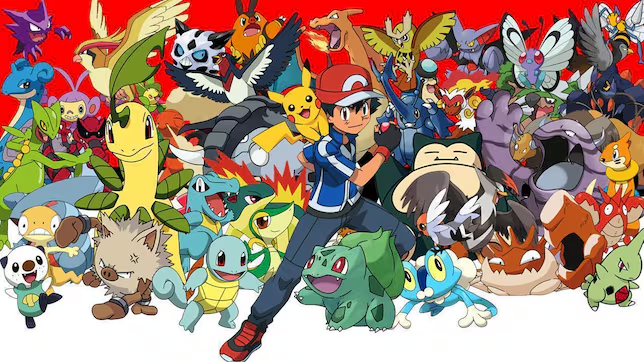
One of Pokemon’s most notable strengths is its ability to maintain long-term vitality across generations. In an entertainment landscape characterized by rapidly shifting trends, Pokemon has preserved its relevance through a stable system of timeless core values: exploration, connection, perseverance, and personal responsibility.
At the same time, Pokemon clearly demonstrates how Japanese culture is transmitted globally through popular media. Elements such as discipline, respect for rules, communal awareness, and harmony with nature are seamlessly integrated into the narrative, allowing Pokemon to retain national identity while remaining universally accessible across cultures.
4.2 Educational Value and Impact on Youth Perception
From an educational perspective, Pokemon offers numerous positive contributions through its content organization and gameplay mechanics. Training Pokemon requires understanding strengths, weaknesses, coordination, and strategic planning, thereby fostering analytical thinking and decision-making skills.
Additionally, Pokemon helps shape awareness of ethical competition, emphasizing fairness, respect for opponents, and acceptance of failure as an inevitable part of learning. These values are consistently conveyed across manga, anime, and video games, making Pokemon an effective form of indirect education for younger audiences.
4.3 Influence on the Comics and Entertainment Industry
Pokemon stands as one of the most successful examples of Japan’s media mix model. The close integration of video games, manga, anime, trading cards, and cinema has created a comprehensive entertainment ecosystem in which each component functions independently while reinforcing the others.
This model has not only generated exceptional commercial success, but has also profoundly influenced how subsequent entertainment franchises are conceived and developed. Many later manga and anime series have adopted Pokemon’s approach to world expansion, fan community building, and sustained engagement through continual content renewal.
4.4 Social Impact and the Formation of a Global Community
Pokemon’s influence extends beyond narrative content to its social and communal impact. The franchise has cultivated a global fan network in which interaction, exchange, competition, and collection serve as bridges connecting individuals across age groups and national boundaries.
The spirit of connection – central to Pokemon’s original concept – is realized through events, tournaments, and online platforms, reinforcing community identity and long-term fan engagement. As a result, Pokemon exists not merely as a consumer product, but as a shared cultural space in which values of cooperation and sharing are continually reinforced.
4.5 The Position of Pokemon in Modern Popular Culture
Viewed holistically, Pokemon has transcended the boundaries of conventional entertainment to become a symbol of modern popular culture. Its presence in social life – from media and education to communal recreational activities – demonstrates the franchise’s deep and enduring influence.
With its ability to adapt flexibly to technological advancements and changing audience preferences while preserving a stable value foundation, Pokemon continues to play a significant role in shaping how people engage with and evaluate comics and entertainment products in the era of globalization.

5. Conclusion
From a literary and comics criticism perspective, Pokemon can be regarded as a representative example of the capacity of popular entertainment works to generate lasting value. Rather than relying on extreme dramatic conflicts or complex philosophical depth, Pokemon constructs its appeal through a stable narrative system, a well-organized fictional world, and universally resonant themes that are accessible without being superficial.
Throughout its development, Pokemon has maintained ideological consistency: emphasizing companionship between humans and Pokemon, valuing growth through experience, and highlighting individual responsibility within a broader community. This consistency has enabled Pokemon to transcend the limitations of trend-driven entertainment and evolve into a cultural symbol capable of long-term adaptation.
On a broader scale, Pokemon has not only contributed to the development of Japanese manga and animation, but has also shaped how modern entertainment franchises are conceptualized and managed. Its media mix strategy, community-building capacity, and controlled yet continuous world expansion have established a new benchmark for the global entertainment industry.
In sum, Pokemon deserves recognition as a popular culture phenomenon of enduring significance – one in which entertainment and education are harmoniously integrated within a sustainable narrative framework. On this foundation, Pokemon continues not only to occupy an important place in the collective memory of multiple generations, but also to reaffirm its status as a defining symbol of contemporary Japanese comics and popular culture.