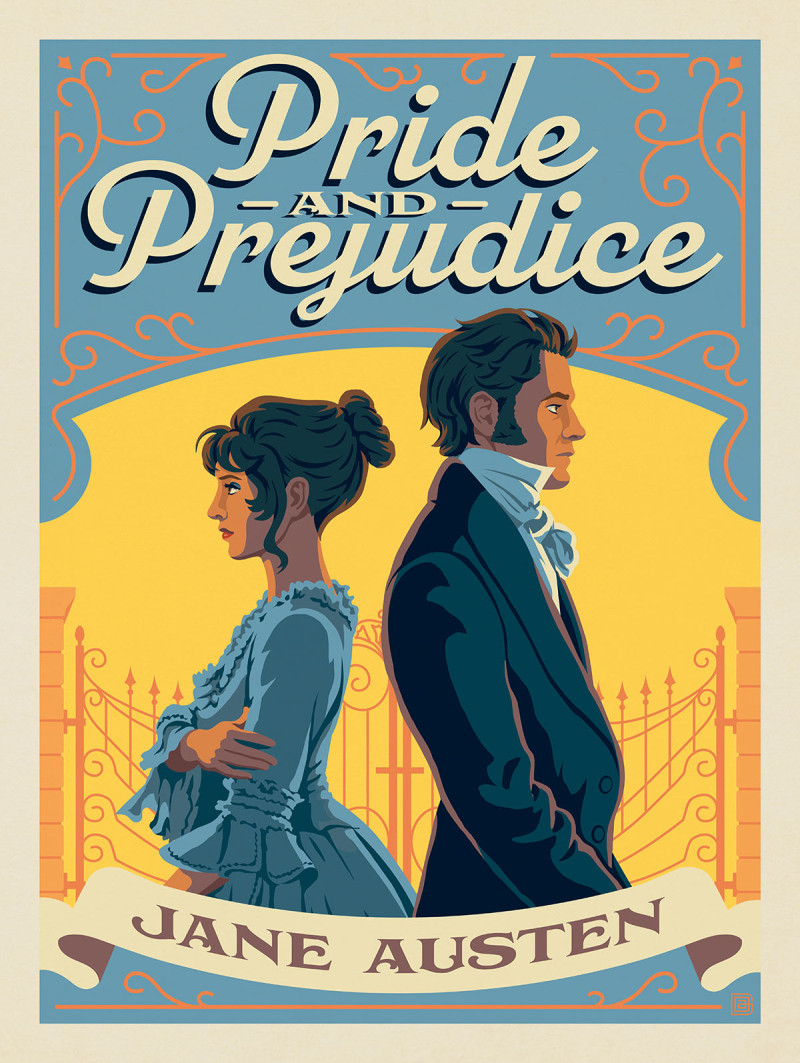
Within the current of nineteenth-century English literature, Pride and Prejudice is remembered not only as a classic love novel, but also as a refined examination of society, human nature, and the invisible constraints that govern individual lives. Under the calm yet incisive pen of Jane Austen, stories that appear entirely ordinary – balls, social visits, and family gossip – become spaces in which class prejudice, personal pride, and the desire for mutual understanding are quietly laid bare.
What distinguishes Pride and Prejudice is that its appeal does not stem from dramatic tension or tragic intensity, but from a subtle evolution of perception. Love in the novel does not arise from immediate infatuation; rather, it is formed through friction, misunderstanding, and self-reflection. It is precisely through this process that individuals are compelled to confront their own limitations and to reassess judgments once assumed to be self-evident.
Beyond the framework of a romantic narrative, Pride and Prejudice opens a profound discourse on marriage, social status, and the right to choose one’s own happiness. Through a tone of gentle yet deliberate irony, Jane Austen does not merely tell a love story, but poses enduring questions about how people perceive one another – and about the cost of allowing pride and prejudice to dominate reason.
1. Introduction to the Author and the Work
Pride and Prejudice is one of Jane Austen’s most representative and influential novels, and a cornerstone of early nineteenth – century English literature. Jane Austen was born in 1775 in Steventon, Hampshire, into a middle – class family with a strong educational foundation and a rich intellectual life. Her father, a clergyman, owned a substantial personal library, which allowed Austen access to classical literature, contemporary novels, and works of philosophy and history – elements that profoundly shaped her thinking and literary style.
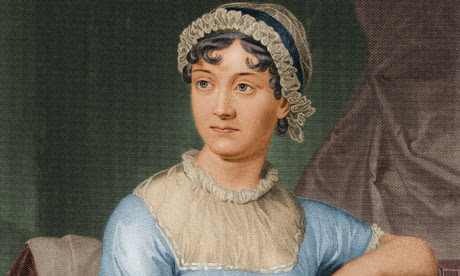
Austen came of age in a society undergoing significant transformation, where class boundaries remained rigid, particularly in matters of marriage, inheritance, and social standing. Women at the time had limited economic independence, making marriage the primary means of securing stability and security. This reality became the central material for Austen’s fiction, with Pride and Prejudice serving as its most emblematic example.
The novel was initially written under the title First Impressions around 1797, when Jane Austen was in her early twenties. However, it was not until 1813 that the work was revised and officially published under the title Pride and Prejudice. Upon its release, the novel received immediate positive attention for its intelligent narration, subtle irony, and vivid character construction. Unlike many contemporary novels that leaned toward emotional excess or idealized romance, Pride and Prejudice approached marriage with a sober, realistic, and socially critical perspective.
Throughout her brief life, Jane Austen published only six novels, most of which are now regarded as classics of English literature, including Sense and Sensibility, Mansfield Park, Emma, and Persuasion. A common feature of her works is their focus on the everyday social world of the rural middle class, where seemingly trivial conversations reveal deeper structures of power, moral standards, and social psychology.
In Pride and Prejudice, Austen’s talent is most evident in her keen observation and disciplined psychological analysis. She avoids overt moral judgments, allowing characters to reveal their true nature through speech, behavior, and personal missteps. This approach enables the novel to transcend its historical context, becoming a work of universal relevance that continues to engage readers across generations.
It can be said that Pride and Prejudice is not only Jane Austen’s greatest achievement, but also a significant milestone in the development of the English realist novel – where literature moves beyond storytelling to become a subtle yet enduring instrument for social and human analysis.
2. Summary of the Plot
Pride and Prejudice is set in early nineteenth – century England and centers on the lives of the rural middle class, where marriage is not merely a matter of personal affection but a complex social and economic calculation. The narrative focuses on the Bennet family, who have five daughters but no male heir, leaving their future uncertain in a society governed by strict inheritance laws and social hierarchy.
Mrs. Bennet, constantly anxious about her daughters’ security, prioritizes marrying them to wealthy men. In contrast stands Mr. Bennet, a calm and intelligent father who is, to some extent, detached from his familial responsibilities. Within this context, Elizabeth Bennet – the second daughter – emerges as the central character: intelligent, independent-minded, and possessed of strong self-respect, unwilling to be easily shaped by conventional social expectations.
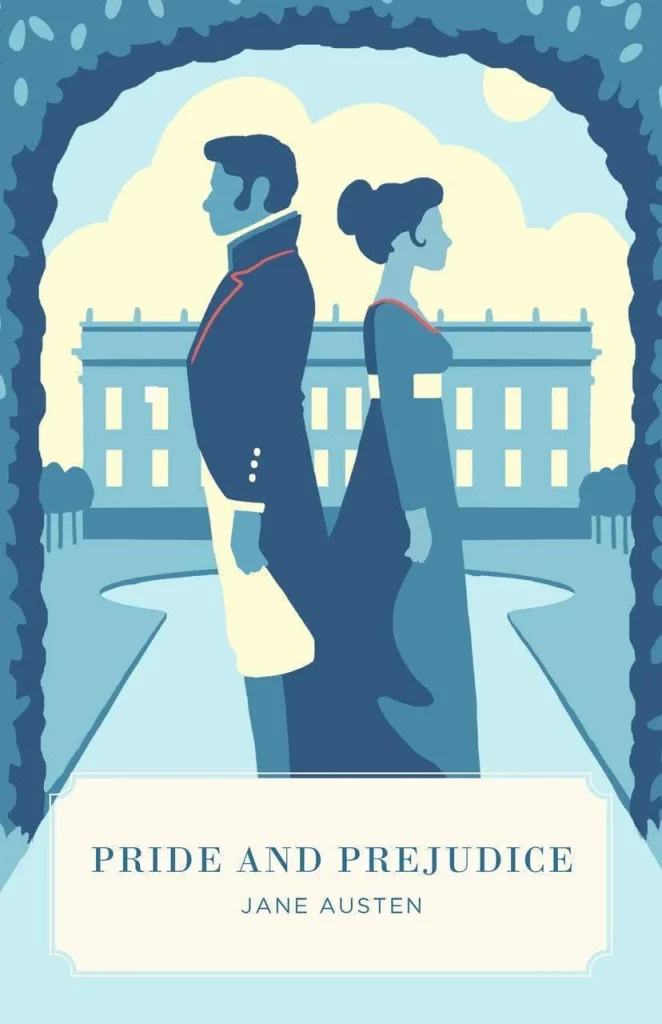
The story’s first major development occurs when Charles Bingley, a young and affluent gentleman, moves into the neighborhood at Netherfield. His arrival quickly captures the attention of local society, particularly the Bennet family. Accompanying Bingley is his close friend Fitzwilliam Darcy, a man of even greater wealth, whose reserved and seemingly arrogant demeanor leaves an unfavorable impression.
At the first ball, Darcy offends Elizabeth by appearing dismissive of those around him and indirectly insulting her. From that moment, Elizabeth forms a negative view of Darcy, seeing him as the embodiment of class-based arrogance. Darcy, in turn, initially looks down on Elizabeth, considering her socially inferior, despite gradually becoming drawn to her intelligence and character.
Running parallel to this tension is the gentle romance between Jane Bennet, Elizabeth’s elder sister, and Bingley. However, their relationship is disrupted when Darcy and Bingley’s social circle conclude that Jane lacks strong affection and that the Bennet family is socially unsuitable. This intervention leads Bingley to leave Netherfield, leaving Jane quietly heartbroken.
The plot becomes more complex with the arrival of George Wickham, a charming and articulate officer who quickly wins Elizabeth’s trust. Through Wickham’s carefully constructed narrative, Darcy is portrayed as unjust and cruel. Elizabeth, already influenced by her own prejudice, readily accepts this account without skepticism.
The novel reaches its climax when Darcy unexpectedly proposes to Elizabeth. Rather than being romantic, the proposal exposes his acute awareness of class barriers and his reluctance to overcome them, prompting Elizabeth to reject him decisively. This confrontation represents not merely the collapse of a potential relationship, but a direct collision between two strong personalities, each convinced of their own righteousness.
Following this, Darcy writes Elizabeth a lengthy letter explaining the truth about Wickham and his reasons for interfering in Bingley and Jane’s relationship. The letter becomes a turning point, forcing Elizabeth to confront her own flawed judgments. It marks the moment when “prejudice” begins to unravel.
From this point onward, Darcy changes not through words, but through actions. He quietly assists the Bennet family when the youngest daughter, Lydia, becomes entangled in a serious scandal with Wickham – an incident that threatens the family’s reputation. Darcy resolves the matter discreetly, seeking no recognition, demonstrating a maturity and humility previously unseen.
As Elizabeth reflects and observes, she begins to view Darcy differently. Her initial prejudices dissolve, giving way to understanding and respect. When the two meet again under new circumstances, both have changed – no longer governed by pride or preconception.
The novel concludes with two marriages: Jane and Bingley, Elizabeth and Darcy. These unions are not merely conventional happy endings, but the result of profound inner growth. In Pride and Prejudice, marriage is no longer a social compromise or a matter of chance, but a conscious choice grounded in understanding, respect, and spiritual equality.
3. Thematic and Artistic Value
The enduring value of Pride and Prejudice lies foremost in its redefinition of marriage within early nineteenth – century English society. Jane Austen neither idealizes love as pure emotion nor reduces marriage to social obligation. Instead, she situates it at the intersection of personal affection, economic conditions, and class conventions, revealing the subtle yet persistent tensions that shape human life.
Within the novel, marriage functions as both a personal choice and a social strategy. Female characters – particularly those without inherited wealth – must navigate the conflict between material security and emotional fulfillment. What elevates Pride and Prejudice above many contemporary works is Austen’s refusal to accept marriage as a mere compromise. Through Elizabeth Bennet’s journey, the novel affirms that marriage holds true value only when founded on intellectual respect, empathy, and mutual understanding.
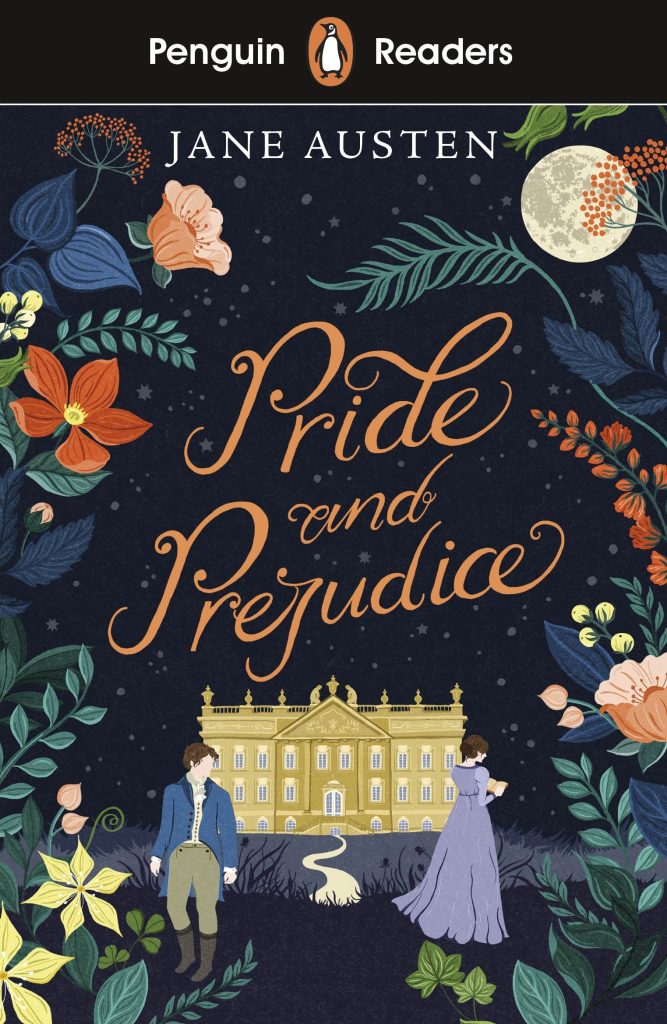
The themes of “pride” and “prejudice” operate as parallel obstacles in the process of self-awareness. Darcy’s pride arises from his class consciousness and social position, while Elizabeth’s prejudice stems from first impressions and wounded dignity. Notably, Austen assigns blame to neither party exclusively. Both characters err, and these errors become essential conditions for their growth. Thus, the novel is not simply a love story, but a narrative of self-recognition – where one must first confront oneself before understanding others.
On a social level, Pride and Prejudice offers a subtle yet incisive critique of England’s class structure. Austen does not openly condemn social stratification; instead, through minor interactions – judgments made at balls, during visits, or in attitudes toward the Bennet family – she exposes the rigidity and absurdity of accepted norms. Characters such as Lady Catherine de Bourgh embody inflexible social authority, standing in contrast to Elizabeth’s independent and adaptive mindset.
Artistically, the novel is distinguished by its restrained narration and measured pacing. Austen employs a flexible narrative perspective that grants access to characters’ inner worlds without resorting to lengthy monologues. Dialogue serves not only to advance the plot but also as the primary means of character development and conflict revelation. Every exchange carries clear social and psychological function.
Irony is among the novel’s most defining artistic techniques. However, Austen’s irony is not harsh or caustic; it is composed, intellectual, and controlled. This narrative voice enables the novel to balance social critique with accessibility, and philosophical depth with broad appeal.
Another crucial value of Pride and Prejudice lies in its universality. Though firmly rooted in a specific historical context, the issues it addresses – prejudice, ego, and the fallibility of judgment – remain relevant today. This ability to transcend time and place accounts for the novel’s enduring vitality and continual reinterpretation.
Taken as a whole, Pride and Prejudice is not merely a successful romantic novel, but a literary work of significant intellectual and artistic merit. Through careful observation and restrained expression, Jane Austen created a text that is both intimate and profound, deeply rooted in its era yet unmistakably timeless.
4. Notable Quotations
One of the reasons Pride and Prejudice has maintained its enduring presence in literary history lies in its precise, concise, and subtly ironic language. Jane Austen avoids ornate expression, favoring restraint, where each utterance contains layered social and psychological meaning. The following quotations not only reflect character traits but also distill the novel’s central concerns.
- “It is a truth universally acknowledged, that a single man in possession of a good fortune, must be in want of a wife.”
→ This famous opening line functions as both declaration and irony. Austen immediately situates the reader within a society where marriage is governed by wealth and status, subtly critiquing the way such assumptions are normalized as “universal truths.” - “Vanity and pride are different things, though the words are often used synonymously.”
→ This quotation reveals the novel’s philosophical depth, distinguishing self-respect from empty vanity and suggesting that the true problem lies not in pride itself, but in how it is used to judge others. - “I cannot fix on the hour, or the spot, or the look or the words, which laid the foundation.”
→ This line rejects the notion of love as a moment of destiny. In Pride and Prejudice, love develops gradually through experience, reflection, and internal change, reflecting Austen’s rational and realistic worldview. - “Till this moment, I never knew myself.”
→ A pivotal statement marking the character’s recognition of personal fallibility. It underscores self-awareness as a prerequisite for maturity. - “Angry people are not always wise.”
→ A concise yet insightful observation, highlighting how unchecked emotion can distort reason and lead to unjust judgments. - “There is a stubbornness about me that never can bear to be frightened at the will of others.”
→ This quote captures Elizabeth Bennet’s independence and self-respect, serving as an implicit declaration of the novel’s advocacy for personal autonomy. - “Think only of the past as its remembrance gives you pleasure.”
→ Austen does not deny the past’s importance, but emphasizes selective remembrance – valuing memory only when it fosters growth rather than burden. - “One does not love a place the less for having suffered in it.”
→ A philosophically rich statement suggesting that pain deepens, rather than diminishes, emotional attachment. - “Happiness in marriage is entirely a matter of chance.”
→ This assertion reflects contemporary social attitudes while simultaneously challenging them, implying that lasting happiness requires conscious choice and understanding.
Viewed collectively, these quotations do not exist as isolated “beautiful lines,” but as integral components of the novel’s intellectual structure. Each contributes to the central theme: humans are prone to flawed judgment, yet capable of correction through reflection and growth.
5. Conclusion
Pride and Prejudice stands as a compelling demonstration of literature’s capacity to reflect society through seemingly ordinary narratives. Without reliance on tragedy or dramatic climax, the novel captivates readers through the steady and resilient process of character development, in which pride and prejudice are gradually dismantled through experience, error, and self-examination.
The novel’s greatest achievement lies in its rare balance between intellectual depth and refined expression. Jane Austen neither imposes moral conclusions nor idealizes love; instead, she allows relationships to reveal their nature within a defined social framework. Marriage thus emerges not as a romantic endpoint, but as the result of understanding, respect, and inner maturity.
From a broader perspective, Pride and Prejudice transcends the boundaries of a classic romance to become a rich exploration of human judgment. The issues it raises – hasty assumptions, the power of prejudice, and the capacity for personal change – remain strikingly relevant in contemporary life. Through the integration of intellect, humanism, and restrained storytelling, Jane Austen ensured the novel’s enduring relevance and its rightful place in world literary history.