For many decades, the path toward a stable life has often been defined by a familiar formula: study diligently, obtain high academic qualifications, secure a safe job, and work continuously until retirement. This model was once considered a reasonable and reliable choice, particularly within the framework of a traditional economy. However, as society enters an era of rapid change, alongside the expansion of financial markets, business, and investment, this conventional formula has gradually revealed its limitations. Stable income no longer guarantees financial security, and hard work alone does not always ensure a sustainable future.
It is precisely within this context that Rich Dad Poor Dad emerges as a work that seeks to “reframe the problem” rather than provide ready-made answers. The book does not focus on explaining how to earn a large amount of money; instead, it delves into a more fundamental question: how should people think about money. Rather than encouraging the pursuit of income alone, the work directs readers toward understanding the nature of assets, cash flow, and the role of financial education in modern life.
Through its comparative approach based on the image of “two fathers,” Rich Dad Poor Dad opens up a new perspective on success and wealth. In this framework, money is not merely an end goal, but a tool that reflects how individuals think, make choices, and take responsibility for their own futures. This shift in focus—from “making money” to “thinking about money” – has enabled Rich Dad Poor Dad to move beyond the boundaries of an ordinary personal finance book and become a work with lasting influence on the thinking of generations of readers worldwide.
1. Introduction to the Author and the Work
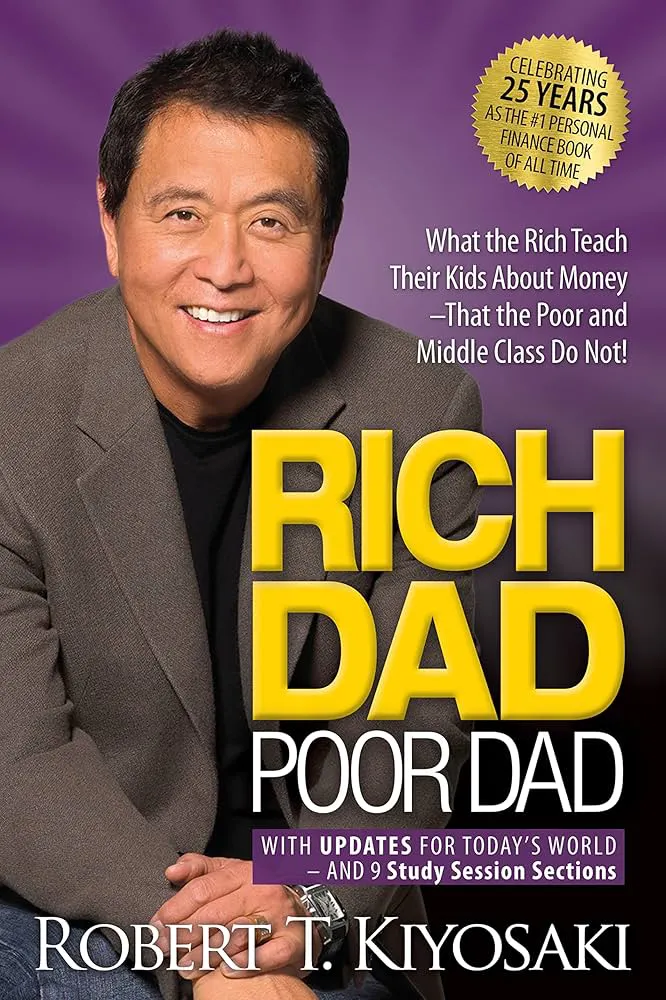
Rich Dad Poor Dad is the most representative work of Robert T. Kiyosaki, a globally influential entrepreneur, investor, speaker, and author in the field of personal finance. Born in 1947 in Honolulu, Hawaii, Robert Kiyosaki grew up in a middle-class family where formal education and a stable career were regarded as the ideal path to a secure future. His biological father was a senior official in the education sector, firmly believing in academic degrees, safe employment, and the traditional salary-based system.

A major turning point in Robert Kiyosaki’s thinking came from his relationship with the family of his childhood best friend, whose father he refers to as his “rich dad.” In stark contrast to his own father, this man did not possess high academic qualifications but had extensive practical business experience and the ability to build independent wealth. The simultaneous presence of these two educational models – one representing traditional financial thinking, the other representing proactive financial thinking – formed the ideological foundation that runs throughout Rich Dad Poor Dad.
The book was first published in 1997, at a time when the U.S. and global economies were undergoing profound changes: financial markets were expanding, personal investing was gaining momentum, and the concept of financial freedom was beginning to attract widespread attention. From its initial release, Rich Dad Poor Dad sparked considerable debate, as it questioned values that had long been considered “correct” in education and career development. Rather than encouraging young people to pursue stability, Robert Kiyosaki emphasized independent thinking, the willingness to accept risk, and financial literacy.
In terms of genre, Rich Dad Poor Dad is not a textbook on finance or investment, but a hybrid of memoir, mindset literature, and personal financial education. The author does not present specific wealth-building formulas or detailed investment strategies; instead, he focuses on constructing a system of foundational concepts such as assets, liabilities, cash flow, financial leverage, and financial intelligence. This approach allows the work to retain long-term relevance, without being overly dependent on the economic context of a particular period.
Another notable feature of Rich Dad Poor Dad is its narrative style. Robert Kiyosaki adopts storytelling, dialogue, and comparison rather than dense academic analysis. The use of the “two fathers” motif functions not only as personal storytelling but also as a symbolic structure representing two parallel financial mindsets in modern society. As a result, financial concepts that are often abstract and difficult to grasp are conveyed in a vivid and accessible manner to a wide range of readers.
From an impact perspective, Rich Dad Poor Dad is widely regarded as one of the foundational works that helped shape the modern personal financial education genre. The book not only popularized basic financial concepts but also contributed to changing how society perceives the role of financial thinking in shaping career paths and life choices. This combination of personal experience, comparative reasoning, and consistent messaging has made Rich Dad Poor Dad an important reference for those interested in personal economics and long-term investing.
2. Summary of the Core Content
Rich Dad Poor Dad is not structured as a linear narrative in the conventional sense of a novel. Instead, it consists of a series of experiences, lessons, and ideological dialogues centered on the formation of Robert Kiyosaki’s financial mindset. The central axis of the book lies in the contrast between two father figures – two fundamentally different views on money, work, and success in modern life.
From the opening chapters, Robert Kiyosaki places readers in the context of his childhood in Hawaii, where he grew up alongside a close friend whose father was a businessman. While Robert’s biological father – the “poor dad” – embodied traditional educational thinking, the “rich dad” represented a practical mindset oriented toward business and investment. The coexistence of these two educational approaches provides the foundation upon which the author develops the entire narrative.
The poor dad consistently emphasized the importance of formal education, high grades, academic credentials, and securing a stable job with a steady salary. Within this framework, money is seen as a reward for diligence and loyalty to one’s profession. In contrast, the rich dad did not focus on grades or degrees but instead asked questions about how money is created, how it operates, and how it grows. Rather than teaching “how to make money,” he taught “how money works.”
One of the central pillars of Rich Dad Poor Dad is its series of lessons surrounding the concepts of assets and liabilities. Through simple yet highly generalizable examples, the rich dad demonstrates that many people confuse owning valuable items with being truly wealthy. A large house, an expensive car, or a high income may create the appearance of success, but if they continuously cause cash to flow out, they are not assets in the financial sense. Assets, by contrast, are elements that generate income even when one is not actively working.
Building on this foundation, the book expands into discussions of cash flow and financial behavior. Robert Kiyosaki describes how poor and middle-class individuals often become trapped in a cycle of working, earning wages, spending, borrowing, and working even harder. Wealthy individuals, on the other hand, focus on building systems of assets that generate independent cash flow, gradually reducing their dependence on salaries. This difference is not merely about income levels but about personal financial structure.
Alongside lessons on assets, Rich Dad Poor Dad devotes significant attention to the role of financial education. The author argues that formal education systems primarily train people to become competent employees while failing to provide foundational knowledge about taxes, investing, business, and personal financial management. As a result, many highly educated individuals struggle to control their finances and achieve long-term financial independence.
Another important thematic thread in the book concerns the psychological factors influencing financial decisions. Robert Kiyosaki identifies fear (fear of failure, fear of losing money) and greed (the desire to get rich quickly) as two dominant forces shaping financial behavior. Through personal experiences and real-world observations, he suggests that the ability to manage emotions and accept calculated risks is essential to developing financial intelligence.
In its later chapters, Rich Dad Poor Dad clarifies the concept of financial intelligence as a skill that can be learned and developed. According to the rich dad, making mistakes, experiencing failure, and confronting challenges are not signs of incompetence but inevitable components of learning. It is through problem-solving and mindset adjustment that individuals gradually acquire the ability to make more effective financial decisions.
Overall, the content of Rich Dad Poor Dad does not aim to lead readers toward a specific destination of wealth. Instead, it focuses on constructing a framework of thinking. By placing two educational and financial models side by side, Robert Kiyosaki helps readers recognize the unconscious assumptions that shape how they work, spend, and plan for the future. This approach positions the book as a guide to mindset formation rather than a conventional wealth-building manual.
3. Content Value and Artistic Value
The core value of Rich Dad Poor Dad lies not in providing specific wealth-building strategies or time-bound investment formulas, but in its ability to restructure personal financial thinking. The book confronts readers with fundamental questions: how money operates in personal life, why many people work their entire lives without achieving financial independence, and what role education truly plays in preparing individuals for their economic future.
From a content perspective, Robert Kiyosaki performs a critical conceptual shift by separating income from wealth. In common thinking, high income is often equated with financial success. However, Rich Dad Poor Dad demonstrates that income is only one variable, while cash-flow structure is the determining factor. A high-income individual with uncontrolled spending may remain financially vulnerable, whereas someone with moderate income but stable income-generating assets can achieve long-term autonomy. This analysis has reshaped how many readers understand the notion of being “rich.”
Another significant contribution of Rich Dad Poor Dad is its emphasis on financial education as a life skill, rather than a supplementary competency. The book argues that traditional education systems focus on professional specialization while neglecting essential knowledge about taxation, investing, entrepreneurship, and financial risk management. This gap leaves many educated individuals ill-equipped to make sound financial decisions. Through the figure of the rich dad, Kiyosaki proposes an alternative educational model centered on real-world experience, learning from mistakes, and independent thinking.
The book also offers a nuanced examination of human psychology in relation to money. Rather than treating finance as a purely mathematical discipline, Rich Dad Poor Dad frames it as a domain heavily influenced by emotions and beliefs. Fear of failure, fear of loss, and an obsession with job security are identified as major barriers that keep people confined to familiar patterns. The book suggests that only by recognizing and managing these psychological responses can individuals make strategic, rather than reactive, financial decisions.
On a broader level, Rich Dad Poor Dad challenges traditional definitions of success. According to the book’s logic, success is not measured solely by social status or salary but by the degree of freedom one has in choosing how to live and work. This perspective is particularly relevant in a modern economy characterized by flexibility, multiple income streams, and evolving career models.
From an artistic standpoint, Rich Dad Poor Dad stands out for its comparative narrative structure. The use of the “rich dad” and “poor dad” figures serves not merely as personal storytelling but as a symbolic device representing two coexisting mindsets in society. This structure allows financial arguments to be presented through direct contrast, making differences easier to grasp and encouraging readers to reflect on their own assumptions.
Robert Kiyosaki’s language also contributes significantly to the book’s reach. His straightforward, accessible style avoids complex terminology, making Rich Dad Poor Dad approachable for a broad audience. This simplicity does not result in superficiality; rather, it enables abstract concepts such as cash flow, assets, and financial intelligence to be communicated clearly and memorably.
In summary, the content value of Rich Dad Poor Dad lies in its capacity to reshape personal financial thinking, while its artistic value is reflected in its comparative storytelling, clear structure, and accessible language. This combination of critical ideas and flexible presentation has allowed the book to transcend the boundaries of conventional finance literature and achieve lasting influence in the field of personal financial education.
4. Notable Quotations
One of the key factors behind the enduring influence of Rich Dad Poor Dad is its system of concise yet highly generalizable statements. These quotations are not merely motivational slogans; they function as conceptual propositions that help readers identify fundamental differences between financial mindsets. Through simple language, Robert Kiyosaki distills practical observations about money, labor, and education, creating cognitive reference points for reflection and real-life comparison.
1. “The poor and the middle class work for money. The rich have money work for them.”
→ This quotation represents the ideological core of Rich Dad Poor Dad, highlighting the contrast between wage dependency and asset-based cash flow.
2. “It’s not how much money you make, but how much money you keep.”
→ This statement emphasizes financial management and cash flow, challenging the belief that high income automatically leads to wealth.
3. “School teaches you how to work for others, but not how to work for yourself.”
→ This quotation reflects the author’s critique of traditional education for its lack of financial and entrepreneurial training.
4. “Assets put money in your pocket. Liabilities take money out of your pocket.”
→ One of the book’s most well-known definitions, simplifying the concept of assets and reshaping how ownership is evaluated.
5. “Fear is the main reason people work all their lives for money.”
→ This statement points to the psychological roots of financial dependency, particularly fear of risk and failure.
6. “Working hard is important, but knowing what you are working for is even more important.”
→ The quotation distinguishes between effort and purpose, emphasizing strategic direction in financial planning.
7. “The rich focus on opportunities. The poor focus on risks.”
→ This highlights the role of mindset in shaping financial decisions and responses to uncertainty.
8. “Financial intelligence is made up of solving money problems.”
→ The quotation reinforces the idea that financial capability is developed through experience and learning, not innate talent.
9. “The world rewards value, not hard work.”
→ This statement extends the discussion from personal finance to market economics, linking income to value creation rather than time spent.
10. “If you want to be rich, you must learn to make decisions when there is not enough information.”
→ This reflects the author’s view on uncertainty and risk as inherent components of investing and entrepreneurship.
5. Conclusion
Rich Dad Poor Dad is not merely a book about money, but a work that reexamines the foundational mindset through which people approach work, income, and financial education in modern society. Through the comparative structure of the “rich dad” and the “poor dad,” Robert Kiyosaki highlights the fundamental difference between working for money and building a proactive financial system capable of generating long – term cash flow.
Throughout the book, concepts such as assets, liabilities, cash flow, and financial intelligence are presented not as rigid theories but as guiding principles of thought. The greatest value of Rich Dad Poor Dad lies in its ability to help readers recognize unconscious assumptions shaped by traditional education, thereby opening a new perspective on success and economic stability. The book demonstrates that wealth is not determined solely by income level, but by how individuals manage money, accept risk, and invest in financial knowledge.
From an overall perspective, Rich Dad Poor Dad may not offer a concrete roadmap to short-term wealth, but it serves as a crucial cognitive foundation for those interested in financial freedom and long-term development. Through its accessible language, clear comparative structure, and consistent message, the book transcends the limits of conventional personal finance literature to become a valuable reference in shaping personal economic thinking.
In general, Rich Dad Poor Dad is well suited for readers seeking a shift in how they think about money and careers. Its value does not lie in promises of rapid success, but in its ability to introduce an alternative framework of thinking – one in which financial literacy, independent thought, and adaptability are regarded as essential elements for building a sustainable economic life amid ongoing change.