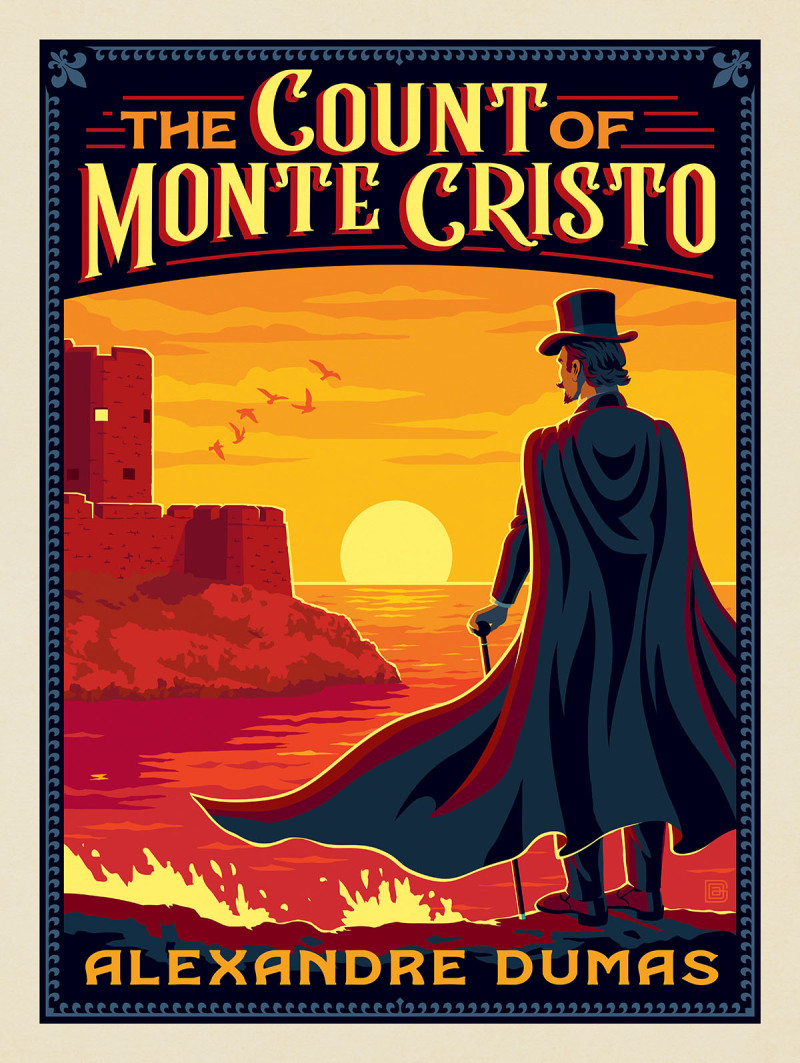
How much injustice can a person endure before believing that they have the right to become justice itself? The Count of Monte Cristo begins with that question, even though it never poses it explicitly. Edmond Dantès is stripped of his freedom, his future, and his honor not because of any crime he committed, but because of jealousy, cowardice, and cold political calculations. When the prison gates close behind him, it is not only one man who is imprisoned, but the very belief in a moral order governing society that collapses with him.
From this starting point, The Count of Monte Cristo does not tell a simple revenge story. Instead, it carefully constructs the gradual transformation of a human being confronted with absolute power. Edmond Dantès does not return to reclaim his past; he returns with a new identity, a sharpened intellect, and a plan calculated to near perfection. The enduring fascination of the novel lies in the fact that every victory carries an ethical question, and every act of punishment pushes the boundaries of cruelty a little further.
It is precisely this combination of narrative drama and philosophical depth that allows The Count of Monte Cristo to transcend the limits of a nineteenth-century adventure novel. The work compels readers not only to follow a character’s fate, but also to interrogate the fragile boundary between justice and vengeance – a problem that has never lost its relevance.
1. The Author and the Work
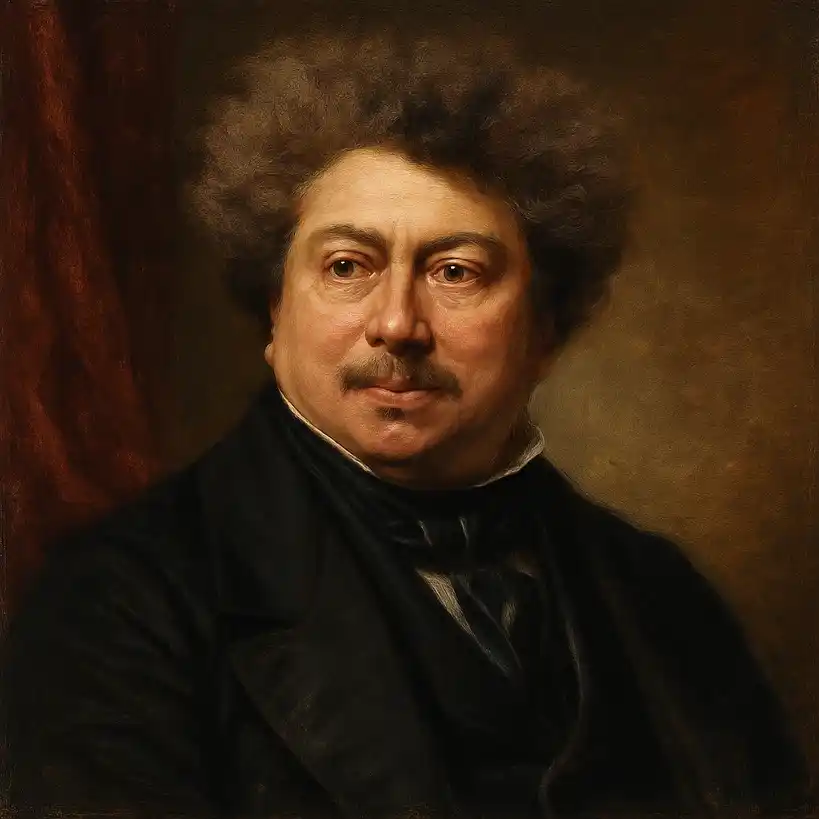
The Count of Monte Cristo is one of the most significant novels by Alexandre Dumas, a major representative of nineteenth-century French Romantic literature. Dumas was not a writer who pursued psychological gloom or formal experimentation. Instead, he possessed a rare storytelling talent: the ability to construct large-scale plots, maintain a gripping narrative rhythm, and weave together multiple character arcs while preserving clarity and accessibility for a broad readership.
Born in post-Revolutionary France and shaped by an era of political upheaval, Dumas was deeply influenced by contemporary history. His works often place individuals at moments where power, honor, and betrayal intersect. Yet the lasting vitality of his writing does not stem from historical accuracy alone, but from his ability to use history as a backdrop against which human nature is exposed and examined.
The Count of Monte Cristo was written and serialized between 1844 and 1846, during the height of the feuilleton tradition in France. This mode of publication required the author to sustain suspense, create continuous climaxes, and retain readers’ attention across installments. These demands directly shaped the novel’s distinctive structure: layered plotlines, interconnected events, and a narrative economy in which no detail is entirely superfluous.
The immediate inspiration for The Count of Monte Cristo is believed to have come from a real criminal case that Dumas encountered in police archives – a story of a man wrongfully imprisoned who later became wealthy and returned to exact revenge on those who had betrayed him. However, Dumas did not merely adapt a revenge tale. He expanded it into a sweeping novel in which Edmond Dantès’s personal journey unfolds alongside a broader portrait of a French society marked by political instability, legal corruption, and moral ambiguity.
Within Dumas’s body of work, The Count of Monte Cristo is often placed alongside The Three Musketeers as one of his two greatest achievements. While The Three Musketeers celebrates friendship, honor, and chivalric ideals, The Count of Monte Cristo delves into humanity’s darker dimensions: hatred, obsession with power, and the desire to control the fate of others. This contrast reveals the breadth of Dumas’s intellectual vision and his acute social awareness.
Nearly two centuries later, The Count of Monte Cristo continues to be reprinted and adapted into films, television series, and stage productions worldwide. Its enduring appeal lies not only in its thrilling plot, but in the fundamental questions it raises: what becomes of justice when the law fails, and how far can a human being go when they believe they are acting in its name?
2. Summary of the Plot
The Count of Monte Cristo opens with the figure of Edmond Dantès – a young sailor who is honest, promising, and almost entirely free of political ambition or desire for power. At the outset, Dantès embodies innocence in its purest sense: he believes in social order, in legal justice, and in fairness among individuals.
Yet it is precisely his integrity and early success that make him the target of envy. The conspiracy against him does not originate from powerful institutions, but from ordinary individuals: a man embittered by professional failure, another driven by selfish unrequited love, and a third too cowardly to speak the truth in order to preserve his own interests. This makes Dantès’s tragedy all the more disturbing – it is not a random catastrophe, but the direct result of petty human motives.
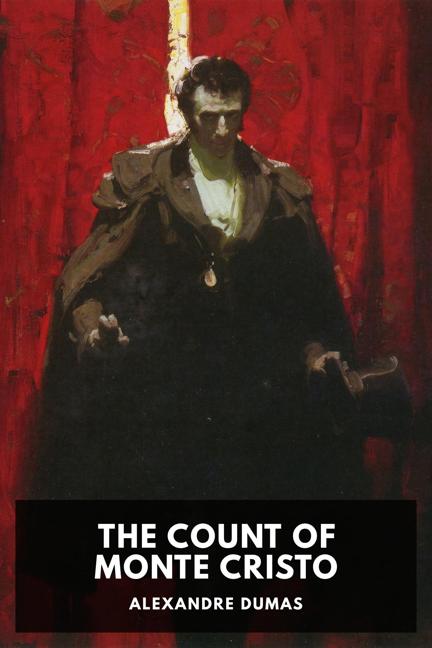
Falsely accused of political espionage in the unstable period following Napoleon’s fall, Dantès is arrested on the very day of his engagement – the happiest moment of his life. This detail carries strong symbolic weight: personal happiness crushed by political manipulation. Even more damning is the role of the legal system itself, which – rather than safeguarding justice – becomes the instrument through which injustice is enforced.
Gérard de Villefort, the prosecutor handling the case, is neither foolish nor purely evil. He understands Dantès’s innocence, yet condemns him to protect a secret involving his own father. Here, The Count of Monte Cristo articulates one of its central arguments: the gravest injustices often arise not from overt cruelty, but from the moral compromise of those who recognize the truth yet choose not to defend it.
Edmond Dantès is imprisoned in the Château d’If, a space completely severed from the living world. His early years in confinement are marked by utter despair. He does not know why he has been condemned, cannot identify his betrayers, and gradually loses faith in both humanity and God. This period represents the “spiritual death” of Dantès, during which his former self is slowly erased.
The narrative turns with Dantès’s encounter with Abbé Faria, an elderly, erudite prisoner dismissed by others as mad. Faria is not merely a mentor but a force that reconstructs Dantès as a human being. Under his guidance, Dantès acquires knowledge of science, philosophy, history, and languages – and, most crucially, learns the full truth behind the conspiracy that destroyed his life.
Faria’s death and the revelation of the treasure hidden on the island of Monte Cristo mark Dantès’s complete transformation. His escape from prison is not merely physical but existential – a rebirth. Upon finding the treasure, Dantès ceases to be a victim of fate and becomes a man who possesses wealth, knowledge, and time – the three essential tools for manipulating society.
Assuming the title of the Count of Monte Cristo, Dantès reenters the world, no longer as the man he once was. He appears as an outsider: immensely wealthy, enigmatic, without a traceable past, and unbound by conventional moral constraints. Rather than confronting his enemies directly, he observes them patiently, tests them, and lures them into revealing their true natures.
What distinguishes Monte Cristo’s revenge is that he does not directly kill his enemies. Instead, he orchestrates circumstances in which they destroy themselves. Each betrayer falls through their own fundamental weakness – greed, false honor, or lust for power. Revenge here is not an impulsive act but a cold, methodical “ethical experiment.”
Yet as his plans near completion, Monte Cristo realizes that the power he wields does not only punish the guilty; it also inflicts suffering upon the innocent connected to them. This realization plunges him into a profound inner crisis. He begins to question his role: is he an agent of justice, or merely another individual abusing power under the guise of past suffering?
Thus, The Count of Monte Cristo does not conclude with an unambiguous triumph, but with awakening. Edmond Dantès – now Monte Cristo – ultimately acknowledges the limits of human judgment. This ending elevates the novel beyond the conventions of revenge fiction, transforming it into a meditation on moral choice and the cost of power.
3. Thematic and Artistic Value
On the surface, The Count of Monte Cristo is often remembered as a grand, dramatic revenge novel. Yet its true value lies not in the satisfaction of seeing villains punished, but in Alexandre Dumas’s sustained interrogation of revenge itself. This systematic doubt allows the work to transcend the boundaries of adventure fiction.
Justice, Law, and the Collapse of Social Trust
One of the novel’s most significant contributions is its exposure of how fragile justice becomes when placed in the hands of fearful and ambitious individuals. Edmond Dantès is condemned not by truth, but by a chain of moral compromises: envy, silence, and self-preservation.
Dumas does not depict the legal system as a consciously malevolent force, but as an impersonal mechanism easily manipulated by human weakness. As a result, Dantès’s tragedy acquires universal resonance – it is not an anomaly, but a predictable outcome when power lacks ethical accountability. In this respect, the novel speaks as forcefully to modern readers as it did to its contemporaries.
Revenge as a Process of Moral Corrosion
Unlike many works in the same genre, Dumas refuses to idealize revenge. Edmond Dantès does not emerge as a heroic figure after gaining power; he becomes someone perilously close to abusing it. The Count of Monte Cristo operates with absolute precision, yet that very perfection exposes the inhuman quality of his designs.
At the height of his campaign, Monte Cristo no longer reacts as a wounded man, but as a detached arbiter. He observes the suffering of others with the calm of one who believes himself to be justice incarnate. This is the novel’s ethical core: those who claim absolute authority to punish risk reproducing the very evil they once endured.
The Moral Limits of Personal Power
A major philosophical achievement of The Count of Monte Cristo is its insistence on limits. Monte Cristo possesses wealth, intellect, time, and social influence – attributes that elevate him to a near-divine position. Yet Dumas refuses to grant him total victory. The harm inflicted upon innocents becomes an unmistakable warning: no form of absolute power is without consequence.
Accordingly, the novel ends not in triumph but in self-recognition. Monte Cristo acknowledges that no human being can replace God in judging good and evil. This realization gives the novel its enduring philosophical depth and distinguishes it from conventional tales of retribution.
Artistic Merit: Structure, Rhythm, and Character Construction
Artistically, the novel demonstrates Dumas’s mastery of large-scale narrative construction. Despite its considerable length and extensive cast, the story maintains coherence, with every subplot ultimately serving the central transformation of Edmond Dantès.
The narrative rhythm alternates effectively between moments of high drama and quieter passages of reflection. Dumas employs delay as a deliberate technique: revenge unfolds gradually, forcing readers to confront its consequences step by step.
Monte Cristo himself stands as the novel’s greatest artistic achievement. He is not a static moral ideal, but a dynamic character shaped by experience and reflection. His imperfection renders him both credible and deeply unsettling.
Enduring Significance
Ultimately, the lasting power of The Count of Monte Cristo lies in its refusal to offer simple answers. The novel does not instruct readers to forgive, nor does it glorify vengeance. Instead, it compels reflection on the cost of every moral choice. In a world where injustice persists, Edmond Dantès’s story remains a powerful reminder of the fragile line separating justice from destruction.
4. Memorable Quotations
Beyond its intricate plot and dramatic turns, The Count of Monte Cristo endures largely because of its language – direct, restrained, yet charged with philosophical weight. Alexandre Dumas does not rely on ornate prose; instead, he distills reflection into sentences that linger long after the story moves on. These lines do not merely describe events, but articulate the emotional and moral undercurrents shaping Edmond Dantès’s transformation.
The following quotations capture the novel’s central concerns: time, injustice, endurance, revenge, and the fragile boundary between human judgment and divine authority.
“All human wisdom is contained in these two words: wait and hope.”
This is perhaps the most famous line of the novel, encapsulating both the patience that sustains Edmond Dantès in captivity and the spiritual lesson that ultimately tempers his thirst for vengeance.
“I am not proud, but I am happy; and happiness blinds, I think, more than pride.”
Dumas here reveals how innocence itself can become a vulnerability, foreshadowing the ease with which happiness can be shattered by unseen malice.
“There is neither happiness nor unhappiness in the world; there is only the comparison of one state with another.”
This reflection underscores the novel’s philosophical stance on suffering: pain gains meaning only through contrast, a realization forged in prison.
“Life is a storm, my young friend. You will bask in the sunlight one moment, be shattered on the rocks the next.”
A concise metaphor for the instability of human fortune, this line frames Dantès’s fate as part of a larger, impersonal order.
“Until the day when God shall deign to reveal the future to man, all human wisdom is summed up in these two words.”
By invoking divine authority, the novel subtly reminds readers of the limits of human foresight and judgment.
“Hate is blind; rage carries you away; and he who pours out vengeance risks tasting a bitter draught.”
This sentence articulates the moral warning at the heart of the novel: revenge promises control, but delivers unforeseen consequences.
“It is not pride, but certainty, which makes us cruel.”
Here, Dumas exposes the true danger of absolute conviction – the belief that one is unquestionably right.
“Man does not know how to respect prosperity until he has learned how to endure misfortune.”
A summation of Edmond Dantès’s moral education, forged through suffering rather than privilege.
“For all evils there are two remedies: time and silence.”
This quiet line contrasts sharply with the violence of revenge, offering an alternative ethic grounded in restraint.
“The difference between treason and patriotism is only a matter of dates.”
A sharply political observation, reminding readers that justice is often shaped by circumstance rather than truth.
Together, these passages reveal why The Count of Monte Cristo continues to resonate across centuries. They transform the novel from a story of calculated revenge into a sustained meditation on time, power, and moral limitation – where language itself becomes a vehicle for reflection, not merely narration.
5. Conclusion
This final line does more than summarize Edmond Dantès’s journey; it leaves readers with a lingering philosophical resonance: not every injustice demands a destructive response.
The quotations above demonstrate that The Count of Monte Cristo captivates not only through plot, but through a depth of thought crystallized in its language – allowing it to transcend the category of entertainment and stand as a work of enduring reflection.
After closing The Count of Monte Cristo, what remains is not the satisfaction of a successful revenge, but an unease at the power humans may claim when justice collapses. Dantès’s journey reveals that injustice does not merely destroy its victims; it can regenerate violence in subtler, morally justified forms.
Alexandre Dumas created a novel in which every victory entails loss, and every act performed in the name of justice demands a price. The Count of Monte Cristo neither advocates revenge nor offers easy forgiveness. Instead, it places readers in the protagonist’s position, compelling them to weigh the limits of judgment and the responsibilities that accompany power.
From a literary standpoint, the novel achieves a rare balance between narrative excitement and philosophical depth. Its tight structure, flexible pacing, and complex central figure ensure its longevity beyond its historical context, transforming it into a universal story about the human condition.
For these reasons, The Count of Monte Cristo is not merely a novel to be read once, but one to be revisited at different stages of life. Each return invites new questions about justice, forgiveness, and the limits of hatred – questions that literature, at its highest form, exists not to resolve definitively, but to illuminate.