
In the course of the development of Japanese manga, the detective–mystery genre has consistently occupied a distinctive position thanks to its ability to combine logical reasoning, tightly structured narratives, and a profound capacity for social reflection. Far from being merely stories about identifying a culprit, detective manga functions as a narrative space in which humanity confronts evil, truth, and the fragile boundaries of justice. Within this context, The Kindaichi Case Files emerges as a representative work that significantly reshaped the approach to detective storytelling in modern manga.
First published in the early 1990s, The Kindaichi Case Files does not follow the trend of action-oriented narratives or the idealization of the detective as a superhuman genius. Instead, the series adopts a restrained and serious direction, focusing on case construction, criminal motives, and the hidden tragedies underlying acts of violence. This approach allows The Kindaichi Case Files to transcend the boundaries of pure entertainment and establish itself as a detective discourse centered on social analysis and human psychology.
What distinguishes The Kindaichi Case Files is not only its sharp logical deductions but also its emphasis on the question of “why crimes occur” rather than merely “who the culprit is.” Each case is constructed as a microcosm of fractured relationships, buried trauma, and moral distortions accumulated over time. Through this lens, the series raises universal questions concerning individual responsibility, justice, and the consequences of social silence.
With its deliberate pacing, meticulous narrative structure, and somber atmosphere rooted in classical detective traditions, The Kindaichi Case Files has forged a unique identity distinct from many works within the same genre. Beyond leaving a lasting mark on the history of Japanese detective manga, the series has also served as a foundation of influence for subsequent generations of creators, affirming its enduring artistic and ideological value.
1. Introduction to the Authors and the Work
The Authors and Creative Team
The Kindaichi Case Files is the result of a collaborative effort between scriptwriters Kaneshiro Seimaru and Amagi Seimaru, with illustrations by Sato Fumiya. This creative model reflects a characteristic feature of Japanese detective manga, in which the responsibilities of narrative construction and visual representation are clearly divided to ensure two essential elements: precise logical reasoning and effective visual communication of atmosphere and psychological tension.
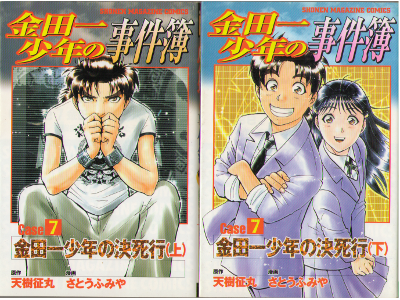
Kaneshiro Seimaru is widely regarded as a screenwriter with a solid foundation in classical detective theory. His work shows clear influences from Western detective literature, particularly the “fair play” principle, whereby all clues are presented transparently to the reader, allowing them to participate actively in the process of deduction. At the same time, the scripts of The Kindaichi Case Files demonstrate continuity with Japanese detective traditions, which emphasize psychological motivation and social context over technical trickery.
Visually, Sato Fumiya employs a moderately realistic drawing style, restraining exaggerated expressions and focusing instead on eyes, gestures, and panel composition. This approach is especially suited to the heavy, somber atmosphere of the series, effectively highlighting moments of psychological tension that define each case.
Historical Context and Development
The Kindaichi Case Files first appeared in 1992 in Weekly Shōnen Magazine, during a period when Japanese manga was undergoing rapid genre diversification. At this time, manga for younger audiences began to move beyond action and adventure, increasingly exploring social, psychological, and ethical themes.
From its earliest installments, The Kindaichi Case Files distinguished itself through its use of extended case arcs, with each mystery spanning multiple chapters. This structure allowed for thorough development of setting, character relationships, and layered clues, marking a clear departure from contemporaneous detective manga that favored shorter, faster-paced storytelling.
The series draws direct inspiration from Kindaichi Kosuke, the legendary detective created by novelist Yokomizo Seishi. The protagonist, Kindaichi Hajime, is conceived as a spiritual successor to this iconic figure, establishing an intertextual connection between modern manga and classical Japanese detective fiction.
The Position of The Kindaichi Case Files in Detective Manga
Beyond its commercial success and popularity, The Kindaichi Case Files is widely regarded as a foundational work in serious detective manga. It demonstrates that deductive comics can achieve structural complexity and ideological depth comparable to traditional detective novels.
The series’ success paved the way for numerous subsequent detective works across manga, anime, and live-action television adaptations. Kindaichi Hajime emerged as an archetype of the “ordinary yet exceptional” detective, contrasting with the distant, cold genius figure and offering a more approachable and humanized model for readers.
From a historical perspective, The Kindaichi Case Files is not merely a form of entertainment but a testament to manga’s capacity to inherit, transform, and renew detective traditions, contributing significantly to the modern identity of Japanese mystery comics.
2. Summary of the Plot
The Kindaichi Case Files is not structured as a single linear narrative but as a collection of independent cases connected through the central character, Kindaichi Hajime. Each case functions as a complete narrative unit while simultaneously deepening the portrayal of the protagonist’s intellect, character, and ethical boundaries throughout the investigative process.
Kindaichi Hajime is introduced as an ordinary high school student, even appearing careless and lazy in daily life. However, when confronted with complex murder cases – particularly those involving mathematical patterns, closed spaces, or classic locked-room scenarios – his extraordinary deductive abilities come to the forefront. Rather than relying on modern technology or legal authority, Kindaichi depends primarily on careful observation, behavioral analysis, and logical reconstruction of events.

The cases often begin in isolated settings such as remote islands, old mansions, secluded resorts, boarding schools, or locations imbued with traditional symbolism. This spatial isolation not only facilitates criminal acts but also allows the narrative to focus on a limited group of characters, each carrying hidden pasts, secrets, and potential motives.
Once a murder occurs, the story shifts swiftly into the investigative phase, featuring familiar elements of classical detective fiction: seemingly impenetrable crime scenes, contradictory evidence, inconsistent testimonies, and clues concealed beneath elaborate misdirection. The Kindaichi Case Files places particular emphasis on fair clue distribution, enabling readers to follow the investigation and deduce alongside the protagonist.
Accompanying Kindaichi is Nanase Miyuki, his childhood friend, who serves as an emotional and human anchor. Miyuki is not merely a witness or source of information; she helps prevent the narrative from becoming overly mechanical while highlighting the contrast between ordinary life and the world of crime. Additionally, Inspector Kenmochi represents law enforcement, bridging individual reasoning and institutional justice.
A defining feature of the series’ narrative approach lies in its focus on motivation. The perpetrators rarely act randomly or without cause. Before revealing the culprit’s identity, the story devotes considerable attention to reconstructing past events, complex relationships, and long-suppressed trauma. These elements lend tragic weight to each case, transforming investigation into an exploration of human nature rather than a purely logical exercise.
The climax of each case typically unfolds when Kindaichi gathers all involved parties and reconstructs the sequence of events in detail, exposing the method of the crime. However, unlike detective works that emphasize intellectual triumph, The Kindaichi Case Files often concludes on a somber note: the culprit is revealed, but irreversible losses remain. Truth is uncovered, yet justice does not equate to emotional redemption.
Through its repetitive yet non-redundant structure, the series gradually constructs a detective world in which crime is inseparable from human tragedy. Consequently, the narrative transcends entertainment and intellectual challenge, inviting reflection on the deeper causes of violence, collective silence, and the enduring moral consequences of crime.
3. Themes and Ideology
One of the core strengths of The Kindaichi Case Files lies in its consistent thematic and ideological framework. The series does not treat detective fiction as a mere intellectual game but as a means of addressing deeper issues such as the nature of crime, the limits of justice, and the fractures inherent in human society. This approach elevates the work beyond conventional entertainment into a reflective social discourse.

Crime as the Accumulation of Tragedy
Unlike many detective stories that portray criminals as simplistic embodiments of evil, The Kindaichi Case Files interprets crime as the result of prolonged accumulation of trauma. The perpetrators are rarely impulsive villains; instead, they are individuals shaped by betrayal, oppression, or abandonment by family, community, or social systems.
By reconstructing layers of the past, the series demonstrates that crime does not emerge from a moral vacuum. It is nurtured by collective silence, unresolved mistakes, and the persistent avoidance of responsibility. While the narrative does not justify criminal acts, it compels readers to confront the social origins of evil.
Justice and the Limits of Judgment
Another prominent theme in The Kindaichi Case Files is its portrayal of justice as an incomplete concept. In many cases, the moment of revelation does not produce a sense of victory but rather emptiness and sorrow. Legal justice may be served, yet emotional wounds and lost lives remain beyond repair.
The series thus distinguishes between legal justice and moral or humanistic justice. While the law can determine guilt, it cannot heal the psychological scars borne by individuals. This perspective lends the work a mature realism, avoiding the moral simplifications common in popular detective fiction.
Humanity at the Boundary Between Good and Evil
A consistent ideological stance in The Kindaichi Case Files is its rejection of rigid moral binaries. Characters are repeatedly placed in situations that force difficult choices, and it is these choices – rather than innate nature – that determine whether they become victims, accomplices, or perpetrators.
As an investigator, Kindaichi Hajime is not merely a revealer of truth but a witness to the fragility of human morality. He understands that the boundary between good and evil is often ambiguous and that anyone may falter under extreme circumstances. This perspective preserves the series’ humanistic tone and avoids idealizing the protagonist as an absolute moral authority.
Individual and Collective Responsibility
Beyond focusing on individual perpetrators, The Kindaichi Case Files extends its ideological scope to collective responsibility. In many cases, tragedy arises not from a single individual but from the indifference, concealment, or complicity of those around them. Silence, in this context, functions as a form of indirect complicity.
Through this lens, the series emphasizes that crime is not solely the act of the person wielding the weapon but the outcome of a social environment lacking dialogue and empathy. This critical social perspective further deepens the thematic complexity of the work.
Ideological Value within Detective Manga
In a genre often underestimated for its ideological depth, The Kindaichi Case Files stands out for its ability to merge rigorous deductive structure with social critique. The series demonstrates that detective fiction is not merely about solving mysteries but about questioning morality, responsibility, and human limitations within a complex society.
This cohesive system of themes and ideas has allowed The Kindaichi Case Files to maintain lasting relevance across time and readership, establishing it as one of the most profound and influential works in detective manga.
4. Value and Influence
Beyond its narrative success, The Kindaichi Case Files affirms its position as a work of enduring artistic, ideological, and cultural significance. Within the development of Japanese detective manga, the series serves as a crucial intersection between classical deductive traditions and modern storytelling, establishing a new standard for the genre.

Artistic and Narrative Value
Narratively, The Kindaichi Case Files is distinguished by meticulously constructed cases that adhere strictly to classical detective logic. Plot details, clues, and testimonies are deliberately arranged to ensure internal consistency and avoid logical gaps, sustaining reader trust – an essential element in long-form detective storytelling.
In addition to logical rigor, the series demonstrates significant investment in psychological narration. Each case is not merely a puzzle but a human story shaped by emotion, memory, and social relationships. This balance between deduction and psychology prevents the work from becoming mechanically technical.
Visually, Sato Fumiya’s illustration style reinforces the series’ dark and tense atmosphere. Careful panel composition, restrained facial expressions, and controlled pacing enhance suspense while supporting the investigative process, allowing the work to maintain a serious and mature tone over many years.
Ideological Value in Popular Manga
At a time when popular manga often prioritizes fast-paced entertainment, The Kindaichi Case Files distinguishes itself through a more restrained and serious approach. It proves that manga aimed at younger audiences can address complex issues such as crime, social responsibility, and the limits of justice without losing appeal.
By emphasizing motivation and psychological depth, the series expands detective fiction beyond surface-level truth-seeking toward an examination of the roots of tragedy. This depth has attracted not only younger readers but also adult audiences seeking reflective value in manga.
Influence on the Detective Genre
The influence of The Kindaichi Case Files on detective manga is undeniable. The series reinforced the long-form case structure, allowing for comprehensive development of setting, characters, and motives – a model later adopted and expanded by other works.
Kindaichi Hajime’s characterization as an ordinary individual with exceptional deductive ability became an important archetype, offering a humanized alternative to the aloof genius detective. In this sense, the series contributed to diversifying detective character portrayals within Japanese manga.
Cultural Reach and Adaptations
Beyond manga, The Kindaichi Case Files has been adapted into anime, television dramas, and films. These adaptations broadened its audience and confirmed the enduring appeal of the Kindaichi detective universe within Japanese popular culture.
Its sustained presence across media demonstrates that the series transcends the limitations of a single format, evolving into a cultural franchise capable of adaptation and renewal – testimony to the strength of its narrative and ideological foundation.
Historical Position in Manga
Historically, The Kindaichi Case Files occupies a pivotal position in modern detective manga. By inheriting classical deductive spirit while adapting to contemporary social contexts, it functions as a bridge between tradition and innovation.
This balance has enabled the series to maintain long-term vitality, becoming a key reference for creators and scholars alike. Its value lies not merely in popularity or sales figures but in its formative contribution to the detective genre as a whole.

5. Conclusion
In summary, The Kindaichi Case Files is not only a successful detective manga in terms of deductive structure but also a work of enduring ideological and artistic value within modern Japanese manga. Through its carefully constructed cases, the series transcends pure entertainment to become a narrative space that reflects deeply on fundamental human and social issues.
From a detective perspective, the series affirms the enduring power of classical deductive logic when applied with rigor and consistency. Each case challenges readers intellectually while compelling them to analyze motives, circumstances, and consequences. The integration of structural precision with psychological depth ensures the work’s lasting appeal despite changing publishing contexts and audience preferences.
More importantly, The Kindaichi Case Files addresses questions that go far beyond identifying the culprit. It invites reflection on the origins of evil, the limits of justice, and the responsibilities of individuals and communities in shaping tragedy. As a result, each case concludes not with simple satisfaction but with lingering contemplation, aligning with the spirit of humanistic detective fiction.
From a genre-historical perspective, The Kindaichi Case Files serves as a bridge between classical detective literature and modern manga storytelling. By inheriting rigorous deductive traditions while adapting them to visual narrative language, the series has secured lasting relevance and influence over subsequent detective works.
Ultimately, the value of The Kindaichi Case Files does not lie in shocking twists or sensational techniques, but in its sustained exploration of human depth through crime and truth. It stands as a representative work that affirms detective manga as a genre capable of serious social reflection and ethical inquiry, enduring in both relevance and intellectual power.