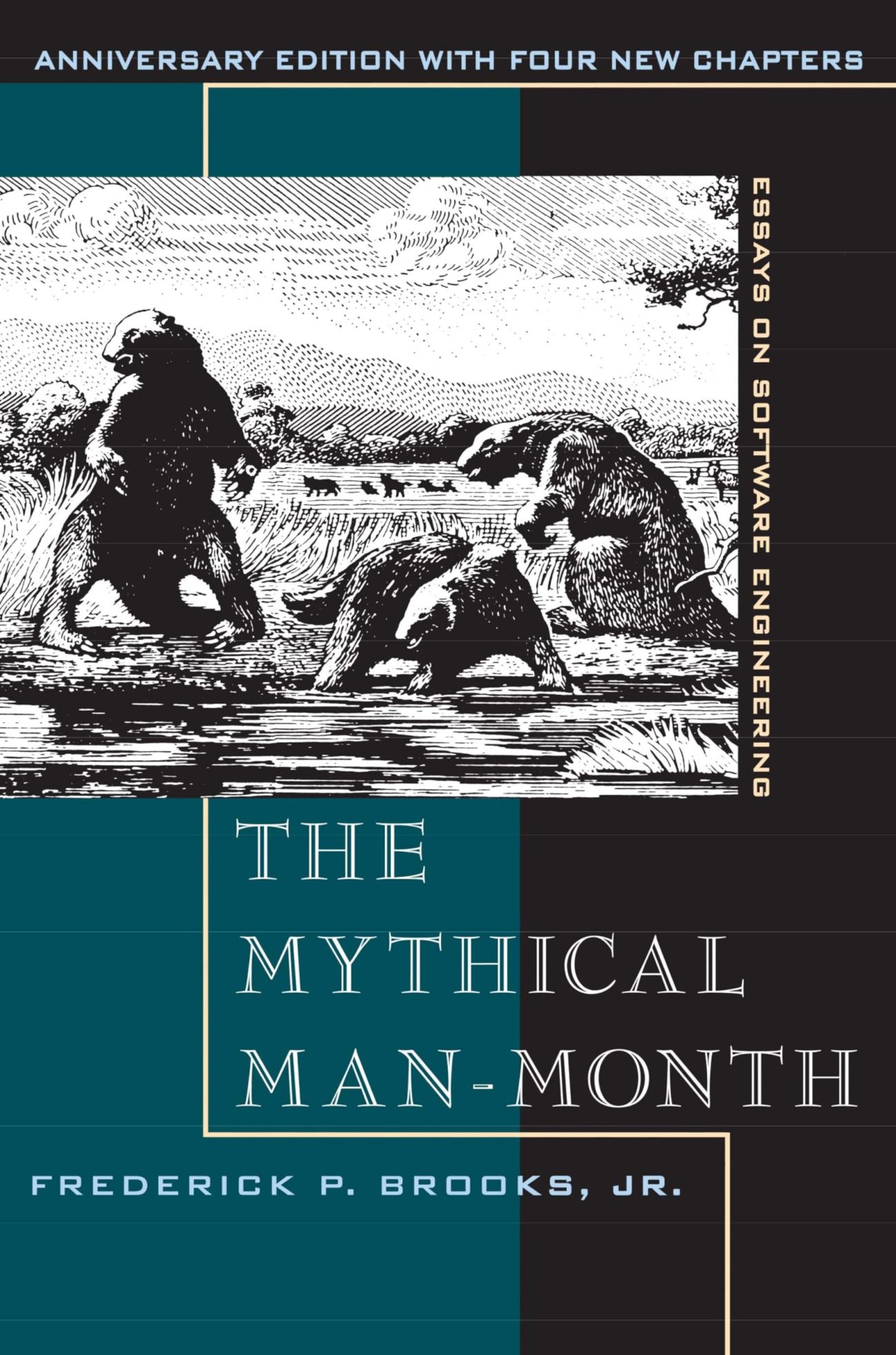
In the history of software engineering, only a small number of books have managed to retain lasting value despite the rapid evolution of technology. Mythical Man-Month, The: Essays on Software Engineering, Anniversary Edition is one of those rare works. Rather than focusing on specific tools or programming languages, the book delves deeply into the fundamental issues of software development, particularly the relationships among people, organizations, and project management.
First published in 1975 and later expanded in the Anniversary Edition, the book reflects practical experience drawn from large-scale software projects while laying the groundwork for many key concepts in modern software engineering. Although the technological landscape has changed significantly, the arguments presented in the book remain highly relevant, revealing the inherent limitations involved in building complex software systems.
1. Introduction to the Author and the Work
Frederick P. Brooks Jr. is one of the most influential scholars and engineers in the formation and development of the field of software engineering. He is known not only as a theoretician, but more importantly as a practitioner who directly participated in and led large-scale software projects during the foundational period of the modern computing industry.

Brooks served as a Project Manager for the IBM System/360 project, a revolutionary computer system developed in the 1960s. This was one of the largest software – hardware projects of its time, characterized by high complexity, long development cycles, and large development teams. His experience managing this project provided Brooks with deep practical insights into the limits of scaling manpower, the communication costs within large teams, and the fundamental differences between software development and traditional engineering disciplines.
Unlike many authors who approach software from a purely technical perspective, Fred Brooks examined the field at the intersection of computer science, project management, and organizational behavior. He observed that failures in software projects rarely stem from a lack of tools or programming skills, but more often from flawed management decisions, unrealistic estimations, and misunderstandings about the nature of intellectual work.
In addition to his industrial career, Brooks made significant contributions to academia. He was a professor at the University of North Carolina at Chapel Hill, where he founded and led the Department of Computer Science and conducted extensive research in computer architecture and computer graphics. In 1999, he was awarded the Turing Award, the most prestigious honor in computer science, in recognition of his foundational contributions to system architecture and software engineering.
Mythical Man-Month, The: Essays on Software Engineering is widely regarded as the most representative work of Fred Brooks’s career. Rather than being written as a formal textbook, the book is a collection of essays grounded in real-world experience, reflecting the author’s process of reflection, analysis, and self-critique regarding successes and failures in software project management. The Anniversary Edition further clarifies Brooks’s position as one of the earliest thinkers to establish a systematic intellectual foundation for modern software engineering.
2. Mythical Man-Month, The: Essays on Software Engineering, Anniversary Edition
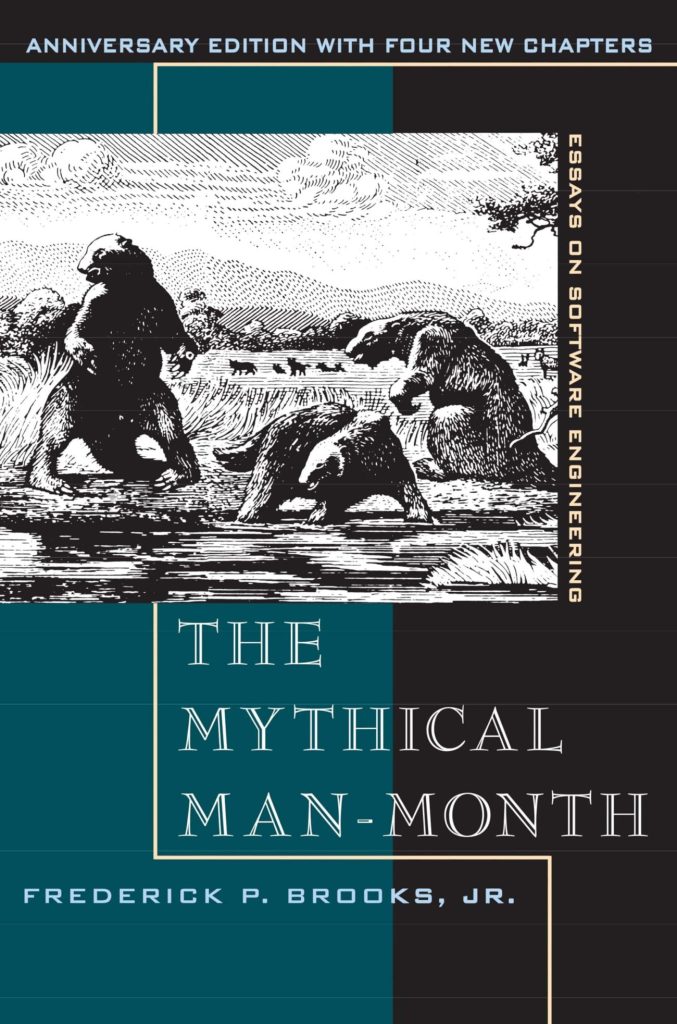
Mythical Man-Month, The: Essays on Software Engineering, Anniversary Edition is not structured as a traditional textbook, but as a collection of essays analyzing core issues in software development and management. This approach reflects the spirit of the work itself: instead of offering fixed processes or formulas, the book focuses on revealing the nature of software work through practical experience, logical reasoning, and critical examination of common assumptions.
The central theme of the book revolves around the relationship between people, time, and complexity in large-scale software projects. Fred Brooks points out that software fundamentally differs from traditional engineering products: it is highly abstract, difficult to measure in terms of progress, and heavily dependent on human communication. These characteristics make software management a distinct challenge that cannot be addressed by mechanically applying methods from manufacturing or construction.
One of the most famous and influential arguments presented in the book is Brooks’s Law: “Adding manpower to a late software project makes it later.” Brooks explains that when a software project falls behind schedule, adding more personnel not only fails to solve the problem but often increases communication, training, and coordination costs. In many cases, this causes further delays because new team members require time to understand the system and integrate with the existing team.
Beyond staffing issues, the book devotes significant attention to planning and time estimation. Brooks argues that software projects often fail not due to insufficient technical capability, but because of excessive optimism during the estimation phase. He analyzes common mistakes such as underestimating complexity, neglecting integration and testing efforts, or assuming that development progress will be linear.
Another important theme in The Mythical Man-Month is the role of system design and architecture. Brooks emphasizes that early architectural decisions have long-term consequences throughout the software lifecycle. A lack of clear design vision leads to fragmented systems that are difficult to maintain and increasingly costly over time. He also examines the relationship between system consistency and user experience, demonstrating that design is not merely a technical concern but a strategic one.
In the Anniversary Edition, Fred Brooks adds several important essays, most notably “No Silver Bullet.” In this essay, he argues that no single technology, programming language, or methodology can deliver a revolutionary leap in software productivity within a short time frame. Brooks clearly distinguishes between the inherent difficulties of software and the accidental difficulties, asserting that technology can mitigate the latter but cannot eliminate the former.
Overall, Mythical Man-Month, The: Essays on Software Engineering, Anniversary Edition does not aim to provide simple answers. Instead, it helps readers gain a deeper understanding of the unavoidable constraints, trade – offs, and realities of software development. The book serves as a conceptual map that enables software professionals to correctly identify problems before attempting to solve them.
3. Value and Key Contributions of the Book
The core value of Mythical Man-Month, The: Essays on Software Engineering, Anniversary Edition lies not in offering specific techniques or procedures, but in clarifying the nature of software engineering – a field heavily shaped by human factors, organizational structures, and cognitive limitations. The book functions as a foundational mental framework that helps readers understand problems correctly before searching for solutions.

Clarifying the Nonlinear Nature of Software Development
One of the most important contributions of the book is its demonstration that software productivity does not increase linearly with additional manpower or time investment. Through practical analysis, Fred Brooks shows that software is a complex intellectual product in which communication, coordination, and integration costs have a direct impact on progress. This insight challenges the mechanistic mindset commonly found in project management, where software is treated as a production line that can be scaled indefinitely.
Brooks’s Law as a Foundational Principle of Software Management
Brooks’s Law is not merely a famous quotation; it has become a widely taught and applied principle in software engineering. Its value lies in forcing managers to carefully balance speed, team size, and communication costs. In an era where projects are increasingly large and geographically distributed, this principle continues to serve as a critical warning and guiding framework.
Emphasizing the Strategic Role of Design and Architecture
The book highlights the importance of early design decisions, particularly system architecture. Brooks argues that a strong architecture not only ensures system stability but also significantly reduces the cost of future changes and maintenance. This perspective laid the foundation for “design-first” thinking and has had a lasting influence on fields such as software architecture, system design, and product engineering.
Distinguishing Between Inherent and Accidental Complexity
Through the essay “No Silver Bullet,” Brooks makes a philosophical contribution to software engineering by arguing that not all problems can be solved through technology. He clearly distinguishes between inherent complexity – such as constantly changing requirements and high abstraction – and accidental complexity introduced by tools and environments. This distinction helps practitioners maintain realistic expectations when evaluating new technologies.
Intellectual Honesty and Lasting Academic Value
Another notable strength of Mythical Man-Month, The: Essays on Software Engineering, Anniversary Edition is the author’s intellectual honesty. In the Anniversary Edition, Brooks revisits his earlier arguments, acknowledging which ideas remain valid and which require reconsideration in light of new contexts. This approach prevents the book from becoming outdated and instead establishes it as a foundational reference for multiple generations of software engineers.
Overall, the value of the book lies in its ability to shape long-term thinking. It does not teach readers how to write better code in the short term, but rather helps them understand the fundamental limits, trade-offs, and principles underlying sustainable software development.
4. Who Is This Book For?
Mythical Man-Month, The: Essays on Software Engineering, Anniversary Edition is not a technical programming manual, but a work focused on developing a mindset for software development and management. Therefore, it is best suited for readers who already have a foundational background in information technology.
For experienced software developers, the book helps explain common real-world issues such as delayed schedules, coordination challenges, and increasing system complexity. For Technical Leads, Software Architects, and engineering managers, it offers a foundational perspective on system architecture, team organization, and the limits of scaling manpower.
In addition, senior-level computer science students, as well as researchers and educators in software engineering, can view the book as an orienting reference that bridges academic knowledge with the realities of large-scale software development.
5. Conclusion
Mythical Man-Month, The: Essays on Software Engineering, Anniversary Edition is one of the seminal works that laid the intellectual foundation for modern software engineering. Rather than chasing specific technologies or development methodologies, the book focuses on uncovering the fundamental principles that govern large-scale software construction, particularly the roles of people, organizations, and project management.
The enduring value of the book lies in its ability to help readers correctly identify problems before attempting to solve them. Concepts such as Brooks’s Law, the limits of manpower expansion, and the distinction between inherent and accidental complexity remain highly relevant in an ever-evolving software industry. The Anniversary Edition further reinforces the book’s status as a foundational reference that connects historical experience with contemporary practice.
For those who take software development seriously as a profession, Mythical Man-Month, The: Essays on Software Engineering, Anniversary Edition is not merely a book to be read once, but a work worth revisiting repeatedly to shape long-term, sustainable professional thinking.
References
[1] F. P. Brooks Jr., The Mythical Man-Month: Essays on Software Engineering, Anniversary Edition, Boston, MA, USA: Addison-Wesley, 1995.
[2] F. P. Brooks Jr., “No Silver Bullet – Essence and Accidents of Software Engineering,” Computer, vol. 20, no. 4, pp. 10–19, Apr. 1987.
[3] R. C. Martin, Clean Code: A Handbook of Agile Software Craftsmanship, Upper Saddle River, NJ, USA: Prentice Hall, 2008.
[4] R. C. Martin, The Clean Coder: A Code of Conduct for Professional Programmers, Upper Saddle River, NJ, USA: Prentice Hall, 2011.
[5] S. McConnell, Code Complete: A Practical Handbook of Software Construction, 2nd ed., Redmond, WA, USA: Microsoft Press, 2004.
[6] A. Hunt and D. Thomas, The Pragmatic Programmer: From Journeyman to Master, Reading, MA, USA: Addison-Wesley, 1999.
[7] I. Sommerville, Software Engineering, 10th ed., Boston, MA, USA: Pearson, 2016.
[8] B. W. Boehm, Software Engineering Economics, Englewood Cliffs, NJ, USA: Prentice Hall, 1981.
[9] T. DeMarco and T. Lister, Peopleware: Productive Projects and Teams, 3rd ed., Boston, MA, USA: Addison-Wesley, 2013.
[10] E. Gamma, R. Helm, R. Johnson, and J. Vlissides, Design Patterns: Elements of Reusable Object-Oriented Software, Boston, MA, USA: Addison-Wesley, 1994.