In the world of fairy tales, there are stories that endure not because of dazzling magic or glorious feats of heroism, but because of the way they touch the deepest layers of human emotion and reflection. The Steadfast Tin Soldier is one such work. The story is brief and simple, even somewhat quiet, yet it carries a spiritual weight far greater than its modest length. Reading it, one does not merely follow the journey of a small toy, but is also confronted with profound questions about fate, dignity, and how human beings remain upright in the face of life’s unforeseeable adversities.
Created within the context of nineteenth – century European literature, The Steadfast Tin Soldier clearly reflects Hans Christian Andersen’s distinctive narrative style: using simple forms to convey profound ideas. The protagonist – a tin soldier with only one leg – bears from the very beginning the mark of incompleteness and imperfection. Yet it is precisely from this seemingly disadvantaged starting point that the story unfolds into a turbulent journey, where courage is not measured by strength or victory, but by perseverance, steadfastness, and the ability to preserve one’s dignity amid relentless trials imposed by fate.
Unassuming and free of melodrama, The Steadfast Tin Soldier leaves behind a deep and lingering resonance. The story reminds readers that what is most valuable does not always lie in what one achieves, but in how one confronts what cannot be avoided. For this reason, though classified as a fairy tale, the work continues to accompany readers of different ages, revealing new layers of meaning – more mature and profound – with each rereading.
1. Introduction to the Author and the Work
Hans Christian Andersen (1805–1875) is one of the most prominent figures in Danish literature and world literature, particularly in the field of fairy tales. Born into a poor family in the city of Odense, Andersen’s childhood was marked by material deprivation, emotional wounds, and a persistent sense of alienation. These turbulent life circumstances played a crucial role in shaping his distinctive artistic world – a world in which small, overlooked, or physically imperfect characters often possess rich inner lives and remarkable spiritual resilience.

Unlike many traditional folk fairy tales that follow simple structures and end happily, Andersen’s fairy tales bear a strong personal imprint, characterized by narrative depth and philosophical reflection. He did not hesitate to incorporate sorrow, loss, loneliness, and irreversible tragedy into his works. As a result, Andersen’s stories are often regarded as “modern fairy tales,” where the boundary between children’s literature and literature for adults becomes increasingly blurred.
The Steadfast Tin Soldier (The Steadfast Tin Soldier) was written and first published in 1838. It is one of Andersen’s most representative short stories and has been repeatedly included in collections of his fairy tales, as well as taught in literature curricula in many countries. From its very title, the work introduces its central theme: “steadfastness” or “courage” is not understood as combat or triumph, but as spiritual resilience – a moral and deeply human quality.
What makes The Steadfast Tin Soldier particularly distinctive is Andersen’s choice of a lifeless toy – a physically impaired tin soldier – as the vehicle for reflecting on the human condition. The soldier has only one leg, having been cast from an insufficient amount of tin, and thus embodies imperfection from the outset. Rather than portraying this deficiency as a weakness, Andersen transforms it into the foundation upon which the character’s inner strength and dignity are revealed.
Structurally, the story is concise and linear, composed of a series of events that repeatedly thrust the protagonist into increasingly harsh circumstances. Each incident functions not merely as narrative progression, but as a test of the tin soldier’s “steadfast” spirit. The restrained narrative voice, combined with a symbolic use of imagery, allows the work to achieve a high level of artistic effectiveness despite its brevity.
It can be said that The Steadfast Tin Soldier crystallizes Andersen’s worldview with exceptional clarity: the belief that human value does not lie in perfection or good fortune, but in one’s ability to maintain spiritual integrity when confronted with unavoidable trials. This is precisely why the story, though written more than a century ago, continues to resonate deeply with contemporary readers.
2. Summary of the Plot
The story of The Steadfast Tin Soldier opens in the familiar setting of a child’s room, where toys – seemingly inanimate – begin to lead a life of their own once they are no longer observed by humans. Inside a brand-new toy box are twenty-five tin soldiers, all cast from the same old spoon. They are identical in every respect except for one particular soldier, who has only one leg because there was not enough tin to complete his form. From the very beginning, the protagonist is positioned as an “other,” marked by an inescapable deficiency.
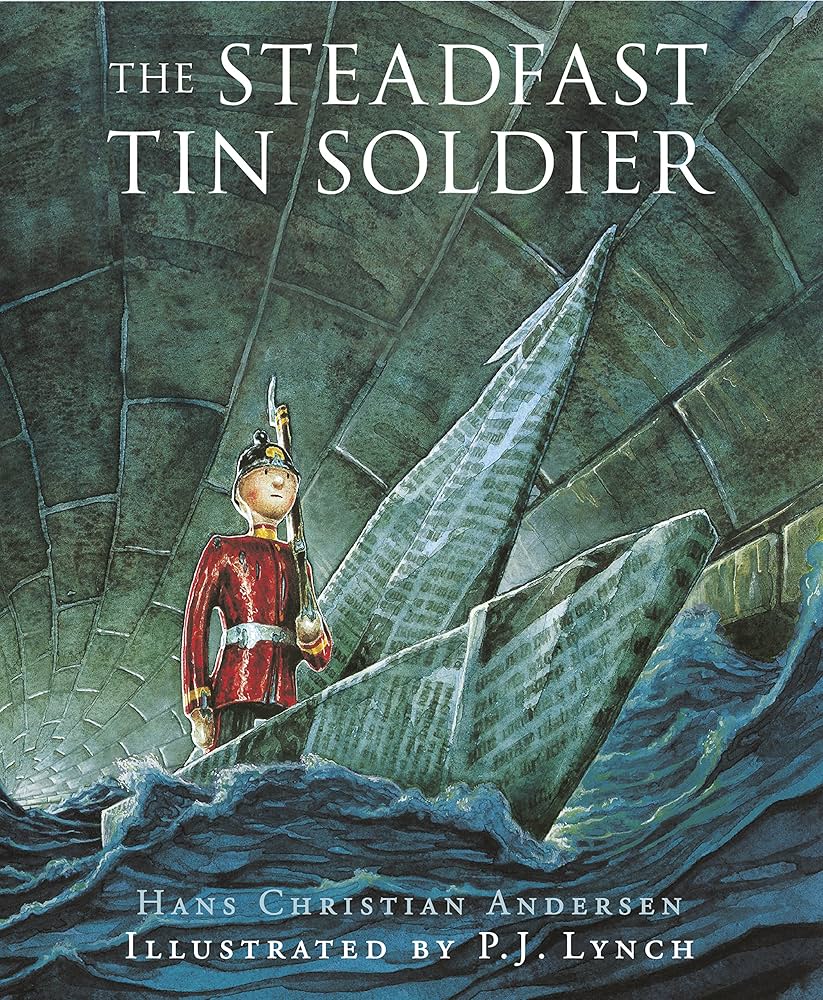
Despite having only one leg, the tin soldier stands upright and steady, no less firm than the others. This posture quietly defines his character: reserved, resolute, and unostentatious. From his place on the table, he notices a paper ballerina standing nearby. She, too, appears to be standing on one leg, with her arms raised gracefully, her figure light and fragile. In the tin soldier’s eyes, the ballerina seems to share his condition, and from this perceived similarity arises a silent, unspoken affection – one that neither seeks recognition nor demands reciprocity. His love is discreet, inward, and marked by dignity.
As night falls, the world of toys comes alive. A small goblin in a jack-in-the-box suddenly pops up and warns the tin soldier, serving as a vague omen of the trials to come. The next morning, in an incident left unexplained – perhaps an accident, perhaps the hand of fate – the tin soldier falls from the windowsill, landing headfirst on the ground outside. Without complaint or resistance, he accepts the fall in silence.
Thus begins the tin soldier’s journey of exile. Two boys find him and place him in a paper boat, setting him adrift on rainwater flowing through the street gutter. The fragile boat carries him into a completely unfamiliar world, where the water rushes violently through dark and dangerous passages. In a sewer, the tin soldier encounters a fierce rat that demands a “passport.” Despite the perilous situation, the soldier remains upright and silent, refusing to plead or submit, as though his dignity will not allow him to yield to fear.
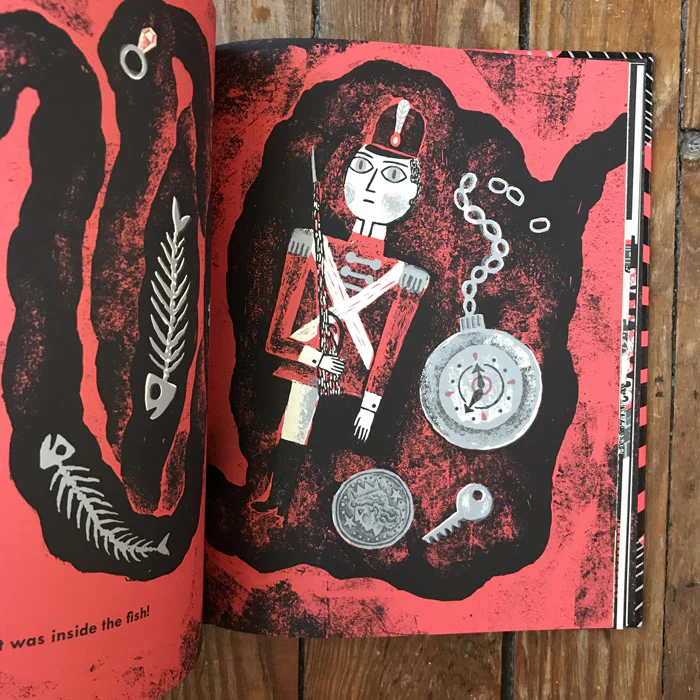
Eventually, the paper boat cannot withstand the current and disintegrates. The tin soldier sinks into deep water and disappears. Just when his fate seems sealed, another twist occurs: he is swallowed by a large fish. Enveloped in the pitch darkness of the fish’s belly, the tin soldier is utterly isolated from the world, yet his story does not end there, as if fate has not yet released its grip.
Some time later, the fish is caught, taken to market, and sold to the very household where the tin soldier once belonged. When the fish is cut open for cooking, the tin soldier is discovered inside and returned to the familiar room. In an almost circular turn of destiny, he once again stands on the table, facing the paper ballerina he has never ceased to hold in his thoughts.
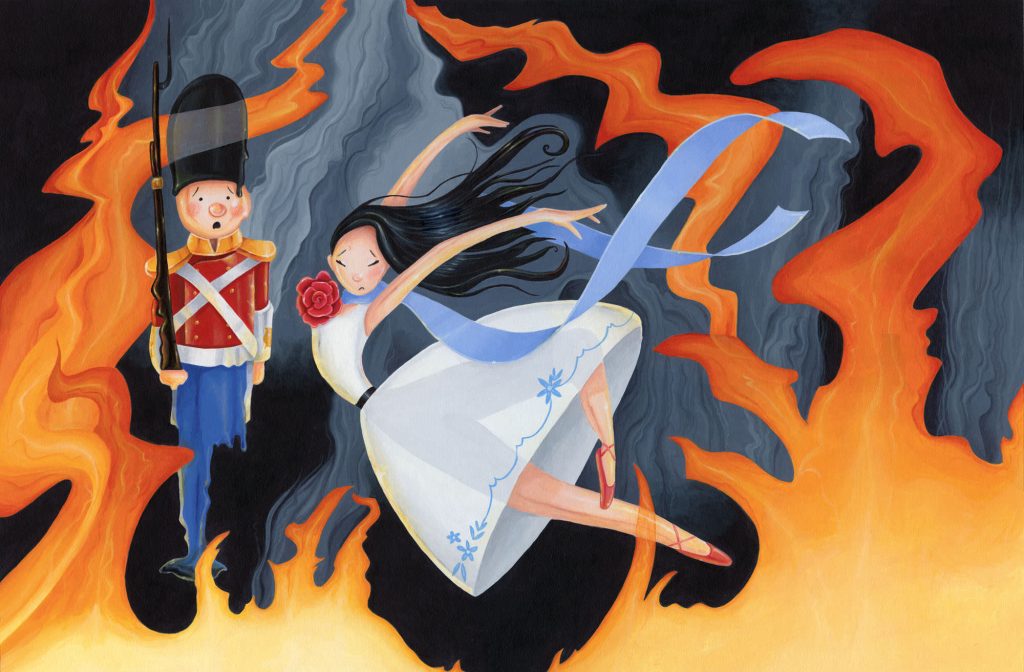
This moment of reunion seems to promise a peaceful ending, but Andersen resists such an easy resolution. A sudden gust of wind blows the paper ballerina into the lit stove, and almost simultaneously, the tin soldier is thrown into the flames as well. In his final moments, as he slowly melts, the tin soldier remains upright, never once losing his stance.
When the fire dies down, all that remains is a small lump of tin shaped like a heart and a charred piece of tinsel – the last traces of the paper ballerina. The story closes not with joy or salvation, but with a quiet, deeply symbolic image that leaves a lasting reflection on fate, love, and human dignity.
3. Thematic and Artistic Value
The enduring power of The Steadfast Tin Soldier lies in the way Hans Christian Andersen addresses the question of human dignity in the face of fate through an extraordinarily simple figure. The tin soldier is not a hero; he possesses no special powers and is physically incomplete from the moment of his creation. Yet this very deficiency becomes the foundation upon which the story explores a universal question: what constitutes human worth when one has no control over the circumstances of one’s existence?
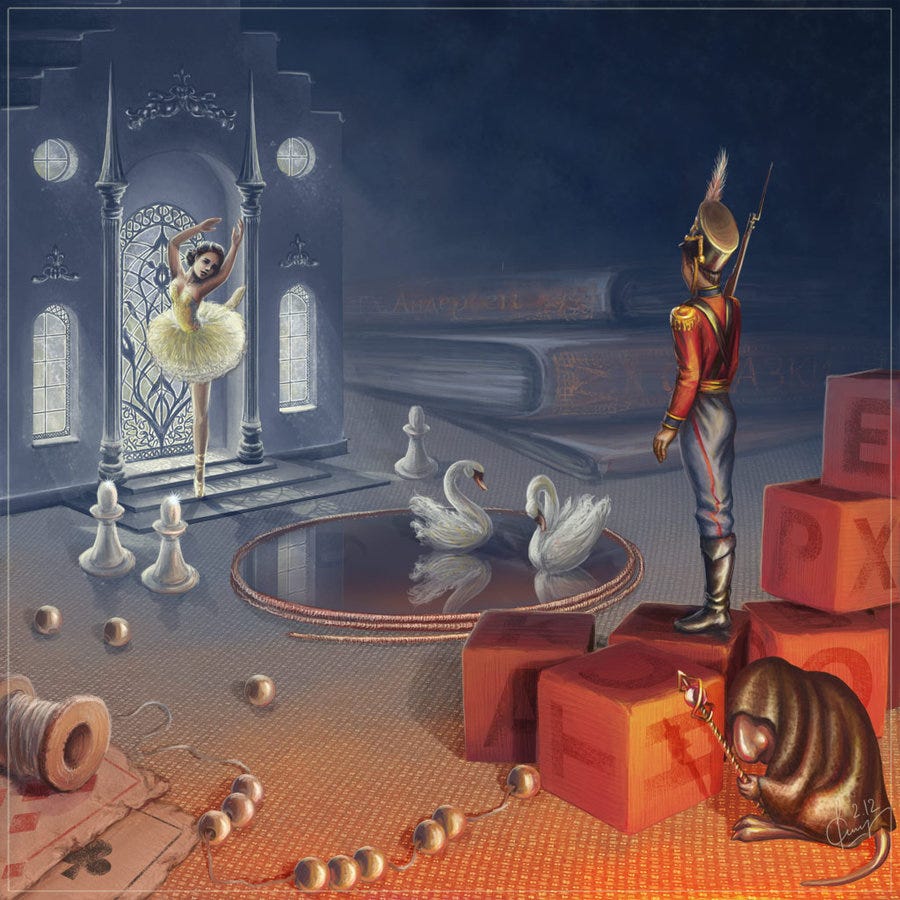
Throughout the narrative, the tin soldier exercises almost no agency. Every major event occurs by chance: he falls from the window, is set adrift, swallowed by a fish, and ultimately thrown into the fire. Andersen grants him no opportunity to alter his fate. Yet within this total passivity, the tin soldier preserves the one thing that truly belongs to him: his spiritual posture. His persistent upright stance is not merely a physical detail, but a sustained symbol of resilience and dignity in the face of overwhelming adversity.
On a thematic level, the story presents a profound conception of courage. In The Steadfast Tin Soldier, courage is not expressed through victory or escape, but through endurance and acceptance without self-betrayal. The soldier never complains, pleads, or succumbs to despair. His silence is not a sign of weakness, but of a quiet, unyielding inner strength.
The story also conveys deep humanistic value in its portrayal of love as a spiritual experience rather than possession. The tin soldier’s affection for the paper ballerina exists entirely in silence – without confession or pursuit, sustained only by observation and empathy. This form of love is quintessentially “Andersen”: delicate, pure, and inherently tragic, as it coexists with an acute awareness of life’s fragility and impermanence.
Notably, the tragic ending does not negate the story’s humanistic meaning; instead, it elevates it. The tin soldier’s melting in the fire, leaving behind a small heart-shaped piece of tin, reflects Andersen’s philosophical outlook: physical existence may vanish, but spiritual values endure. The story suggests that while human beings may not be materially permanent, the integrity they uphold can transcend destruction.
Artistically, The Steadfast Tin Soldier exemplifies Andersen’s signature narrative style: restrained language, vivid imagery, and rich symbolic depth. Rather than directly analyzing the character’s psychology, Andersen allows actions, spaces, and events to speak for themselves. Each element – the fragile paper boat, the rushing water, the darkness inside the fish, and the final fire – functions as a metaphor, shaping a tightly woven and symbolically coherent journey of fate.
Andersen’s decision to forgo a happy ending demonstrates a modern and daring artistic vision. He refuses to console readers with easy reassurance, instead compelling them to confront loss and reflect. This very sense of incompletion propels The Steadfast Tin Soldier beyond the realm of conventional fairy tales, transforming it into a work of philosophical and existential significance.
Ultimately, the work’s value does not lie in complexity or scale, but in its ability to condense fundamental human concerns into a seemingly small story. This is why, despite its brevity and simple plot, The Steadfast Tin Soldier continues to invite readers of all ages to pause, reflect, and recognize themselves in the image of a quiet yet unwavering tin soldier.
4. Memorable Quotations
In The Steadfast Tin Soldier, Hans Christian Andersen does not rely on lengthy passages or explicit philosophical discourse to convey his ideas. Instead, he allows short, seemingly simple sentences to carry profound meaning. Each quotation below is not merely a narrative detail, but a crucial component of the symbolic system through which the work explores fate, courage, and human dignity.
1. “Out of the twenty-five tin soldiers, there was one who had only one leg, for there was not enough tin.”
→ This opening sentence establishes the entire premise of the story: imperfection arises not from personal fault, but from chance circumstance.
2. “He stood firmly on his one leg, just as steadily as the others on two.”
→ From the outset, the upright stance defines the character, asserting that physical limitation does not equate to spiritual inferiority.
3. “His eyes never left the paper ballerina who stood on one leg.”
→ Love here is born from silent recognition and empathy rather than possession.
4. “He said nothing, though everything was happening around him.”
→ The soldier’s silence underscores a form of courage that requires no verbal assertion.
5. “The paper boat rushed along in the swift current.”
→ The paper boat symbolizes the fragility of human existence amid uncontrollable forces.
6. “The rat demanded a passport, but the tin soldier stood still.”
→ This moment highlights dignity: a refusal to submit to fear or intimidation.
7. “The fish swallowed him, and darkness surrounded everything.”
→ The climax of isolation, representing the ultimate trial imposed by fate.
8. “In the fire, he stood upright until he melted.”
→ The most powerful symbol of the story, affirming steadfastness to the very end.
9. “All that remained was a small lump of tin shaped like a heart.”
→ The final distillation of the story: physical destruction cannot erase spiritual value.
Taken together, these quotations demonstrate Andersen’s ability to compress profound ideas into deceptively simple language. His restraint does not impose emotion upon the reader, but instead creates an open space for reflection across different ages and contexts.
5. Conclusion
The Steadfast Tin Soldier is a brief work whose significance far exceeds its modest length. Through the figure of a physically imperfect tin soldier, Hans Christian Andersen tells a story that transcends childhood imagination to address the human condition under the weight of unpredictable fate. The work affirms that while people may not choose their circumstances, they can choose how they face them.
What sets the story apart is Andersen’s refusal to construct a narrative of triumph or redemption. The tin soldier is granted no miracle, escapes no tragedy, and reaches no conventionally happy ending. Yet this very refusal underscores the story’s central value: spiritual dignity. The image of the soldier standing upright until the moment he melts becomes an indelible symbol etched into the reader’s memory.
From a personal perspective, The Steadfast Tin Soldier is a story that grows more poignant with age. As children, readers may be drawn to its fantastical elements and dramatic events. As adults, they encounter it anew – as a quiet parable about resilience and self-possession in circumstances beyond one’s control. The courage celebrated here is not loud or heroic, but persistent, restrained, and deeply self-respecting.
It is precisely this simplicity combined with depth that allows The Steadfast Tin Soldier to transcend the boundaries of children’s literature and endure as a work of lasting humanistic value. Across generations, the story continues to resonate because it addresses a timeless question: in a world shaped by uncertainty, what enables human beings to remain themselves? For Hans Christian Andersen, the answer lies in spiritual posture – standing upright, even on a single leg, until the very end.