
In the digital age, knowledge is no longer a scarce resource but has instead become a dense, continuous, and seemingly limitless stream. Each day, individuals are exposed to hundreds of units of information – from books, articles, and videos to short-form content on social media. Yet this ease of access gives rise to a striking paradox: the more one reads, the less one feels they truly retain.
This phenomenon is not merely a personal shortcoming but reflects a structural limitation of human memory. The brain is not designed to store all incoming information; rather, it prioritizes processing, filtering, and discarding what is not actively used. In this context, reading alone – no matter how diligent or consistent – is no longer sufficient to build lasting knowledge.
It is precisely from this need that the concept of a “Second Brain” emerges as a systemic solution. It is not a specific tool, but a method for organizing, storing, and reusing knowledge outside the biological mind. More importantly, it introduces a fundamental shift in how reading is approached: reading is no longer a passive act of consumption, but the starting point of an active process of knowledge creation.
1. THE CONCEPT OF A “SECOND BRAIN” – FROM METAPHOR TO A KNOWLEDGE SYSTEM
A “Second Brain” is not merely a vivid metaphor, but a fundamental redefinition of how humans interact with knowledge. If the biological brain is responsible for perception, reasoning, and real-time decision-making, then the “Second Brain” functions as an external cognitive infrastructure – a space where knowledge is stored, organized, and, more importantly, continuously restructured over time. This “offloading” of function is not a replacement, but an extension: it frees short-term memory from the burden of storage, allowing the mind to focus on higher-value activities such as analysis, synthesis, and creative thinking.
However, if such a system is reduced to mere storage, it becomes indistinguishable from a static data repository – a place where information is effectively “frozen” once recorded. This is precisely the limitation of most traditional note-taking practices: they accumulate information but fail to generate momentum for knowledge. A true “Second Brain” must operate as a knowledge ecosystem, in which each unit of information does not exist in isolation, but remains in a state of potential – ready to be connected, reinterpreted, and activated in new contexts. It is this capacity for flexible reuse that ultimately distinguishes storage from thinking.
Historically, the need to externalize knowledge is not new. Renaissance scholars maintained notebooks – commonly referred to as commonplace books – not merely to record what they read, but to engage in an ongoing dialogue with it. Each excerpt, each note was not a closed unit, but a starting point for further reflection. Over time, these notebooks evolved into personal maps of thought, revealing how individuals organized and navigated the intellectual world around them.
In the modern era, with the advancement of technology, note-taking practices have evolved toward greater structure and scalability. Systems such as atomic note-taking and linked notes allow knowledge to be broken down into small, independent units that can be flexibly connected. Once digitized, these units are no longer constrained by physical space; they can be retrieved, reorganized, and recombined almost instantaneously. Yet technology serves only as a catalyst. The essence of a “Second Brain” lies not in the tool, but in the underlying logic of organization and the way individuals interact with the knowledge within the system.
The core distinction between a “Second Brain” and conventional note-taking, therefore, does not lie in the medium, but in structure and operational principles. Passive note-taking tends to produce fragmented pieces of information, where each note marks an endpoint. In contrast, within a true knowledge system, each note functions as a node in a network, inherently open to connections with others. As these connections accumulate and intensify, they form a dynamic structure in which knowledge is no longer isolated, but begins to interact, reinforce, and even challenge itself.
It is within this networked structure that knowledge becomes truly “alive.” It ceases to be a collection of static information units and instead transforms into a continuous flow – where each act of retrieval is not merely recalling information, but reconstituting meaning. An old note, when placed alongside a new one, can generate an entirely different interpretation. In this sense, a “Second Brain” is not only a repository of what is already known, but also an environment in which previously unarticulated ideas can emerge.
2. WHY READING IS NOT ENOUGH – THE LIMITS OF MEMORY AND COGNITION
One of the most persistent misconceptions in the act of reading is the immediate sense of “having understood.” When an idea is presented clearly, logically, and accessibly, readers often experience a form of cognitive fluency – a smooth, low-resistance processing of information. It is precisely this sense of ease that produces the illusion of understanding. In reality, however, this is merely recognition, not mastery. An idea is only truly understood when the reader can restate it in their own words, apply it across different contexts, or use it as a conceptual tool to interpret new problems. Without these operations, knowledge remains at the surface level – like a thin layer of memory that can easily fade.
This limitation is not a reflection of intellectual inadequacy, but a direct consequence of how the brain functions. Human memory is not a neutral storage system, but a highly selective one. Guided by principles of efficiency, the brain prioritizes information that is repeated or actively used, while discarding what appears unnecessary. As a result, reading alone – when confined to passive intake – does not generate sufficient “signals” for the brain to retain information. Only when knowledge is reactivated through writing, reasoning, or application does it have a chance to move from short-term memory into long-term memory, from a transient state into a more stable form.
Yet the issue extends beyond biological constraints; it is further intensified by the structure of the modern information environment. In the digital age, reading culture has shifted from depth to speed. Content is increasingly designed for rapid consumption – brief, easily digestible, and highly stimulating – conditioning readers to skim rather than to engage deeply. As a result, the process of intake becomes fragmented into discrete, disconnected units, lacking the continuity required to sustain a coherent line of thought. Instead of developing a single idea in depth, readers constantly shift between multiple ideas, each retained only briefly before being replaced.
The consequence of this pattern is a diminished capacity for deep knowledge accumulation. What is read does not entirely disappear, but neither does it remain sufficiently structured or accessible for future use. It lingers as scattered fragments of memory – familiar yet indistinct, present yet unusable. When confronted with a problem that demands sustained thinking, the reader is unable to mobilize previously encountered ideas, precisely because they were never organized into a functional system.
It is at this point of rupture that the need for an intermediary mechanism becomes evident. A “Second Brain” does not replace reading; rather, it completes the process that reading initiates but cannot finish on its own. It provides a space where information is deliberately retained, reprocessed through personal language, and embedded within meaningful connections. In doing so, knowledge is no longer entirely dependent on biological memory – which is inherently limited and unstable – but is instead anchored within an external structure, where it can be retrieved, reused, and continuously developed over time.
3. CORE PRINCIPLES FOR BUILDING A “SECOND BRAIN”
For a “Second Brain” to function as a true knowledge system, the issue is not how much information is collected, but how the principles governing its processing are established. Without clear principles, the system quickly devolves into a chaotic repository; with them, even a modest collection of notes can generate disproportionate value. These foundational principles do not merely shape how notes are taken – they shape how knowledge itself is perceived and developed.
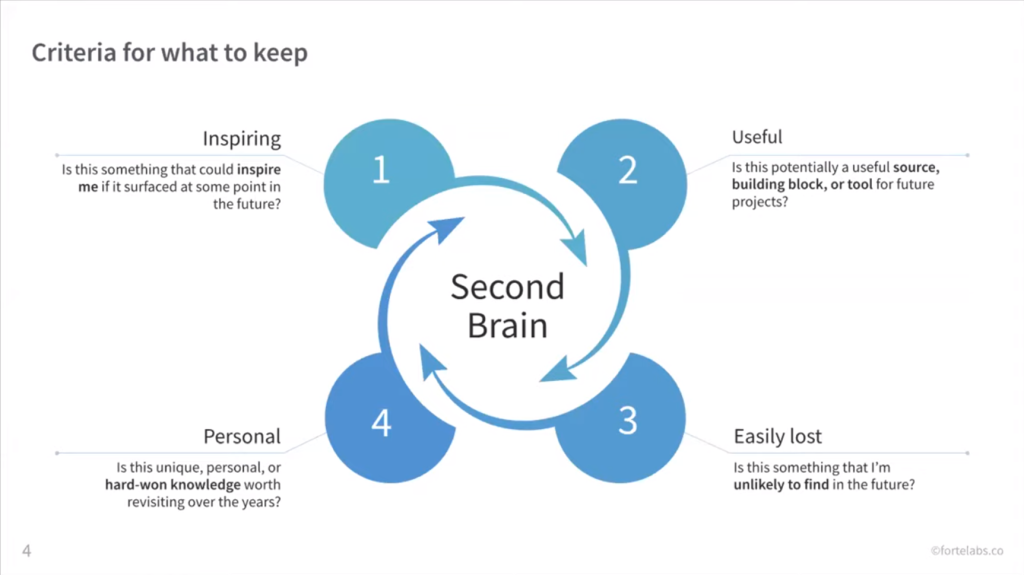
The first principle is selectivity – both the starting point and the most critical filter of the entire system. In an environment where information is perpetually abundant, the ability to say “no” to most inputs becomes an essential cognitive skill. Not every interesting idea deserves to be preserved; only those with the potential to be used, connected, or further developed should be retained. Excessive note-taking does not enhance a system’s value; instead, it increases storage costs and introduces “cognitive noise,” making retrieval and navigation less efficient. A high-quality knowledge system is typically concise: limited in volume, but rich in meaning. In this sense, selectivity is not about discarding information arbitrarily, but about defining what truly matters within one’s intellectual framework.
The second principle is simplification – the process through which information is transformed into knowledge via active intervention. When content is copied verbatim, it remains bound to the original author’s structure and context; it has not yet been internalized. Only when information is rearticulated in one’s own language does it become integrated into personal cognition. Simplification, therefore, does not imply reduction in depth, but rather the distillation of essence – extracting ideas that can stand independently of their original context. A well-crafted note does not need to be long, but it must be sufficiently clear so that its meaning is immediately accessible without external reference. This quality makes knowledge more flexible and readily reusable.
The third principle is connection – the element that transforms a collection of notes into a coherent system. If each note exists in isolation, the system remains fragmented and incapable of organic growth. By contrast, when notes are placed in relation to one another, they form a network in which value emerges not only from individual points, but from the links between them. An idea from psychology may connect with a real-life observation; an economic concept may illuminate a social issue. Such cross-domain connections enable the emergence of new insights – something linear note-taking rarely achieves. Connection, therefore, is not merely a technical operation, but an expression of a deeper cognitive stance: viewing knowledge as a dynamic system rather than a static archive.
The final principle is usability – the criterion that determines the system’s practical value. A “Second Brain” does not exist to store information, but to support action: writing, research, decision-making, or problem-solving. If notes are never retrieved or applied in concrete contexts, they gradually lose relevance and become a form of intellectual hoarding. Usability requires that each note be constructed with sufficient clarity and independence to be “activated” when needed, without excessive reliance on its original context. It also demands that the user actively re-engage with the system – not only to add new material, but to extract and deploy existing knowledge. Through this repeated cycle of use, notes are reinforced, connections are expanded, and the system gradually matures.
Taken together, these four principles – selectivity, simplification, connection, and usability – do not operate in isolation, but interact as components of an integrated structure. Selectivity governs input, simplification shapes the unit of knowledge, connection defines structure, and usability ensures output. When aligned and consistently applied, they do more than enable the construction of a “Second Brain”; they redefine how individuals approach, process, and develop knowledge in an increasingly complex world.
4. THE PROCESS OF BUILDING A “SECOND BRAIN” FROM WHAT YOU READ
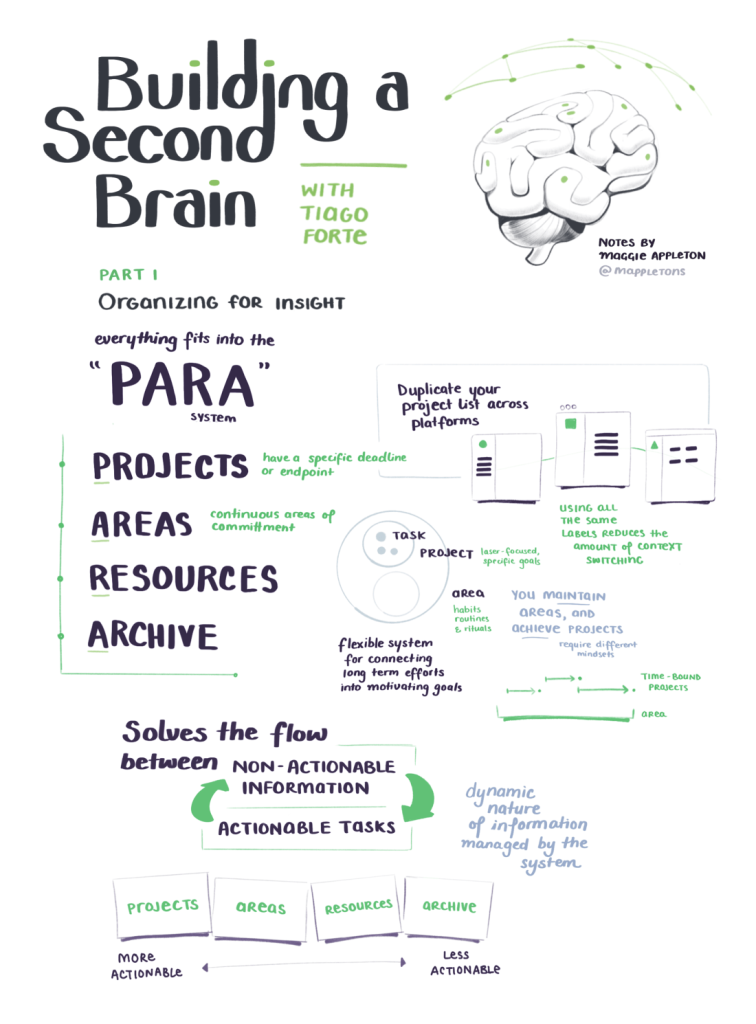
The formation of a “Second Brain” is not a singular act, but a sequence of tightly interconnected stages, each functioning as a transformation – from raw information to structured knowledge, from passive intake to active creation. If any link in this chain is missing, the entire system becomes incomplete: one may accumulate without understanding, or understand without ever applying. For this reason, clearly identifying each stage is not only essential for optimizing the process, but also for ensuring the long-term sustainability of the system.
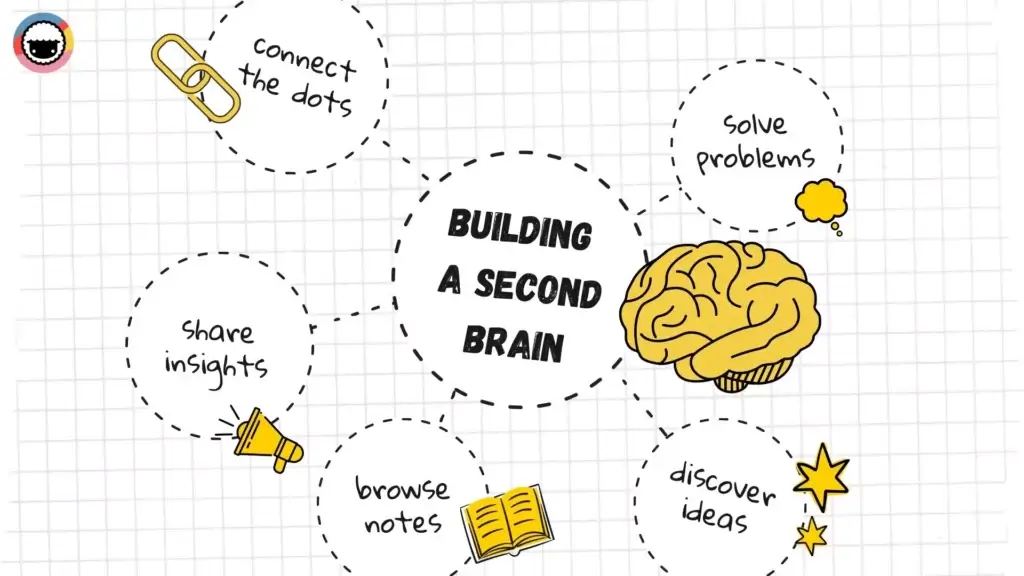
The first stage is selective intake – the point of entry that ultimately determines the quality of the entire system. Reading, in this context, is no longer an act of indiscriminate consumption, but a goal-oriented process. The reader does not simply “pass through” a text, but engages in an ongoing dialogue with it through questions: which ideas have lasting value beyond their immediate context? which pieces of information can be reused in different situations? what connects with existing knowledge or current concerns? These questions form a cognitive filter, distinguishing what is worth retaining from what can be discarded. The outcome of this stage is not a large volume of information, but a smaller set with genuine developmental potential.
The second stage is active note-taking – where information is “fixed” into a form that can be further processed. However, this is not an act of copying, but one of selection and minimal restructuring. The note-taker must identify the “center of gravity” of the content – the core ideas that can represent the broader argument – and record them as concisely as possible. These notes function as cognitive anchors, preserving the structural essence of an idea without dependence on the full original text. More importantly, they serve as raw material for deeper processing in subsequent stages.
The third stage is transformation – the decisive step in converting information into personal knowledge. At this point, the note-taker moves beyond retention and begins to intervene. Rewriting ideas in one’s own language forces a level of understanding sufficient to reconstruct them according to one’s own logic. In this process, ambiguities become visible, gaps in comprehension demand clarification, and it is precisely this effort that generates cognitive depth. The result is a set of independent knowledge units – each clear enough to stand outside its original context, and flexible enough to connect with other ideas.
The fourth stage is organization – where these units of knowledge are placed within a deliberate structure. If notes remain isolated, they quickly become difficult to retrieve and lose value over time. Organization establishes a “map” of the system, in which each note has a position and function. This structure may be based on various criteria – topics, projects, problems, or even states of use – but its overarching goal is to create a system that is both orderly and adaptable. An effective organizational framework not only improves retrieval efficiency, but also creates opportunities for ideas to “encounter” one another in new contexts.
The fifth stage is connection – the step that transforms the system from a static repository into a dynamic network. As notes begin to link with one another, they cease to be isolated units of information and become nodes within a knowledge network. Each connection introduces a new possibility: comparison, contrast, synthesis, or the formation of more complex ideas. Crucially, the value of connections lies not in their quantity, but in their significance. A meaningful link does not merely highlight similarity, but often reveals contrast, opening new directions of thought that were previously unrecognized. It is within this space of interconnectedness that creativity begins to emerge as a natural byproduct.
The final stage is application – where the entire system is tested in practice. Knowledge that is not used gradually loses its sharpness and becomes inert. Writing, analyzing, explaining, or applying ideas to solve problems does not simply “consume” accumulated knowledge; it restructures it at a higher level. When a note is used in a piece of writing, it is placed into a new context; when multiple notes are combined, they form an argument; and through this process, new connections continue to emerge. Application, therefore, is not the endpoint of the process, but a feedback loop – where knowledge is activated, tested, and continuously refined.
Taken as a whole, these six stages – intake, note-taking, transformation, organization, connection, and application – form a closed yet dynamic cycle. Each iteration not only reinforces existing knowledge, but also expands the system in new directions. A “Second Brain” built upon this process does not merely store the past; it becomes a living structure – one in which knowledge is continuously regenerated, adapted, and developed alongside the individual who uses it.
5. “SECOND BRAIN” AND THE TRANSFORMATION OF THINKING
When a “Second Brain” is maintained as a long-term practice, its impact extends beyond the technical domain – how information is stored or retrieved – and gradually reaches a deeper level: the very structure of thought itself. What begins as a support system for memory evolves, over time, into an environment that shapes how one thinks, frames problems, and generates ideas. In other words, a shift in tools leads to a shift in cognition.
The most immediate transformation occurs in the role of the reader. From being a passive recipient, the reader gradually becomes an active creator of knowledge. Note-taking is no longer an act of preserving someone else’s ideas, but a process of re-producing them in a new form – where each idea is reinterpreted, repositioned, and at times critically examined. In this context, each note is not a copy, but a processed version – marked by the writer’s own understanding, selection, and emphasis. As these notes accumulate over time, they do not merely form a database, but give rise to a cognitive structure – a system of perspectives characterized by continuity and the capacity for self-development.
It is through this process that what may be called a “personal voice” begins to emerge. Unlike fragmented statements or spontaneous reactions, this voice is built upon accumulation and connection. New ideas do not arise in isolation, but are situated in relation to prior reflections. As a result, thinking becomes continuous rather than disjointed, capable of both inheritance and expansion. Over time, the user of such a system does not simply “hold opinions,” but develops a structured way of interpreting the world – where arguments are interconnected, observations are contextualized, and conclusions are no longer arbitrary.
Parallel to the formation of a personal voice is a shift toward systems thinking. As notes are organized and linked into networks, the user becomes accustomed to viewing knowledge as a web of relationships rather than as isolated units. A problem is no longer approached at the surface level, but is examined within a broader context of causes, consequences, conditions, and interacting variables. This mode of thinking is particularly critical in the modern world, where most challenges – whether economic, social, or personal – are complex and cannot be addressed through simple linear reasoning.
Moreover, a “Second Brain” introduces a necessary distance between the thinker and the object of thought. When ideas are externalized and placed into a structured system, they become objects that can be observed, revised, and evaluated. This separation helps mitigate cognitive biases that often arise when thinking remains entirely internal. The writer can revisit an earlier note, treat it as an independent entity, and identify inconsistencies, gaps, or unexplored possibilities. It is through this reflective process that thinking becomes sharper and more self-correcting.
Finally, the transformation of thought brought about by a “Second Brain” does not occur abruptly, but accumulates through repeated interactions with the system. Each act of note-taking, each connection made, and each retrieval of information represents a small restructuring of cognition. Over time, these incremental changes crystallize into a new mode of thinking – slower yet deeper, more structured yet more flexible. In an increasingly complex knowledge environment, the ability to think in this way is not merely advantageous, but gradually becomes a necessary condition for understanding and acting with intention.
6. COMMON MISCONCEPTIONS
In the process of approaching and building a “Second Brain,” many individuals encounter systemic misconceptions – seemingly reasonable interpretations that, in practice, undermine the effectiveness of the entire endeavor. These misunderstandings often stem from conflating form with substance, or from the tendency to seek quick solutions in what is inherently a long-term, accumulative process.
The first – and most widespread – misconception is the belief that “the more you capture, the better.” On the surface, this appears logical: if the goal is to build a knowledge system, then accumulating more information should increase its value. In reality, however, the opposite tends to occur. When the volume of notes exceeds one’s capacity to process and retrieve them, the system begins to lose clarity. Information is no longer clearly distinguished between what is essential and what is peripheral, leading to a state of “cognitive noise” in which the user struggles to quickly locate or recognize what truly matters. In such cases, note-taking ceases to support thinking and instead becomes a cognitive burden. An effective system is not measured by its size, but by its density of meaning: each note exists for a clear purpose and contributes to a living network of knowledge.
The second misconception concerns the role of tools. The proliferation of digital note-taking platforms has created the impression that the effectiveness of a “Second Brain” depends primarily on selecting the right software. Users often fall into cycles of experimentation, switching, and optimization, with the expectation that a better technical system will automatically improve the quality of their thinking. However, tools are merely vehicles of expression, not sources of knowledge. Any note-taking system, regardless of platform, ultimately reflects how the user thinks, selects, and organizes information. Without a clear methodology, changing tools only alters the surface, not the substance. Conversely, when principles and processes are well-defined, even the simplest tools can support a highly effective knowledge system. Misplacing emphasis – prioritizing tools over thinking – often leads to misdirected effort.
The third misconception is the expectation of perfection from the outset. Many approach the idea of a “Second Brain” with the intent to design an optimal system immediately – from folder structures and categorization schemes to rules for note-taking and linking. Yet this very expectation becomes the greatest obstacle. Before a system is used in practice, any design remains hypothetical; when reality diverges from these assumptions, users tend to either endlessly revise or abandon the system altogether. In practice, an effective “Second Brain” is not a perfectly engineered construct from the beginning, but an evolving system. It develops through use, feedback, and iteration; each adjustment is not a correction of error, but an adaptation to increasingly स्पष्ट needs. Accepting initial imperfection, therefore, is not a compromise, but a prerequisite for growth and maturation.
Taken together, these misconceptions reveal a broader pattern: the tendency to seek certainty and optimization in visible elements – quantity, tools, structure – while the true essence of a “Second Brain” lies in less tangible factors such as selectivity, consistency, and usability. Recognizing and overcoming these misconceptions not only prevents wasted effort, but also reorients the user toward the core objective: building a living, flexible knowledge system that remains deeply integrated with the process of thinking itself.
7. CHALLENGES IN MAINTAINING THE SYSTEM
Establishing a “Second Brain” already demands a degree of awareness and discipline, but sustaining it over the long term is the more formidable challenge. Unlike purely technical systems, a personal knowledge system depends directly on the user’s behavior and habits. When interaction with the system is interrupted, it not only ceases to grow but gradually loses its coherence and functional integrity.
The most common obstacle is inconsistency. Note-taking, by nature, is not a spontaneous act but a practice that requires regular repetition. In reality, however, many people only take notes when they feel inspired or when they encounter content that seems “interesting enough.” This creates an irregular rhythm, causing the system to become fragmented. As the gaps between note-taking sessions widen, returning to the system becomes increasingly difficult – not only operationally, but psychologically. Over time, the system loses continuity, and the user begins to lose a sense of ownership over it. The issue here is not a lack of ability, but the failure to internalize note-taking as a cognitive habit – an integral part of reading and thinking.
Another structural challenge is information overload. When the input into the system exceeds the user’s capacity to process it, foundational principles such as selectivity and simplification begin to break down. Users start storing more than necessary, driven by the assumption that everything might be useful later, yet lack the time or cognitive resources to revisit and process it. The result is a system that expands in size but deteriorates in function: information exists but is never activated, notes accumulate but remain unconnected. In such a state, the system no longer supports thinking; instead, it becomes a source of cognitive overload, where retrieving an idea is more demanding than reconstructing it from scratch.
In addition, the absence of purpose significantly weakens the system. When note-taking is not tied to a concrete objective – such as writing, research, or problem-solving – it risks becoming a purely formal activity. Users continue to record information, but without a clear intention to use it. In this scenario, the system functions as a “potential archive” that is never activated. Knowledge fails to enter the cycle of thinking and gradually loses its practical relevance. This lack of purpose also diminishes motivation: without visible outcomes, there is little incentive to continue investing time and effort.
In response to these challenges, the solution does not lie in increasing the system’s complexity – by adding more layers of categorization, rules, or tools – but rather in returning to principles of simplicity. An effective system does not need to capture everything; it needs to align with the user’s actual pace and needs. Maintaining a moderate but consistent note-taking rhythm is far more valuable than periods of intense activity followed by abandonment. At the same time, limiting input and prioritizing the processing of existing material helps keep the system in a usable state, rather than allowing it to become saturated with unprocessed information.
Ultimately, the value of a “Second Brain” is not determined by how structurally refined it appears, but by how present it is in everyday thinking. A small, simple system that is used consistently will gradually evolve into a robust and flexible structure. In contrast, an elaborately designed system that lacks interaction quickly becomes meaningless. Maintenance, therefore, is not about preserving the system in a static form, but about keeping it alive – through continuous use, adaptive refinement, and deep integration with the actual process of thinking.
8. DEEPER SIGNIFICANCE – THE “SECOND BRAIN” AS A FORM OF INTELLECTUAL AUTONOMY
At a surface level, a “Second Brain” can be understood as a knowledge management system – a means of helping individuals store, organize, and retrieve information more efficiently. However, when examined more closely in terms of how it operates and influences cognition, its significance extends far beyond technical functionality. It does not merely change how information is processed; it redefines the relationship between the individual and the broader flow of knowledge in society. In this sense, a “Second Brain” becomes a form of intellectual autonomy – the capacity to consciously shape what one knows, how one knows, and how that knowledge is ultimately used.
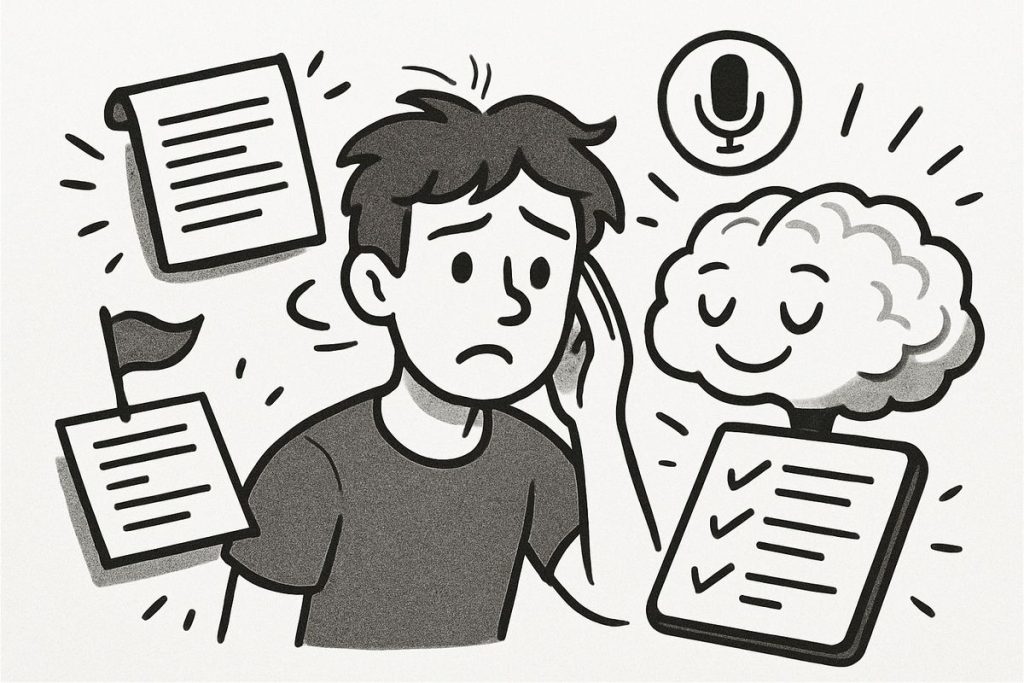
In the contemporary environment, where information is produced and distributed at unprecedented speed, individuals increasingly face the risk of being drawn into a state of passive consumption. Content appears continuously, in diverse forms, and is optimized to capture attention, making deliberate selection more difficult than ever. In the absence of a system to filter and retain information, knowledge intake becomes governed by immediacy: what is new, prominent, or easily consumable takes precedence, while ideas of long-term value are often overlooked. Under such conditions, cognition is no longer guided by internal priorities, but by the structural logic of the information environment itself.
It is precisely at this juncture that a “Second Brain” functions as a mechanism for reclaiming control. By establishing a dedicated space for storing and organizing knowledge, the individual is no longer entirely dependent on external flows, but can actively determine what is worth retaining. Each act of note-taking becomes a deliberate decision: does this idea merit inclusion in my system of thought? Over time, these decisions accumulate into a highly personalized knowledge structure – one that reflects not only what has been read, but how it has been evaluated, prioritized, and connected. Knowledge, in this framework, is no longer something passively received, but something actively constructed.
At another level, a “Second Brain” can be understood as a form of intellectual capital. Unlike fragmented information – which is easily forgotten or replaced – processed, connected, and integrated notes possess a cumulative quality. Each note is not merely an isolated unit of knowledge, but part of a larger structure, whose value increases with the number and quality of its connections. As the system develops, it not only reflects what an individual already knows, but also expands their capacity for future thinking and creativity. In this sense, knowledge ceases to be a consumable resource and becomes a form of capital – one that can be reused, recombined, and compounded over time.
Importantly, this form of capital does not exist independently of the individual, but is inseparable from its use. A note only becomes “valuable” when it is retrieved, placed into a new context, or used to construct an argument. It is this continuous interaction that keeps the system alive, while simultaneously reinforcing the individual’s control over their own knowledge. The owner of a “Second Brain,” therefore, is not merely a collector of information, but a manager of a knowledge ecosystem – one in which each component can be activated and developed according to need.
Taken as a whole, the deeper significance of a “Second Brain” lies in its capacity to provide a foundation for escaping dependence on the external flow of information. In a world where knowledge is increasingly fragmented and abundant, the ability to self-organize and self-direct becomes a core competency. Within this context, a “Second Brain” is not simply a supportive tool, but a structural framework that enables individuals to remain deliberate, consistent, and intellectually autonomous in how they engage with and create knowledge.
9. CONCLUSION – READING TO CREATE, NOT MERELY TO CONSUME
In an environment where information continues to expand in both volume and velocity, the criteria for evaluating intellectual capacity have undergone a subtle but significant shift. Reading extensively is no longer an advantage in itself if it is not accompanied by the ability to organize, process, and transform what has been read. The distinction no longer lies in the quantity of information absorbed, but in how that information is integrated into a structured system – one in which it can be retrieved, connected, and applied with intention. In this context, a “Second Brain” is not merely a supportive tool, but an essential intermediary mechanism that bridges two stages often treated as separate: consumption and creation.
Reading, when confined to the act of exposure, remains fundamentally a form of consumption – albeit an intellectual one. It may broaden perspective in the short term, but rarely produces lasting change without a deeper process of engagement. Only when information is captured, rearticulated, placed in relation to other ideas, and ultimately applied does it move beyond a transient state to become genuine knowledge. It is this progression – from intake to organization, from organization to application – that enables reading to generate enduring value.
In this sense, a “Second Brain” does not alter the nature of reading, but completes it. It provides a structure through which what is encountered does not dissipate over time, but is accumulated, reinforced, and developed. Each note is not merely a trace of reading, but a unit within a larger system – one in which ideas are preserved not because they once appeared, but because they retain the potential to be used. As this system is maintained and expanded, reading ceases to be a sequence of isolated experiences and instead becomes a continuous process marked by coherence, continuity, and direction.
From this perspective, the value of knowledge cannot be measured by the amount of information acquired, but by the degree of organization and the operational capacity of the system that contains it. A large volume of unstructured information quickly loses its usability; conversely, a well-organized system can extract significant value from even a modest amount of input. This suggests that the true advantage does not belong to those who “know more,” but to those who “use better” – those capable of transforming knowledge into a functional instrument for thinking and action.
Ultimately, when knowledge is embedded within a meaningful structure, the relationship between the individual and the world is fundamentally altered. One is no longer merely a receiver of reality through information, but an active agent in interpreting and reconstructing it. Memory is no longer the final objective; instead, it becomes the foundation for deeper understanding, broader connection, and the creation of new perspectives. In this process, a “Second Brain” does not simply help preserve the world – it participates in shaping how that world is understood, organized, and ultimately reimagined through the lens of the individual.