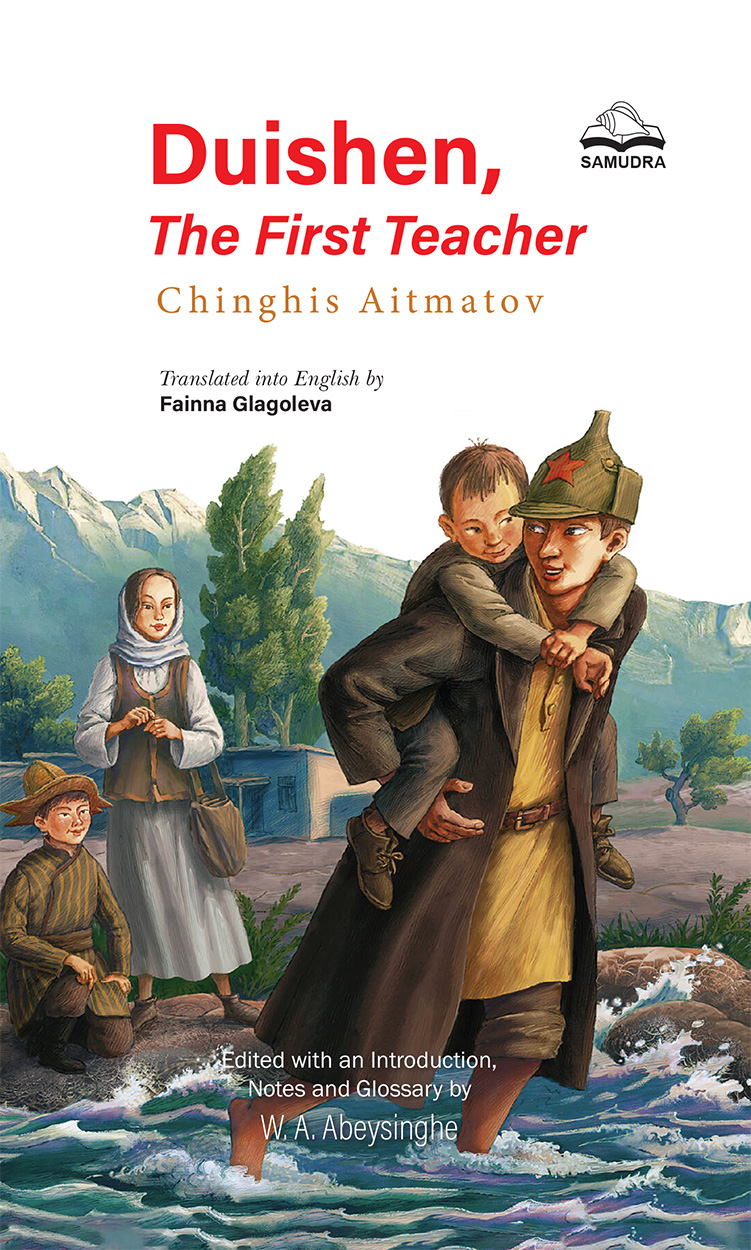
In the memory of every person, there is always the image of a first teacher – the one who opens the initial door leading us into the world of letters, knowledge, and fundamental values of life. That teacher may not be perfect, may even be awkward or clumsy, yet often leaves the most enduring influence, because they appear at a time when a person is still young, vulnerable, and most receptive to guidance. World literature has touched upon this theme many times, but few works portray the figure of the teacher with such simplicity, authenticity, and lasting resonance as The First Teacher by Chingiz Aitmatov.
Set against the backdrop of Central Asia in the early twentieth century – when modern education was still a foreign concept in impoverished steppe villages – The First Teacher does not tell a “grand” story in the conventional sense. Instead, it focuses on a very small slice of life: a village teacher, a makeshift classroom, a handful of barefoot children, and the skeptical gazes of the community. Yet from this modest setting, Aitmatov raises a profoundly universal question: where does education begin, and who is brave enough to take the first step in the journey of enlightenment?
With a quiet, deeply humanistic tone, The First Teacher is not merely a story about the teaching profession. It is a subtle record of the collision between the old and the new, between entrenched traditions and the desire for change. The work confronts readers with a restrained but haunting question: what truly defines the value of a teacher – extensive knowledge, or an unwavering belief in the power of education to transform human beings?
It is precisely through this simple yet profound approach that The First Teacher transcends the limits of a time-bound short novel to become a work of lasting vitality, especially for those concerned with education, reading culture, and the process of human growth in modern society.
1. Introduction to the Author and the Work
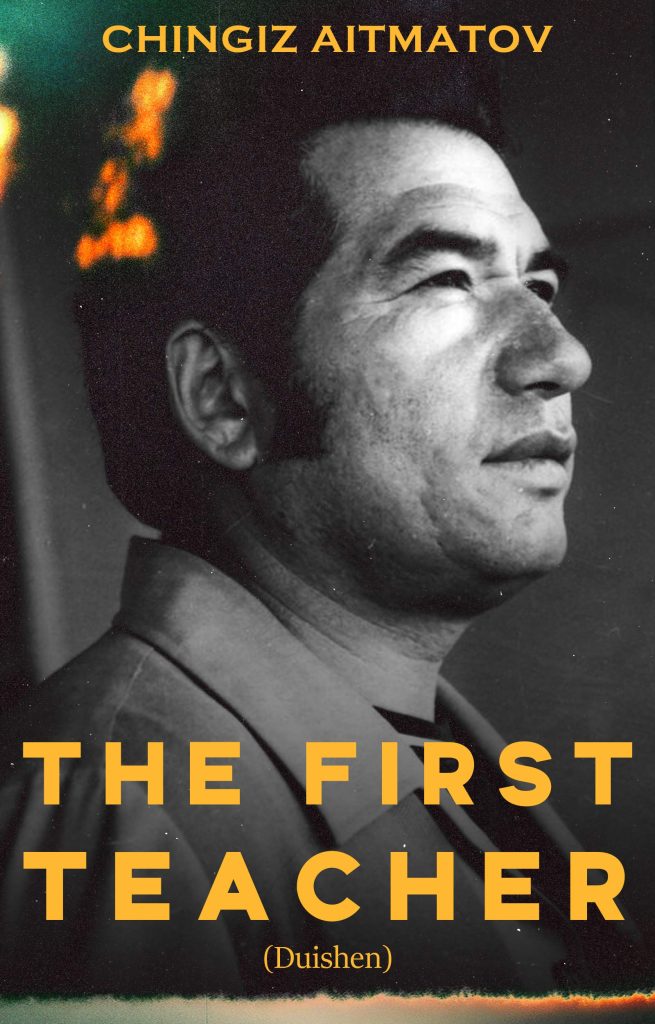
Chingiz Aitmatov (1928–2008) was one of the most influential writers of Soviet and Central Asian literature in the twentieth century. He was born in Kyrgyzstan into an intellectual family deeply affected by historical upheavals: his father, a state official, was executed during Stalin’s purges. This personal tragedy left a profound mark on Aitmatov’s literary worldview, and his works consistently reflect meditations on human fate, historical memory, and the silent losses borne by society.
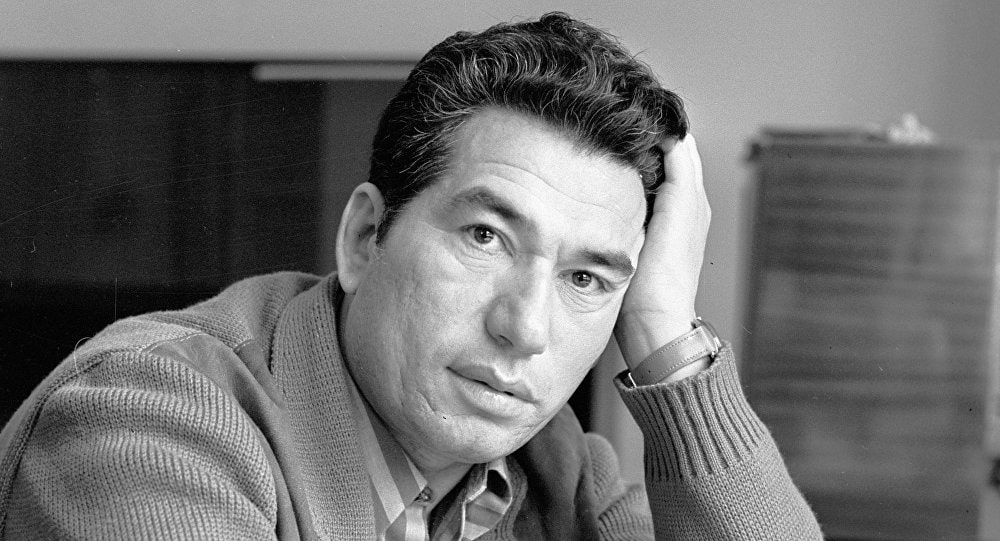
Aitmatov entered literature with a unique foundation shaped by the intersection of Central Asian nomadic culture and modern Soviet thought. Writing in both Kyrgyz and Russian, he brought stories from the remote steppes to a global readership. A defining feature of his prose is the harmonious blending of Eastern lyricism, elements of folk mythology, and a restrained, realistic narrative style rich in philosophical depth. As a result, his works transcend local realities to address issues of universal human concern.
Throughout his prolific career, Chingiz Aitmatov became widely known for major works such as Jamila – praised by Louis Aragon as “the most beautiful love story in the world” – The White Ship, The Red Scarf, and The Day Lasts More Than a Hundred Years. Each of these works places individuals at moral crossroads where tradition, memory, and modernity collide.
The First Teacher, published in 1962, stands as one of Aitmatov’s most representative works on education and enlightenment in the context of early twentieth-century Central Asia. The story draws inspiration from the initial efforts to build a new educational system in remote rural areas, where literacy and schooling were still unfamiliar concepts, often viewed with suspicion or outright resistance.
Unlike many contemporaneous works that tended toward propaganda or idealized portrayals of teachers, The First Teacher approaches its subject with a humane and clear-eyed perspective. The teacher in the story is not constructed as a flawless symbol of knowledge, but as a concrete individual marked by limitations, awkwardness, and even failure. This artistic choice allows the work to move beyond the confines of topical literature and endure as a timeless story about humanity and education.
Through The First Teacher, Chingiz Aitmatov not only recounts a historical moment but also creates one of the most memorable teacher figures in world literature – a pioneer of knowledge in conditions of poverty and backwardness, forced to confront the loneliness of those who walk ahead of their time. This is precisely why the work continues to captivate readers, particularly those interested in the role of education in shaping individual and collective destinies.
2. Summary of the Plot
The First Teacher is structured as a recollection, narrated through the memories of Altynai, who has grown into an accomplished intellectual. Returning to her old village to attend the unveiling of a portrait of her former teacher, Altynai confronts her own past, and through her reflections, the story of her first teacher gradually unfolds in a quiet yet deeply affecting stream of memory.
The setting is a poor village on the Kyrgyz steppe in the early twentieth century, a time when modern education was virtually nonexistent. The villagers lived in poverty and backwardness, heavily bound by patriarchal customs. Literacy was regarded as a luxury, even a threat, because it had the potential to disrupt the established social order. Against this backdrop, the arrival of Dyuisen, a young former Red Army soldier assigned to open a school for village children, appears strikingly out of place in local life.
Dyuisen is not an erudite intellectual. His knowledge is limited, his teaching methods crude, and his manner rough. What sets him apart, however, is his near-absolute faith in the power of education. With no proper school building, he converts an old stable into a classroom. With insufficient desks and books, he teaches children their first letters amid the harsh winds and snow of the steppe. That first classroom is fragile and makeshift, yet it becomes the birthplace of knowledge for a new generation.
Dyuisen’s students are impoverished children accustomed to labor rather than study. They attend class with a mixture of curiosity and fear, as learning offers no immediate practical benefit compared to herding livestock or doing household chores. The villagers view the school with suspicion, even ridicule, dismissing the young teacher’s efforts as futile. In such an environment, Dyuisen must not only teach literacy but also endure the loneliness of someone moving against the collective mindset.
Among the students, Altynai stands out. Orphaned and living at the mercy of relatives, she is treated as a burden. Her fate seems predetermined: an early marriage and a life of poverty and submission. Dyuisen, however, recognizes her intelligence, sensitivity, and rare thirst for learning. For Altynai, the classroom is not merely a place to study but the only space where she feels respected and hopeful.
Dyuisen becomes Altynai’s protector against familial pressure and village customs. He insists on keeping her in school despite mockery and opposition. When Altynai is eventually given the opportunity to continue her education in the city, it marks not only a turning point in her life but also the clearest validation of Dyuisen’s belief in education. Yet the teacher’s sacrifices bring no immediate reward or recognition. He remains in the village, quietly continuing his work amid hardship and indifference.
Years later, Altynai returns as a successful adult. In that moment, past and present converge, revealing – to both the character and the reader – that her intellectual journey began in that impoverished classroom and with an imperfect teacher sustained by unwavering faith. The story closes not with dramatic climax but with quiet realization: the most profound changes in life often originate from small, persistent, and largely unacknowledged acts.
3. Thematic and Artistic Value
At its deepest level, The First Teacher is a work about education as a solitary journey of enlightenment, where knowledge advances not through grand strides but through patience, perseverance, and silent sacrifice. Chingiz Aitmatov does not treat education as a slogan or a collective achievement, but as a slow and arduous process, one that demands personal cost – especially from the teacher.
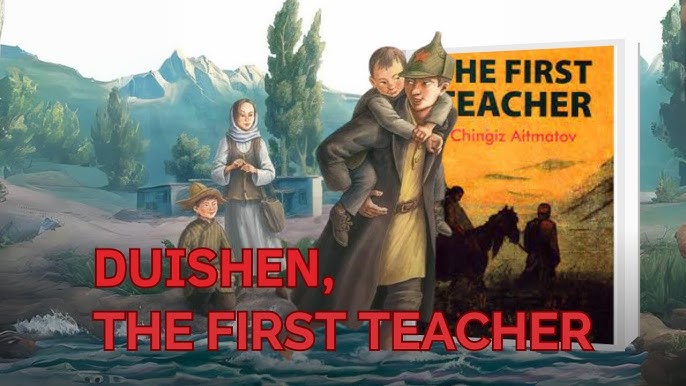
The central thematic strength of the work lies in how Aitmatov situates the teacher within his specific historical and social context. Dyuisen is not an idealized embodiment of knowledge. He lacks systematic education, employs rudimentary teaching methods, and at times appears clumsy or irritable. Yet this very imperfection renders the character authentic and convincing. Aitmatov suggests that in the early stages of enlightenment, what matters most is not expertise, but a sense of mission and an unshakable belief in the value of literacy.
The work also vividly portrays the conflict between tradition and progress. The village is not romanticized as a pure or idyllic space; instead, it is depicted as a place rife with prejudice, conservatism, and psychological violence. Education is resisted because it threatens entrenched hierarchies, particularly those tied to patriarchal authority and the fate of women. Through Altynai’s story, Aitmatov addresses the painful issue of liberation through education, especially for society’s most vulnerable members.
Altynai is more than Dyuisen’s student; she embodies the human capacity for self-renewal through learning. Her growth does not occur overnight but is rooted in the earliest lessons of that impoverished classroom. The author shows that education does not merely transmit knowledge – it instills self-worth, the ability to choose, and the right to dream. This is what elevates The First Teacher beyond a simple narrative about teaching into a deeply humanistic work.
Artistically, the use of a retrospective narrative structure is a deliberate and effective choice. Telling the story from Altynai’s adult perspective creates temporal distance, allowing the reader to grasp the long-term significance of seemingly small actions in the past. This distance highlights the work’s central paradox: the teacher remains behind in poverty and obscurity, while the student moves forward into a wider world – a paradox that is both painful and noble.
The language of The First Teacher is restrained yet evocative. Images such as the old stable, the snowy steppe winds, and the muddy village roads function not merely as descriptive details but as symbols of the arduous path knowledge must traverse to enter human life. Aitmatov avoids dramatic climaxes, allowing emotion to accumulate gradually, in keeping with a story centered on endurance rather than immediate triumph.
Ultimately, the value of The First Teacher lies not in a simplistic educational message, but in its capacity to prompt reflection on the role of pioneers – those who accept isolation and doubt in order to open paths for others. It is this depth of thought that gives the work its enduring relevance and universal significance.
4. Memorable Quotations
In The First Teacher, Chingiz Aitmatov avoids didactic proclamations or overt philosophical statements. Instead, the ideas of the work are conveyed through simple sentences that emerge naturally within the narrative, yet carry substantial ideological weight when viewed in the context of the characters’ journeys. The following quotations exemplify how Aitmatov articulates the role of education, the figure of the teacher, and the meaning of enlightenment in human life.
1. “Our first school was nothing more than an old stable.”
→ This sentence establishes the contrast between material deprivation and the aspiration for knowledge, laying the foundation for the work’s central idea: education can begin from the most modest conditions.
2. “Teacher Dyuisen did not know many letters, but he believed in literacy more than anyone.”
→ Aitmatov emphasizes belief as the core quality of a teacher, transcending formal expertise or pedagogical technique.
3. “The villagers laughed at him because they could not understand why one should learn things that brought no immediate benefit.”
→ The quotation captures the tension between traditional pragmatism and the long-term vision of education.
4. “For him, every child who learned to read was a victory.”
→ Education is framed as a cumulative struggle, where small achievements carry profound significance.
5. “No one believed in him except himself.”
→ This concise sentence expresses the silent tragedy of the pioneer: loneliness in faith and conviction.
6. “I do not know when I began to excel in my studies; I only know that he never allowed me to give up.”
→ Through Altynai’s voice, the teacher emerges not merely as an instructor, but as a guardian of perseverance.
7. “Had I not been allowed to attend school, my life would have taken a different path.”
→ The quotation affirms education as a decisive factor in shaping one’s ability to choose a destiny.
8. “He stayed in the village, and I left, but the road I took began with him.”
→ The central paradox of the work is clearly articulated: the teacher’s silent sacrifice underpins the student’s advancement.
9. “Knowledge came slowly to our village, but once it took root, it could not easily be uprooted.”
→ Aitmatov underscores the enduring strength of education despite resistance and hardship.
10. “The first teacher did not only teach letters; he taught people to believe that they could become different.”
→ This quotation encapsulates the core message of the work: education transforms not only understanding, but self-perception and the possibility of life itself.
5. Conclusion
As The First Teacher draws to a close, what lingers is not a dramatic plot or major upheavals, but the enduring resonance of a quiet journey of enlightenment. Through the figure of Dyuisen and the growth of Altynai, Chingiz Aitmatov shows that education rarely begins under ideal conditions; it often takes root amid scarcity, doubt, and solitude. It is precisely in such circumstances that the true value of the teacher and the transformative power of knowledge become most visible.
The work does not idealize education as a straight path to success, but portrays it as a long-term process whose outcomes may only become apparent years later, sometimes through the lives of others. The teacher remains behind in poverty and obscurity, while the student steps into a wider world – this paradox is both realistic and profoundly humane. The First Teacher is therefore not merely a story about teaching, but a tribute to those pioneers who quietly lay the foundations for social change.
On a personal level, The First Teacher is a book that is easy to read yet difficult to forget. Its power lies not in dramatic events, but in the sense of reflection it leaves behind: respect for knowledge, for ordinary teachers, and for small beginnings capable of transforming an entire life. In a time when education continues to face debate and challenge, Chingiz Aitmatov’s work remains strikingly relevant, prompting readers to ask themselves: who was their own “first teacher,” and where did their journey of learning truly begin?