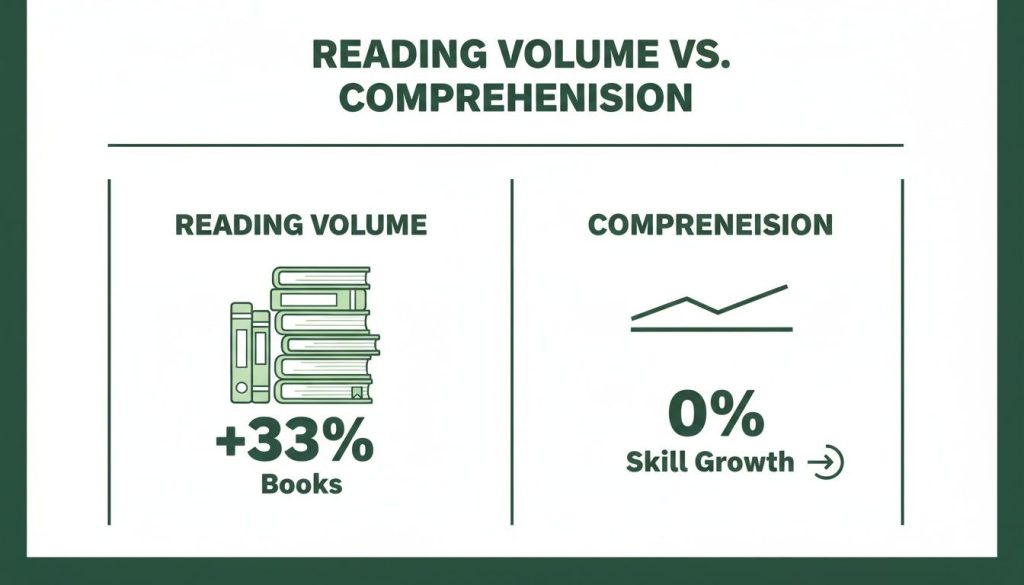
In the historical development of human knowledge, reading has always been regarded as one of the most fundamental pathways through which individuals access, accumulate, and transmit understanding. However, in the digital age – where information is produced and disseminated at an unprecedented speed – the act of reading is undergoing a profound transformation. People today are not lacking in opportunities to read; on the contrary, they are surrounded by an overwhelming volume of texts – from books, newspapers, and academic studies to short-form content on social media. Yet, within this abundance, a notable paradox emerges: people are reading more than ever before, but their capacity for deep comprehension, retention, and practical application of knowledge appears to be declining.
The phenomenon of skimming, reading for “main ideas,” and consuming content as a rapid reflex has become increasingly common. In many cases, reading is no longer a process of thinking, but merely an act of surface-level reception. As a result, knowledge – despite being encountered in large quantities – is not internalized and does not become part of one’s cognitive competence. Readers may remember that they have “read” something, but are unable to explain it, apply it, or translate it into concrete action.
It is precisely in this context that a fundamental question arises: why does reading not automatically transform into skill? And how can the process of receiving information be turned into a genuine process of learning? The answer lies in a concept that has been increasingly emphasized in education and cognitive research: active reading.
1. THE CONCEPT OF “ACTIVE READING” – BEYOND PASSIVE RECEPTION
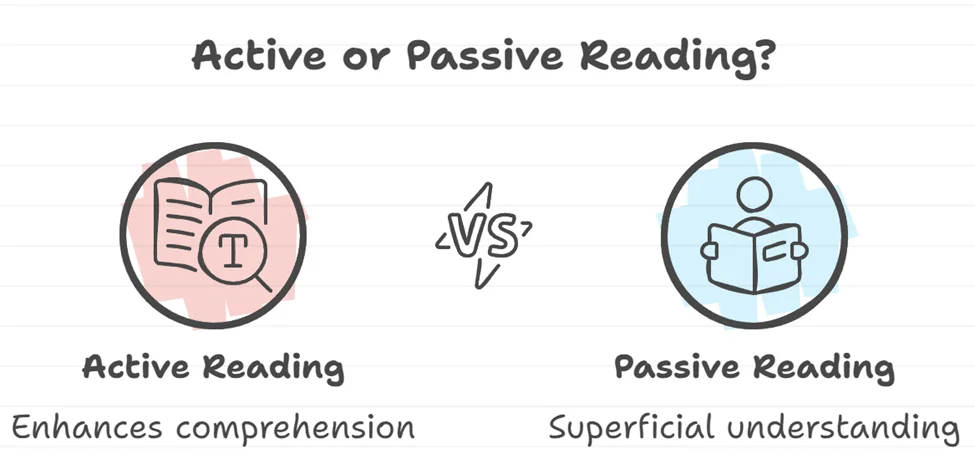
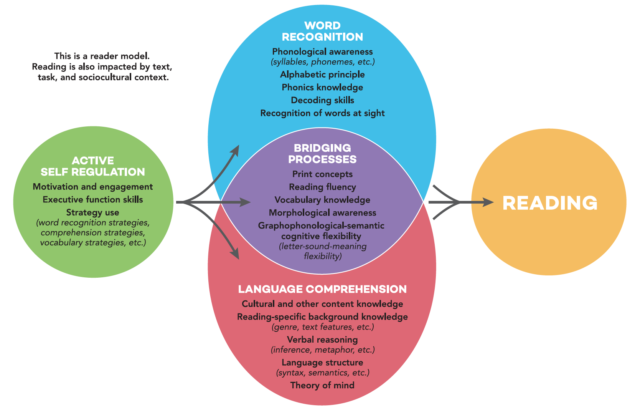
At a fundamental level, reading is often understood as the act of receiving information through written language. However, when examined more closely, this activity reveals two fundamentally different modes of engagement: passive reading and active reading. This distinction is not merely descriptive, but reflects two distinct levels of cognitive processing – one oriented toward linear reception, the other toward interaction, analysis, and the construction of meaning.
Passive reading is the most common form in practice, especially in a context where readers are increasingly shaped by the speed and volume of information. In this mode, the text is approached as a finished stream of structure and meaning. Readers tend to follow the text’s internal logic, absorbing content sequentially without raising questions or seeking verification. As a result, the act of reading largely remains at the level of “understanding what is said,” without advancing to “understanding why it is said in that way” or “how it might be interpreted differently.” Consequently, information is received but not deeply processed, making it easily forgotten and difficult to transform into practical competence.
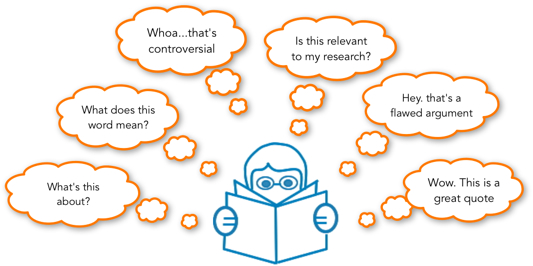
In contrast, active reading places the reader in an entirely different position – that of an engaged and reflective cognitive agent. Rather than merely receiving, the reader enters into an ongoing dialogue with the text. Every claim, argument, and linguistic choice becomes a potential object of inquiry: What assumptions is the author making? On what basis is this argument constructed? Are there alternative interpretations? How does this text relate to what I already know or have experienced? It is precisely this chain of questioning that generates a space for thinking, in which the text is no longer a closed entity, but an open structure subject to analysis, reinterpretation, and expansion.
Within this framework, the essence of active reading lies not in reading more, but in reading more deeply and with greater awareness. The reader does not simply follow the flow of information, but continuously monitors their own cognitive process – a capacity often referred to as metacognition. They recognize when understanding is incomplete, when an argument is unconvincing, and when it is necessary to pause, reflect, compare, or seek additional information. Reading, therefore, does not unfold passively over time, but operates as a dynamic and adaptive process, shaped by the complexity of the material and the reader’s cognitive goals.
More importantly, active reading does not end with the comprehension of textual content; it extends into the integration of knowledge into one’s existing cognitive framework. Information is restructured through summarization, paraphrasing in one’s own language, connecting with prior knowledge, or applying it to concrete situations. This process transforms knowledge from an “external” state (residing in the text) into an “internal” one (becoming part of personal understanding).
In other words, active reading is a higher-order cognitive activity in which the reader not only receives meaning but participates in its production. It mobilizes multiple cognitive capacities simultaneously: analysis, synthesis, critical thinking, association, and self-awareness. In this process, the text is no longer the final destination, but the starting point of an intellectual movement. It is precisely through this mechanism that reading transcends the limits of theoretical knowledge and becomes a foundation for the development of skills – the ability to apply understanding in flexible and effective ways.
2. WHY DOES MOST READING FAIL TO BECOME SKILL?
One of the fundamental reasons why reading often fails to transform into skill lies in what is commonly referred to as the “illusion of understanding.” When encountering a text that is clearly structured, logically argued, and expressed in accessible language, readers tend to experience a sense of cognitive fluency – the feeling that they have “understood” the content. However, this sensation largely reflects surface-level familiarity rather than genuine mastery. The distinction becomes evident only when readers are required to reconstruct the knowledge in their own words, explain it to others, or apply it in a new context. At that point, the gaps in understanding – the areas that were never fully grasped – begin to emerge. In other words, passive understanding often produces a false sense of certainty, whereas true understanding is only validated through the ability to restructure and apply knowledge.
In addition, the absence of clear cognitive goals during reading significantly undermines the transformation of knowledge. When readers do not define why they are reading – whether to build foundational knowledge, solve a specific problem, or develop a particular skill – the process of reception becomes fragmented and directionless. In such cases, the text is approached as a continuous stream of information rather than as a system of meaning to be organized and integrated. As a result, knowledge is not structured into a coherent framework, but instead exists as disconnected fragments that are difficult to link together and even harder to retrieve when needed. Reading, therefore, does not lead to cumulative understanding, but rather to a form of temporary information consumption.
Another critical factor is the absence of post-reading processing – a stage that plays a decisive role in consolidating and transforming knowledge. In practice, many readers treat the completion of a text as the endpoint of reading, without engaging in subsequent activities such as note-taking, summarization, systematization, or self-testing. Consequently, information remains in short-term memory and quickly fades over time. From a cognitive science perspective, knowledge becomes durable only when it is “reactivated” through deeper processing – such as paraphrasing in one’s own words, connecting it with prior knowledge, or placing it in new contexts. Without these operations, reading fails to leave a strong imprint in the memory system and therefore cannot serve as a foundation for skill development.
Finally, a decisive yet often overlooked factor is the lack of connection between knowledge and practice. Knowledge that remains confined to the theoretical domain has little opportunity to be tested, refined, and reinforced. Skill, by definition, is the ability to apply knowledge in concrete actions across diverse contexts. If readers do not actively seek to apply what they have read in their work, studies, or daily life, knowledge remains at the level of potential and is never actualized into competence. It is through the processes of experimentation, error, and adjustment in real-world situations that knowledge becomes flexible and functional.
Taken together, the reason reading does not become skill is not due to any inherent limitation of reading itself, but because it is often confined to surface-level reception. When shaped by the illusion of understanding, a lack of clear purpose, the absence of post-reading processing, and the failure to connect with practice, knowledge cannot be transformed into competence. Only when readers engage actively, consciously, and systematically throughout the entire process – from reception to processing to application – can reading truly become a tool for skill development.
3. CORE PRINCIPLES OF ACTIVE READING
Active reading is not an abstract or purely theoretical concept, but a cognitive approach that can be operationalized through concrete, systematic principles applicable across various contexts. These principles not only guide how texts are approached, but also redefine the role of the reader – shifting from passive reception to active participation in the construction of knowledge.
First and foremost, one of the foundational principles of active reading is that reading must always be accompanied by questioning. This process begins even before engaging with the text, when the reader clearly defines their cognitive objective: what they are seeking, what problem they aim to solve, or what capability they intend to develop through reading. This objective functions as a guiding framework, helping the reader select an appropriate approach and maintain focus throughout the reading process. During reading, continuously posing questions – about the author’s arguments, the validity of the reasoning, the reliability of the evidence, or the underlying assumptions embedded in the text – activates analytical thinking and prevents passive reception. It is this chain of inquiry that creates a dialogic space in which the text is no longer a one-way source of information, but an object of examination and exploration.
Second, note-taking must be reconceptualized as a process of reinterpretation rather than mere transcription. Copying content verbatim may create the illusion of learning, but it does not ensure that information has been processed at a deep cognitive level. In contrast, when readers are required to summarize, paraphrase, or systematize content in their own language, they must engage in a series of complex cognitive operations: selecting key ideas, establishing relationships between concepts, and reformulating expression in a way that aligns with their own mental structures. This process not only strengthens memory, but also exposes gaps in understanding – areas that remain unclear or only partially grasped. In this sense, note-taking becomes a tool for evaluating and refining comprehension, rather than simply storing information.
Third, critical thinking is an indispensable component of any form of active reading. A text, regardless of the authority of its author or the credibility of its sources, must be situated within context and examined independently. This requires the reader not only to absorb content, but also to evaluate arguments based on logic, evidence, and coherence. Questioning underlying assumptions, identifying potential biases, and comparing alternative perspectives expands the scope of understanding and prevents uncritical acceptance of information. More importantly, critical thinking fosters intellectual independence – a fundamental condition for knowledge not merely to be received, but to be selectively processed and reconstructed.
Finally, knowledge only acquires value when it is connected and applied in practice. Information, no matter how accurate or insightful, remains inert if it is not linked to personal experience or used in concrete situations. Therefore, active reading necessarily involves seeking connections: How does this content relate to what I already know? How can it be applied in academic, professional, or everyday contexts? Situating knowledge within real-world frameworks not only reinforces understanding, but also enables it to be tested and refined through experience. It is through this process that information is transformed into skill – the capacity to apply knowledge flexibly and effectively across different situations.
Taken as a whole, the principles of active reading do not function in isolation, but operate as an integrated system: from defining objectives, questioning, and reinterpretation, to critical evaluation, connection, and application. When practiced consistently, these principles not only enhance reading effectiveness, but also contribute to the development of comprehensive cognitive abilities – the essential foundation for transforming knowledge into sustainable skill.
4. SPECIFIC METHODS OF ACTIVE READING
In practice, active reading does not remain at the level of guiding principles, but is actualized through concrete methods with clear structures, many of which have been validated in the fields of cognitive science and educational research. These methods provide readers with actionable “operational frameworks,” transforming reading from a spontaneous activity into a strategic process that can be systematically optimized.
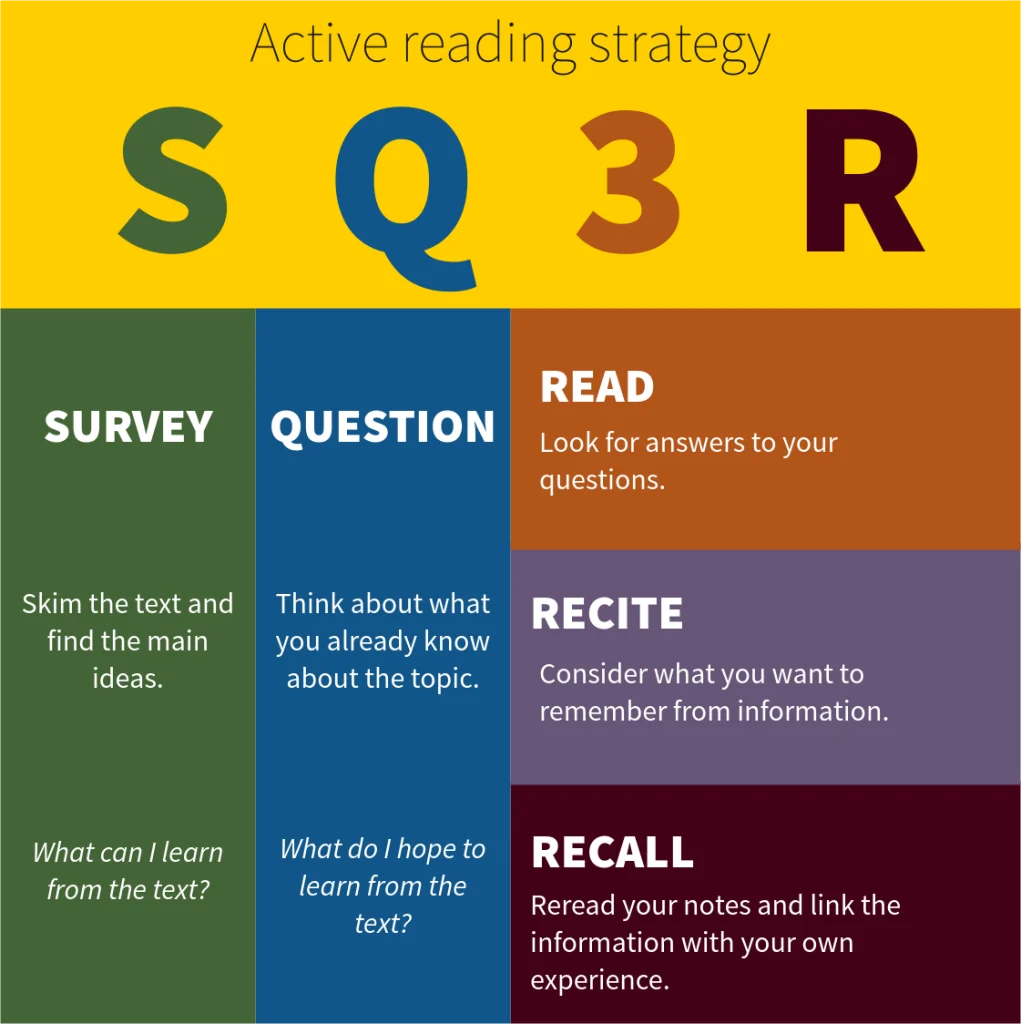
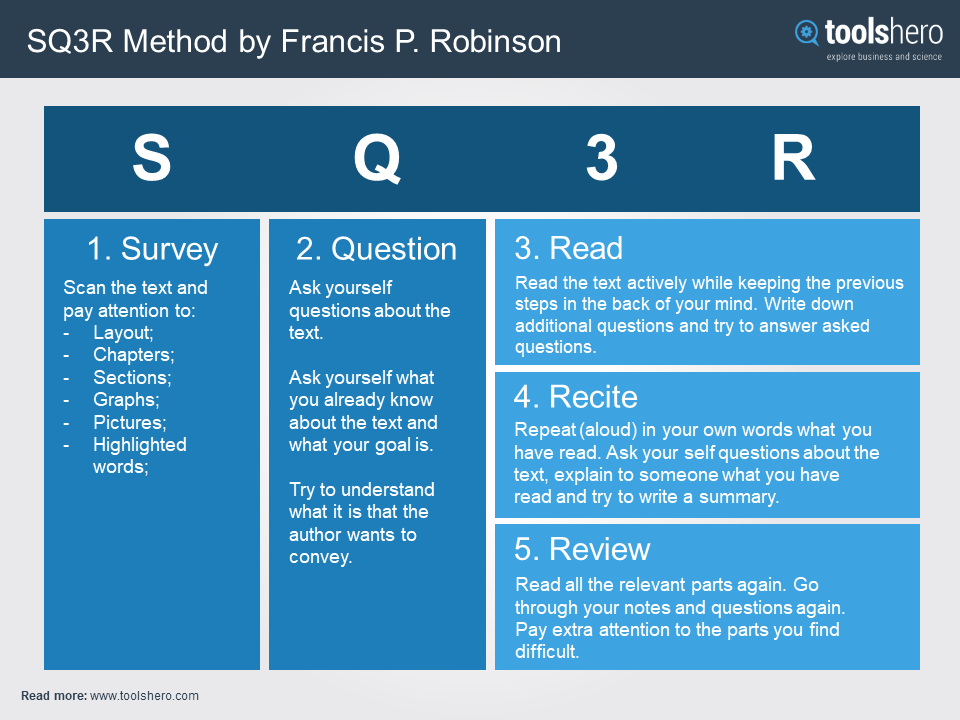
One of the most representative methods is SQ3R (Survey – Question – Read – Recite – Review). Its strength lies in breaking the reading process into interconnected stages. In the “Survey” phase, the reader does not immediately engage with details, but instead examines the overall structure of the text – titles, headings, introductions, and conclusions – in order to construct a preliminary cognitive map. This is followed by the “Question” phase, in which the reader formulates key questions to guide deeper engagement. During the “Read” stage, information is no longer passively absorbed, but actively processed in relation to these guiding questions. The “Recite” phase requires the reader to reconstruct the content in their own words without referring to the text, thereby testing the depth of understanding. Finally, the “Review” stage reinforces and organizes knowledge, ensuring that information is transferred from short-term to long-term memory. Taken together, this process forms a closed loop of reception, processing, and consolidation.
In addition, the Feynman Technique – named after the renowned physicist – emphasizes explanation as a measure of understanding. At its core, this method requires the learner to explain a concept in simple, clear language, as if teaching someone with no prior background knowledge. In doing so, the reader must eliminate vague expressions, clarify key concepts, and establish coherent relationships between ideas. Any point that cannot be explained clearly reveals an incomplete understanding. Thus, the Feynman Technique not only reinforces knowledge, but also serves as a diagnostic tool, helping readers identify and address gaps in their comprehension.
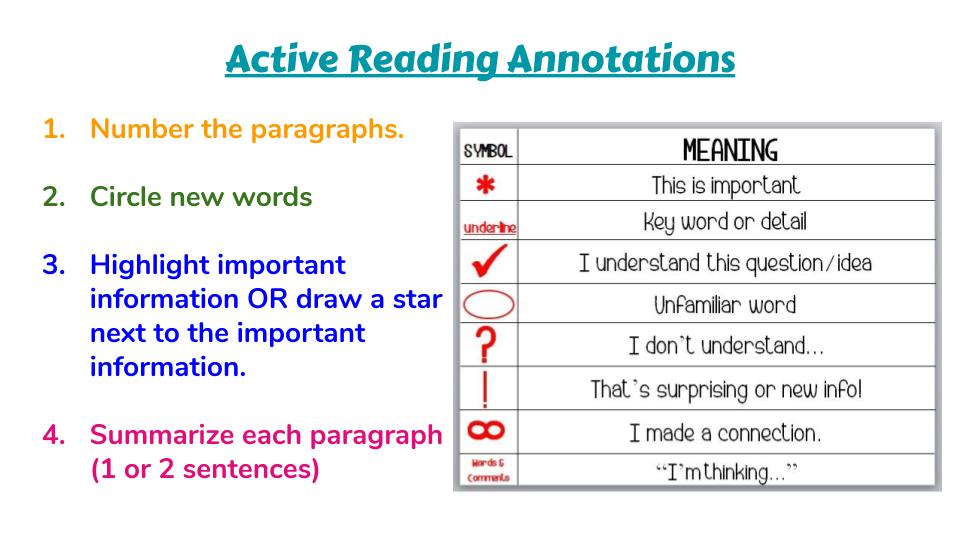
Beyond structured methods, direct interaction with the text also plays a crucial role in active reading. Annotation – including underlining key ideas, highlighting important concepts, writing marginal notes, or using personal symbols – helps maintain focus and creates a visible trace of the reader’s thinking process. These traces not only support later review, but also reflect how the reader engages with the text: what they prioritize, where they raise questions, and how they respond to the author’s arguments. In this way, the text is no longer a static surface, but becomes a dynamic workspace in which thought is recorded and developed.
Another particularly important technique is retrieval practice – the act of recalling information without referring to the source material. Contrary to common intuition, actively retrieving knowledge from memory is one of the most effective ways to strengthen and deepen understanding. When readers attempt to reconstruct information, they not only test retention, but also reinforce neural pathways associated with that knowledge, making it more durable over time. This process also helps reveal areas of weak understanding, thereby guiding more targeted review.
Taken as a whole, the specific methods of active reading are not isolated techniques, but can be flexibly combined depending on the reader’s goals and the nature of the text. From surveying structure, questioning, and explaining, to annotating and retrieval practice, each method contributes to moving the reader beyond passive reception toward a learning process that is active, deep, and capable of transforming knowledge into practical competence.
5. From Knowledge to Skill – The Process of Transformation
Knowledge, by its very nature, does not automatically transform into skill simply through acquisition or memorization. Knowing something and being able to do it represent two fundamentally different levels of cognition and action. For this transformation to genuinely occur, knowledge must be placed within a continuous cycle of repetition, application, and adjustment. Only when it is brought into practice – in learning, work, or real-life situations – does knowledge move beyond a static state and become an operational capability.
In a general sense, this process can be understood through three closely interconnected stages: understanding – practice – feedback. “Understanding” is the necessary starting point, where the learner grasps concepts, principles, or structures of knowledge. However, theoretical understanding remains potential; it is not sufficient to ensure application. It is in the “practice” stage that knowledge is placed into concrete contexts, where it must confront variables, real-world conditions, and limitations that theory alone cannot fully capture. In this phase, the learner not only applies knowledge but also recognizes the gap between “knowing” and “doing.”
Following this, “feedback” functions as an essential mechanism of adjustment. Feedback may come from multiple sources: the outcomes of actions, evaluations from others, or the learner’s own observation and reflection. Through feedback, errors, shortcomings, and inefficiencies in the application of knowledge become clearly visible. This provides the basis for refining strategies, reinforcing what is correct, and revising what remains inadequate. As this cycle repeats over time, knowledge is gradually internalized – becoming part of a skill set that can be deployed flexibly and effectively.
Within this framework, mistakes should be reconsidered as an inherent component of the learning process rather than as signs of failure. Each error in practice reveals areas of weak understanding and creates opportunities for correction and improvement. It is through experimentation, error, and revision that proficiency develops – a state in which knowledge no longer needs to be consciously recalled but instead operates as an integrated part of action.
Therefore, the transformation from knowledge to skill is not an immediate leap, but a cumulative process that requires sustained and active engagement from the learner. Only when knowledge is embedded within the cycle of understanding – practice – feedback, and continually reinforced through real-world experience, can it move beyond theoretical limitation and become a durable, practical capability.
6. Active Reading in the Digital Age
The digital age, marked by an unprecedented explosion of information and rapid dissemination, has introduced significant challenges to maintaining a mode of reading that fosters depth. Contemporary readers operate within an environment constantly fragmented by notifications, social media, and streams of short, easily consumable content. Attention fragmentation becomes the default state, while the habit of “skimming” gradually replaces systematic reading. In this context, the ability to sustain focus on complex texts – a necessary condition for active reading – is considerably diminished. At the same time, time pressure encourages speed over quality, leading to surface-level information intake with little room for reflection or deep processing.
However, these very conditions also highlight the urgency of active reading. When information becomes excessive, value no longer lies in “how much one reads,” but in “how deeply one understands” and “what one can actually use” from what has been read. Active reading, in this sense, is not merely a learning technique but a capacity for filtering and controlling information. It enables readers to establish evaluative criteria, determine which content is worth their time, and avoid being absorbed into streams of low-value information. As a result, reading shifts from a passive reaction to the digital environment into an intentional act guided by cognitive needs and personal goals.
Alongside its challenges, the digital age also offers powerful tools that can support active reading. Note-taking applications, personal knowledge management systems, and platforms for storing and organizing information allow readers to record, categorize, and connect ideas with relative ease. When used strategically, these tools can enhance information processing and help construct a structured, retrievable knowledge system. However, it is crucial to emphasize that tools cannot replace method. Without organizational thinking and personal discipline, the use of such tools may simply increase the volume of stored information without improving the quality of understanding.
Therefore, the decisive factor lies in how readers adjust their habits and approaches. The deliberate act of “slowing down” – taking time to reflect, question, and reinterpret – becomes a conscious practice that runs counter to prevailing trends but is essential for preserving cognitive depth. At the same time, selective reading – prioritizing content with long-term value over fleeting information – helps optimize the limited resource of attention. More importantly, readers must create spaces for reflection, where information is processed, connected, and transformed into personal understanding.
Overall, active reading in the digital age is not merely a form of adaptation but a strategy for safeguarding and developing cognitive capacity under the pressures of speed and distraction. It requires a synthesis of tools, methods, and personal discipline – elements that enable readers not to be carried away by the flow of information, but to retain agency in constructing their own knowledge.
7. The Deeper Significance of Active Reading
At a deeper level, active reading is not merely a technique for learning, but reflects a philosophical approach to knowledge and the world. It embodies a fundamental stance toward information and understanding: rather than passively receiving what is presented, individuals choose to participate in the construction of meaning – questioning, verifying, comparing, and establishing their own cognitive positions. In this sense, active reading is not simply a method, but an expression of a mode of thinking – one that does not accept knowledge as a fixed entity, but views it as an open structure, subject to exploration and redefinition.
When reading is practiced actively, the text ceases to be a mere source of information and becomes a space for dialogue. The reader does not remain external to the text, but enters into it as an engaged subject, continuously interacting with its arguments, concepts, and modes of expression. This process simultaneously generates a reverse movement: while “reading” the text, the reader is also “reading” themselves. They come to recognize what they know and what they only assume they know; they confront their own biases, beliefs, and cognitive frameworks; and more importantly, they become aware of the gaps in their understanding.
This dual dialogue – between the reader and the text, and between the reader and the self – transforms reading into a form of self-awareness. Each act of deep reading becomes an opportunity to recalibrate one’s cognitive structure: incorporating new elements, discarding outdated assumptions, and reorganizing one’s understanding of the world. In this way, knowledge is not merely accumulated, but transformed into a highly personalized system of understanding, reflecting how each individual interprets and makes sense of reality.
Moreover, active reading plays a foundational role in the development of independent thinking and creative capacity. When readers do not accept information at face value, but instead subject it to analysis and evaluation, they gradually cultivate the ability to form their own perspectives. As a result, they move beyond merely “repeating” knowledge to restructuring, connecting, and extending it in new directions. Creativity, in this sense, is not the sudden emergence of novelty, but the outcome of a continuous process of accumulating and transforming knowledge through active thought.
Therefore, active reading not only enables individuals to learn more effectively, but also allows them to exist more consciously within the world of knowledge. It transforms reading from a receptive activity into a cognitively rich act, in which individuals not only engage with information, but actively shape the way they understand and interact with the world around them.
8. Conclusion – Reading to Become
In a world where information is no longer scarce but overwhelmingly abundant, the value of reading no longer lies in the quantity of knowledge acquired, but in the quality of understanding and the ability to transform that knowledge into practical capability. Simply “knowing more” is no longer a sufficient advantage if such knowledge is not organized, verified, and effectively applied. For this reason, active reading is not merely an optional learning method, but an essential condition for individuals to adapt and develop within the modern knowledge environment.
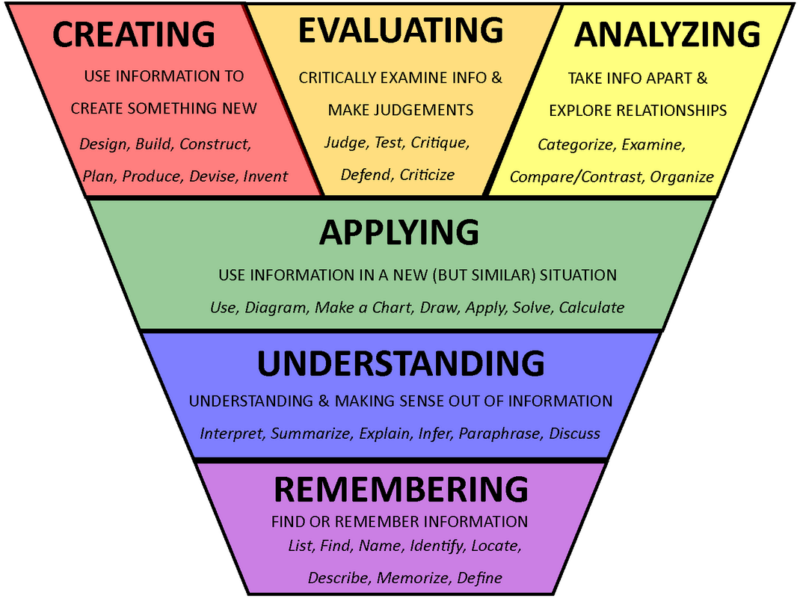
The fundamental difference between those who merely read a great deal and those who genuinely grow through reading does not lie in the number of books they have encountered, but in how they engage with content. Reading to gather information is only the starting point; reading to understand structure and meaning marks an important progression; but only when readers are able to question, critique, connect, and apply does knowledge become truly “activated” as a living capability. At this level, reading is no longer an act of consumption, but a process of construction – one in which the reader actively participates in the formation of meaning.
Moreover, the transformation from knowledge to skill does not remain confined to academic contexts, but extends into all aspects of personal and professional life. A concept only holds value when it can guide action; an idea becomes meaningful only when it is tested through practice. Active reading, by compelling readers to think, reinterpret, and apply, builds a bridge between “knowing” and “doing” – between cognition and action. It is this bridge that ensures knowledge does not remain static, but becomes a dynamic component of individual capability.
At a deeper level, active reading also contributes to shaping how individuals exist within the world. By reading consciously, individuals not only acquire knowledge, but also cultivate the ability to choose, evaluate, and take responsibility for what they believe. This is particularly critical in a complex information environment, where the boundary between truth and falsehood, value and noise, becomes increasingly fragile. In this context, reading is not merely a learning skill, but a life capacity – a way for individuals to position themselves within the flow of knowledge and information.
Therefore, active reading not only enables more effective learning, but also allows individuals to become conscious agents – those who do not simply receive the world as it is, but are capable of understanding, reflecting upon, and reconstructing it in meaningful ways. In this sense, reading is no longer a secondary activity, but a path of self-development: an ongoing process through which individuals continuously refine their cognition, expand their capabilities, and shape themselves through what they read and how they read.